California’s Zero-Emission School Bus and Infrastructure incentive project begins accepting applications for its second solicitation on Tuesday, November 17, at 10 a.m., with at least $55 million in state funding available on a first-come, first-served basis.
The project, known as ZESBI, is funded by the California Air Resources Board and the California Energy Commission and administered by Catalyst Mobility. A pre-application period opened November 3, allowing eligible schools to create accounts in the ZESBI Application Portal and assemble documentation ahead of Tuesday’s opening.
Baseline vehicle incentives are set by bus type: $280,000 for a Type A bus, $340,000 for a Type C and $360,000 for a Type D. Every bus funded in this round also receives a $40,000 School Bus Incentive Increase, and buses equipped with a wheelchair lift qualify for an additional $15,000. Combined, the maximum per-bus award reaches $335,000 for Type A, $395,000 for Type C and $415,000 for Type D.
The $40,000 increase is directly tied to federal cost pressure according to a recent announcement, an offset for higher bus prices resulting from the elimination of the federal Commercial Clean Vehicle Credit under Section 45W and from federal tariffs.
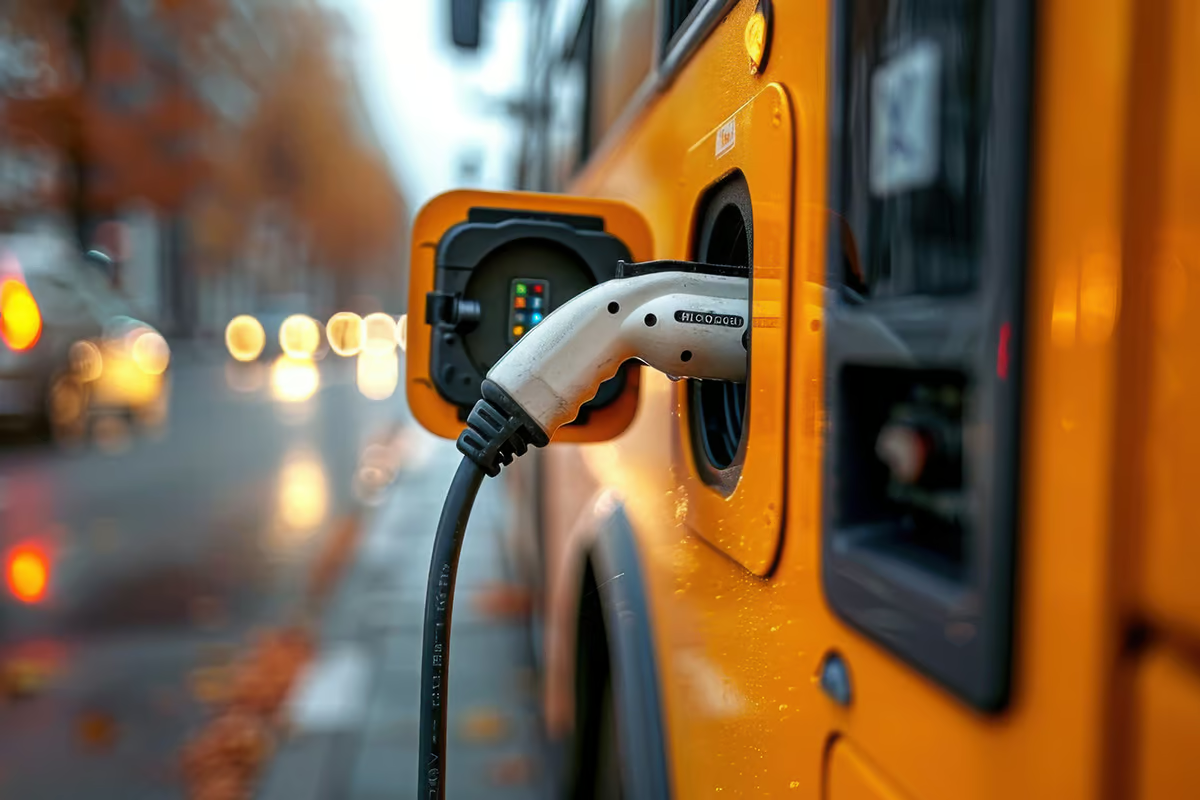
Charging incentives are awarded alongside the vehicles rather than through a separate application. Level 2 chargers qualify for up to $20,000 each. DC fast chargers, including bidirectional units, qualify for up to $75,000 each, with one exception: the first bidirectional DC fast charger in an application can receive up to $95,000.
Applicants must request at least one charger for every ZESBI-funded bus. Vehicle-only applications and infrastructure-only applications are not permitted, and neither are applications that fall short of the one-charger-per-bus floor. Applicants may request more chargers than buses, though those additional units are awarded depending on funding availability.
Eligible applicants must serve K-12 students and own their school buses. The project lists California public school districts, public charter schools, joint powers authorities and county offices of education as eligible entities. Charter schools classified as non-classroom-based as of fiscal year 2021-22 are not eligible, and neither are private schools.
Participation requires retiring an existing bus. The bus being scrapped must have a 2010 or older chassis, carry no lienholder on its DMV registration and have a gross vehicle weight rating above 10,000 pounds, and it must hold a current CHP 292 certification or equivalent at the time Part A of the application is submitted. Diesel buses above 14,000 pounds that are out of compliance with California’s Truck and Bus Regulation carry a $20,000 deduction per bus. In this solicitation, scrappage and the supporting documentation are due within 12 months of the new bus being delivered.
Several obligations follow an award. Grantees sign and submit a purchase order within 10 business days after the grant agreement is fully executed. Funding can be cancelled if an applicant stops responding for more than 10 business days. Payment is due within 60 days after a new bus passes CHP inspection, unless the grantee and the dealer agree to extended terms.
Schools pursuing ZESBI funds can also draw on statewide contracts for zero-emission school buses that California awarded in 2023 through the Department of General Services Procurement Division. The project encourages but does not require using those contracts, and schools can combine them with ZESBI funding.
Eligible schools must create an account in the ZESBI Application Portal before they can submit an application.