
Over the past few decades, diesel and gasoline prices have fluctuated, spiking in times of geopolitical turmoil. Since the war on Iran began in early 2026, costs spiked to historic highs, with diesel prices in the U.S. up 70% from February and unleaded gas up 45%. Most people don’t fill up their cars with diesel at the pump, so the economic shock hits home with rising prices of everyday goods that are transported by medium- and heavy-duty fleets. But for school districts across the U.S. that rely on diesel-burning school buses, the financial strain of high diesel prices is direct and immediate – and strains already scarce school budgets.
This fall, diesel prices surpassed $6 a gallon for the first time in history — and have stayed there for months on end, with the average national cost of diesel rising from $3.75 a gallon in September 2025 to $6.29 in September 2026. As a result, the national average cost to fuel a diesel-burning school bus at those prices rose from $7,924 per year in 2025 to $13,292 in 2026.
“This was already a tight budget year without skyrocketing diesel prices,” said Richmond Public Schools Superintendent Jason Kamras when speaking with the Times-Dispatch. Amherst County, another Viriginia school district, estimated that they spent about $78,000 on diesel in August. That was roughly $37,000 more than the monthly charge for December 2025.
In Jefferson County, Colorado, the district’s transportation director says soaring diesel prices have already cost the district $100,000 more than during the same quarter the year before.
When diesel costs cause the price of goods and services to ramp up, businesses pass along increased prices to consumers. But school budgets don’t work that way. As Peter Manella, public policy liaison for the National Association for Pupil Transportation, explained to Colorado Public Radio, schools “have to look at, do we take the team to the football game, or do we let mom and dad do that? Do we have field trips to museums and to the state capital and other places that we go?”
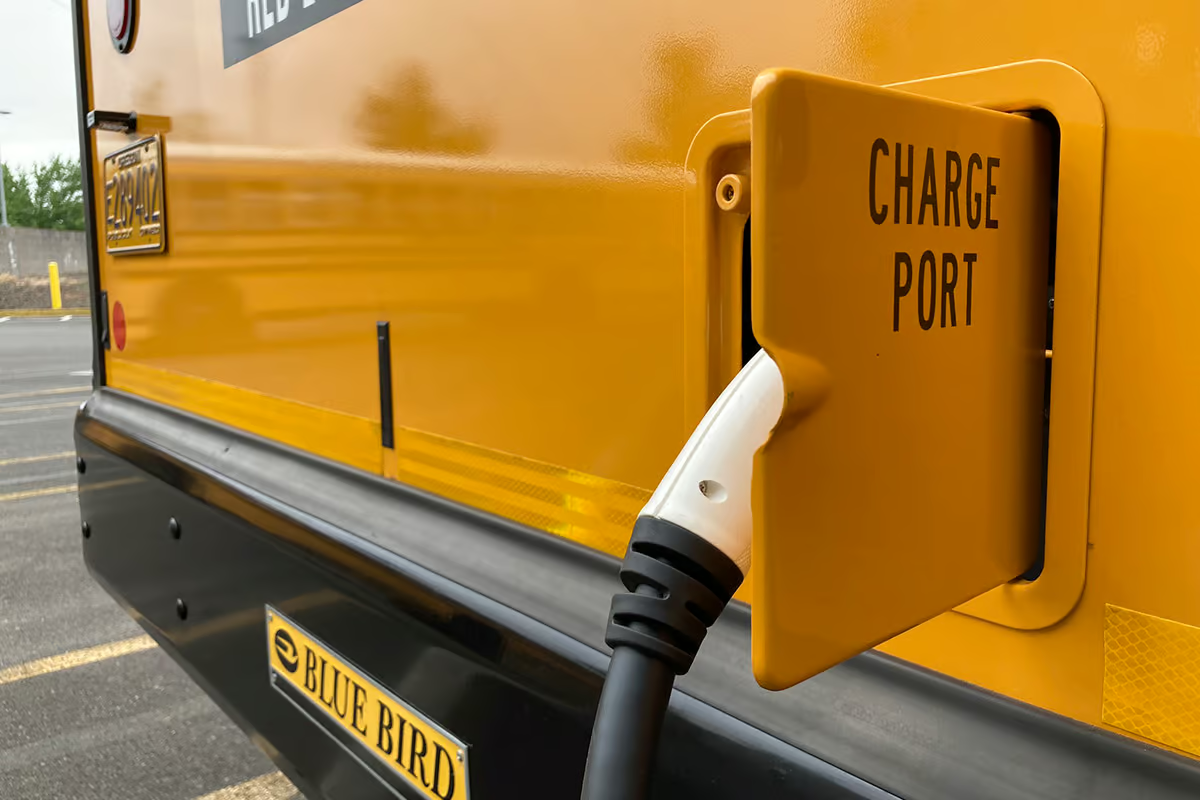
For districts looking for cleaner air, lower emissions and cost savings, electric school buses have proven to be a promising alternative, especially as diesel costs rise. Districts are already seeing cost savings from making the switch, even before the recent spike in diesel prices.
“What I can save in diesel and maintenance, I can almost hire a teacher, or an instructional aide, or give some other benefit to my teachers. The cost savings are going to let me better support my kids,” said Keith Kimbrough, principal at Martinsville ISD in unincorporated Martinsville, Texas, according to the Texas Tribune. In rural Fleming County, Kentucky, the school district expects to save around $600,000 per year, thanks to its electric school buses, and is using those savings to give teachers a raise.
Electricity costs rose on average between September 2025 and September 2026, too, but much less dramatically than diesel prices. The average nationwide cost to fuel an electric school bus rose from $3,481 per year in September 2025 to $3,860 in 2026. The cost to fuel an electric bus rose 10.8%, versus a 67.7% increase for diesel buses. When electricity costs rise, they generally do so at more gradual rates, which allows for time to prepare, unlike volatile shocks to gas and diesel that can upend school budgets in months.
Electric school bus charging can also be managed to take advantage of off-peak rates, and in some cases, allow vehicles to send energy back to the grid. This allows school districts to earn electricity credits to offset utility bills, therefore sending more money back to school budgets.
Shawnee Public Schools in Shawnee, Oklahoma, saved roughly $40,900 in fuel costs during the 2024-2025 school year after adding eight electric school buses to its central Oklahoma fleet. This summer, the district connected with the local utility to send power back to the grid through vehicle-to-grid technology to save the district even more money. That makes for valuable reinvestments in school supplies, teacher salaries and building upgrades.
“We saved so much money just running the electric bus,” said John Wiles, transportation director for Shawnee Public Schools. “Now that we’re going to the [vehicle-to-grid], we’re going to save even more money.”