
The 15-liter Cummins X15N brought compressed natural gas back into consideration for heavy-duty trucking. After its first full year of commercial availability in 2025, the question for fleets is no longer whether the equipment can do the work. The conversation has shifted to economics and evaluating ease of fueling and operating those CNG trucks.
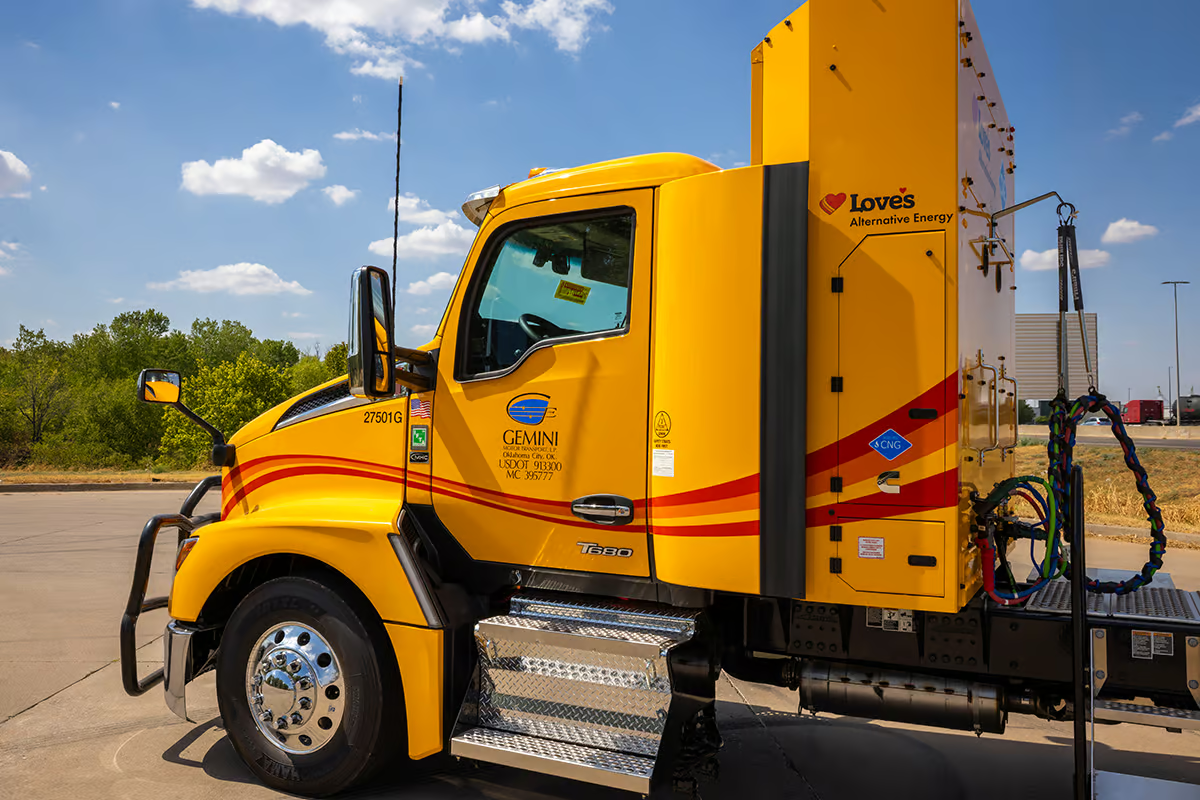
Love’s Alternative Energy is answering that question with its own investment. The company recently added 50 CNG tractors, all powered by the X15N.
But unlike a typical fleet, Love’s Alternative Energy added these trucks to gain insights into their customers’ fueling needs, as the company builds, owns and operates CNG stations and supplies a range of alternative fuels to commercial customers. By using the same CNG fueling systems as its customers who are deploying the X15N, Love’s Alternative Energy is getting a “boots on the ground” view of the customer experience, with the goal of growing alternative fueling across the industry.
The business case
For fleets weighing natural gas, the case comes down to three benchmarks: fuel cost, uptime and total cost of ownership.
The 2026 State of Sustainable Fleets Market Brief, which tracked the X15N through its first full commercial year, reported fuel-cost savings paired with performance, range and payload capacity comparable to diesel. For high-mileage operations, those savings build over the life of the tractor and help offset its higher purchase price.
On uptime, the X15N has its advantages, especially in emissions aftertreatment, because CNG is a clean burning fuel that allows a three-way catalyst in place of the more maintenance-prone diesel particulate filter and selective catalytic reduction system found on modern diesel engines. That means no filter regeneration and no diesel exhaust fluid dosing, which removes a common source of derates and unplanned shop visits.
Running 50 tractors on one engine platform also gives Love’s Alternative Energy a working record of maintenance intervals, component life, and refueling best-practices. That experience helps fine tune the CNG experience at its fuel stations, and at the behind-the-fence fueling depots the company builds for customers who want onsite CNG fueling. Love’s Alternative Energy’s experience operating its own CNG fleet informs the training and maintenance services it provides after installing CNG fueling at a customer’s own depot.
The engine
Cummins rates the X15N at 400 to 500 hp and 1,450 to 1,850 lb-ft of torque, comparable to a 15-liter diesel. The engine is certified by the U.S. EPA and California Air Resources Board. According to Cummins, it runs on conventional or renewable natural gas without modification, and its nitrogen oxide emissions are 90% below the current EPA standard, giving it a very low-emissions profile. Range depends on fuel-system capacity. Supplier Hexagon Agility has cited configurations reaching 800 miles in day cabs and more than 1,200 miles in sleepers, which can be configured on new trucks when they are purchased.
The tradeoffs remain. Cummins has said natural gas trucks still cost more upfront than comparable diesels, but fueling costs are lower and more predictable. Fleets face a learning curve on fueling and maintenance, but the X15N is still a combustion engine that truck technicians understand. Operations with predictable routes and return-to-base vehicles have adopted the technology most readily. That is a fair description of fuel delivery fleets, where trucks run around the clock and a tractor in the shop means fuel isn’t being delivered.
Building the network
Love’s Alternative Energy network now includes nearly 100 CNG fueling locations across North America. The company added to its footprint in April 2025 by acquiring 44 stations in 15 states and Canada, giving customers access to CNG fuel at more locations and across larger geographies and popular trucking routes.
Running its own trucks in those corridors gives firsthand insight as it evaluates new markets, and each new fleet customer adds the volume that supports the next station.
Fuel choice
The renewable pathway is where the natural gas case has gained a lot of traction with fleets. Because the X15N runs on RNG without modification, the carbon intensity of a natural gas fleet depends on the fuel it buys, not only the equipment it specifies. The 2026 market brief found that 65% of surveyed fleets operating natural gas vehicles use RNG, and RNG accounted for 97% of the natural gas used for transportation in California in 2025. And for fleets that request their own natural gas fueling infrastructure, a fleet ordering natural gas tractors today can lower its carbon profile later by changing its fuel contract, with no second equipment purchase.
Whether CNG fits an operation depends on duty cycle, route predictability and fueling access. Love’s Alternative Energy works with fleets of all sizes to answer those questions and match the right fuel for each operation, including natural gas, all from one supplier. Fleets can begin that conversation through the company’s website.