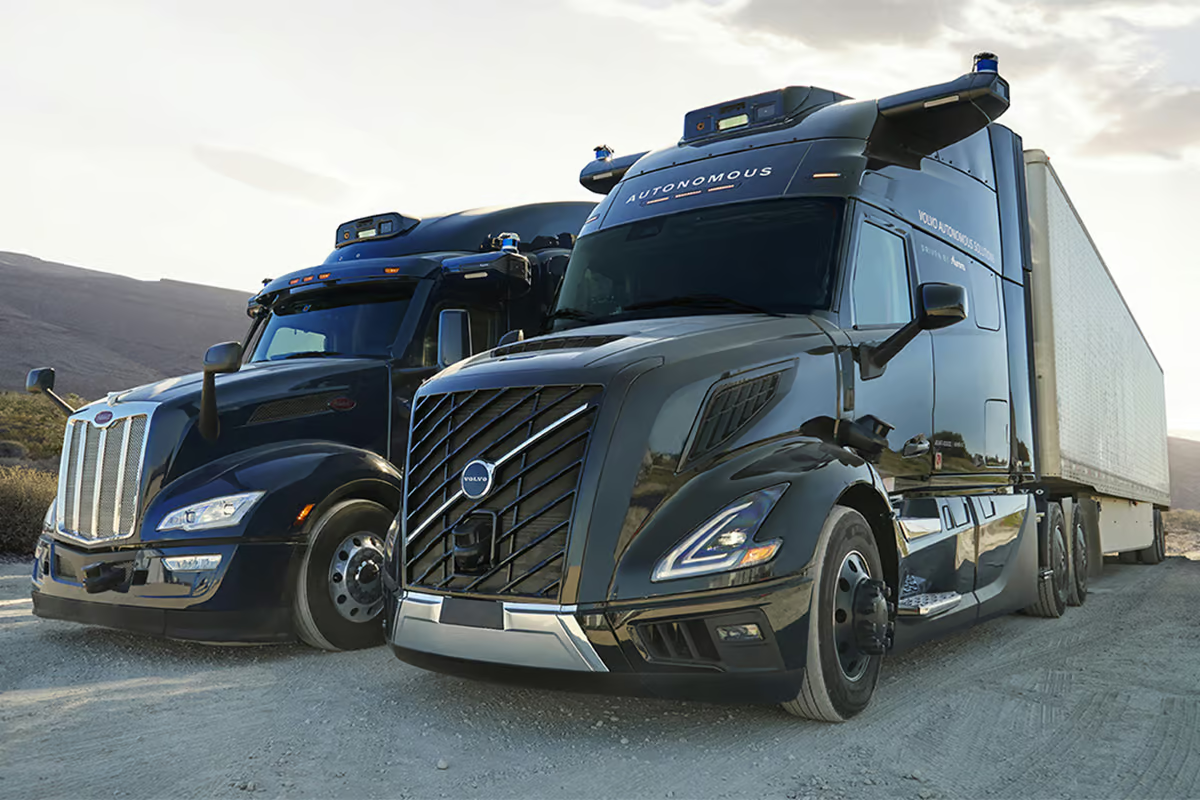

Autonomous trucking companies are backing provisions in the BUILD America 250 Act that would create a federal framework for automated driving system-equipped commercial motor vehicles operating in interstate commerce.
The House Transportation and Infrastructure Committee approved H.R. 8870, the BUILD America 250 Act, on May 22 by a vote of 62 to 2. The committee described the bill as a bipartisan, five-year surface transportation reauthorization package covering roads, bridges, transit, rail, highway safety and motor carrier safety programs. It also said the legislation would provide the first federal autonomous commercial motor vehicle framework.
For autonomous freight developers, that framework could address one of the sector’s biggest barriers to scale: moving trucks across state lines under rules still largely shaped by state-by-state requirements.
Under the bill, the U.S. Department of Transportation would be required within two years of enactment to establish and maintain a performance-based safety standard for ADS-equipped commercial motor vehicles operating in interstate commerce. The bill also would require manufacturers to certify that vehicles meet the federal safety standard before operating under the framework.
Daniel Goff, vice president of external affairs at Kodiak, said a federal autonomous commercial motor vehicle framework would “significantly accelerate” Kodiak’s ability to deploy, scale and commercialize autonomous freight operations across the United States.
Today, Goff said, autonomous trucking companies must navigate “a patchwork of state-by-state regulations, permitting requirements, and operational restrictions,” which increases complexity and slows expansion into new markets. A comprehensive federal framework, he said, would provide regulatory consistency, reduce compliance burdens, streamline fleet expansion and expedite scaled commercialization.
Aurora also framed the legislation as an important signal from Congress.
“The inclusion of a first-ever federal framework for autonomous commercial vehicles in the BUILD America 250 Act signals that Congress recognizes the immense potential of autonomous trucking to fortify the American economy,” said Gerardo Interiano, senior vice president of government relations and public affairs at Aurora. “Thanks to the leadership of Chairman Graves, Ranking Member Larsen, and Representative Fong, this bill strengthens interstate commerce and establishes safety standards for our nation’s highways.”
A National Pathway for Interstate Freight
The freight industry’s interstate nature is central to the push for federal rules. Autonomous trucking developers say long-haul and regional freight networks cannot scale efficiently if deployment requirements vary significantly from one state to the next.
Anne Marie Lewis, government affairs and regulatory compliance at Torc Robotics, said a federal autonomous commercial motor vehicle framework would provide the regulatory certainty needed to scale autonomous freight operations across the national freight network.
“Because trucking is inherently interstate commerce, a consistent federal approach is essential to enabling deployment at commercial scale,” Lewis said. “Clear, nationally applicable rules allow carriers, technology developers, and customers to make long-term investments with confidence and support a more predictable path to commercialization.”
Earl Adams Jr., vice president of policy and regulatory affairs at PlusAI, also said a federal framework would be an important step because “freight doesn’t move within neat state lines.”
“A patchwork of different state rules for driverless operations makes it much harder to scale a national freight network,” Adams said. “That’s why the industry needs a clear federal safety pathway, and that doesn’t mean less oversight. It means consistent oversight.”
For PlusAI, that consistency could help move autonomous trucking from state-by-state testing toward repeatable commercial deployment. Adams said a federal structure would give developers, OEMs, fleets, insurers, law enforcement and regulators a common set of expectations.
The bill also addresses federal and state authority by adding ADS-equipped commercial motor vehicle safety to the existing federal review and preemption process for state laws and regulations related to commercial motor vehicle safety.
Adams said states should continue to play a major role in traffic laws, enforcement, registration and roadside safety. But because autonomous trucks are designed for interstate operations, he said the federal government has the primary responsibility to set the standards those vehicles must meet.
“A scalable national freight system is only achievable if there is one standard that all autonomous trucks must meet,” Adams said.
Lewis said Torc is also focused on clarity around federal and state roles.
“Autonomous trucks must be able to operate safely and consistently across jurisdictions, and fleets need confidence that the regulatory framework governing those operations will be clear, scalable, and predictable,” she said.
Safety Certification Comes First
While companies support the federal framework, they also emphasized that the details of safety certification and performance standards will be critical.
The bill would require a safety case showing that the design, construction and performance of an ADS or ADS-equipped commercial motor vehicle provide an equivalent or greater level of safety than a non-ADS-equipped commercial motor vehicle subject to federal requirements. The safety case would need to include information on hardware and software, operational design domain, engineering methodology, hazard analysis, verification and validation processes, simulations, test environments, crash response, hazard alerting and cybersecurity.
Adams said the federal government needs to define what an autonomous commercial motor vehicle must demonstrate to be considered safe. That includes the ability to follow traffic laws, detect and respond to hazards, manage system failures and operate within a clearly defined operational design domain.
Lewis said Torc is encouraged by the bill’s focus on performance standards and commercial vehicle operations.
“The BUILD America 250 Act takes an important step in that direction by addressing key regulatory issues facing autonomous trucks, including the use of safety-enhancing warning beacons and the establishment of federal performance standards,” Lewis said. “These types of issues are best addressed through a national framework that promotes safety while enabling innovation.”
For Waabi, the bill’s federal framework comes as autonomous trucking is moving closer to broader commercial deployment.
“The inclusion of a federal autonomous trucking framework in the BUILD America 250 Act is a definitive signal that the moment to scale this transformative technology is here,” said Lior Ron, COO of Waabi. “With the industry moving from pilots to broad commercial deployments, it couldn’t have come at a better time.”
Ron said a federal framework would provide the certainty needed to support safe autonomous trucking deployment across the U.S. He also said the bill moves the country toward performance-based safety standards and addresses older federal rules that hamper innovation.
Inspections, Enforcement and Roadside Interactions
The BUILD America 250 Act would not simply set a safety standard. It also would begin a broader rulemaking process to determine how autonomous commercial vehicles are inspected, enforced and managed in real-world operations.
The bill would require the Secretary of Transportation to establish a transportation rulemaking committee within 90 days of enactment. The committee would make recommendations on implementing the ADS commercial vehicle framework and on how federal motor carrier regulations apply to ADS-equipped commercial motor vehicles, remote drivers, remote assistants and driverless dispatch operators. It would include representatives from autonomous commercial motor vehicle technology providers, OEMs, law enforcement, traffic safety professionals, roadway safety advocates, trucking, shippers, labor organizations, first responders, state highway safety offices, insurers and independent research and testing organizations.
Those details matter because much of today’s roadside enforcement model assumes a human driver is in the cab.
Adams said regulators and first responders need to know how to identify an autonomous vehicle, inspect it, confirm permits or certifications, contact the operator and understand what the truck will do if the autonomous system experiences a failure.
Lewis said inspection and enforcement procedures should be among the highest priorities for Congress and federal regulators to clarify.
“Modernized inspection and enforcement processes, including clear guidance for roadside interactions and vehicle inspections, will be critical to safe deployment,” Lewis said. “In addition, clarity around remote operations, cybersecurity, incident response, and data reporting will further support industry growth while maintaining public trust and safety.”
Cybersecurity and data reporting also should be part of the framework, Adams said, but reporting should be standardized and useful rather than creating large volumes of data that do not improve safety understanding.
Warning Beacons Address a Practical Deployment Issue
Another practical provision drawing industry attention is the bill’s treatment of warning devices.
Current rules generally assume that a driver can exit the vehicle and place reflective warning devices when a commercial motor vehicle is stopped on the roadway. The BUILD America 250 Act would allow cab-mounted warning beacons to be treated as permissible warning devices for commercial motor vehicles stopped on the traveled portion or shoulder of a highway, allowing them to be used in place of certain existing warning devices. The bill does not require commercial motor vehicles to be equipped with or use cab-mounted warning beacons.
Goff said the legislation would solve the “warning triangle” issue by allowing fleets to use cab-mounted warning beacons as a replacement for traditional reflective warning devices. He said the provision also lays the groundwork for broader modernization of motor carrier safety regulations.
Rich Steiner, vice president of government relations and public affairs at Gatik, also pointed to cab-mounted warning beacons as a minimum element of a federal autonomous vehicle policy framework, alongside a national safety standard for AVs.
“The U.S. is the global leader in autonomous trucking,” Steiner said. “Every day, Gatik is enhancing road safety, making the supply chain more reliable and ensuring that consumers across the nation have access to goods where and when they need them.”
Lewis said the beacon provision is an example of the kind of practical regulatory issue that is best addressed through a national framework.
“A clear federal approach will help ensure the United States remains a leader in autonomous vehicle technology and deployment,” she said.
How the Bill Could Shape Fleet Deployment
For fleets, the BUILD America 250 Act could make the autonomous trucking timeline easier to evaluate, but it would not eliminate the operational and commercial fundamentals that determine adoption.
Adams said the legislation signals that Congress is beginning to give autonomous trucking a durable regulatory home. That matters, he said, because fleets need to understand the rules of the road before making long-term decisions about equipment, lanes, maintenance, insurance and customer commitments.
“The business case will still come down to the fundamentals: safety, reliability, uptime, lane density, customer demand, maintenance, insurance, and total cost of ownership,” Adams said. “A federal framework does not replace those fundamentals, but it helps create the conditions for responsible, scalable deployment.”
Lewis said fleets should view the legislation as an important milestone toward a clearer federal pathway for autonomous trucking.
“While successful deployment will continue to depend on demonstrating safety and delivering value to customers, the legislation helps address regulatory uncertainty that can otherwise slow adoption and investment decisions,” Lewis said.
For fleets evaluating autonomous technology, Lewis said, regulatory certainty matters because a more consistent federal approach can create a clearer roadmap for deployment, improve confidence in long-term planning and support broader commercialization across interstate freight corridors.
Goff said the bill could provide much-needed regulatory certainty while helping ensure autonomous trucks can operate from state to state. That, he said, could increase the adoption rate of autonomous technology.
Steiner said Gatik is already scaling commercial operations across multiple states, including Arizona, Arkansas and Texas, with major retail, e-commerce and grocery customers. Still, he called the inclusion of an autonomous trucking framework in the bipartisan BUILD America 250 Act “a historic moment” for the sector.
The bill also includes a workforce development provision that would direct the Secretary of Transportation to establish grants supporting the commercial motor vehicle workforce, including training to safely operate and maintain ADS-equipped commercial motor vehicles. Eligible projects would include training for current CDL holders, apprenticeships, internships, scholarships and partnerships with workforce organizations.
Steiner said autonomous trucks are positioned to make roads safer, strengthen supply chain resiliency and create new workforce opportunities in roles such as fleet dispatchers, technicians, transportation coordinators and remote supervisors.
From Pilots to Scale
The BUILD America 250 Act would not instantly resolve every question facing autonomous trucking. Companies still need to prove safety, reliability, uptime, lane fit, maintenance models and total cost of ownership at commercial scale.
But for an industry designed around interstate freight movement, a federal framework could provide the common rulebook companies and fleets have been seeking.
Kodiak, Aurora, PlusAI, Waabi, Gatik and Torc each pointed to the same core issue: autonomous trucking is moving from pilots toward broader deployment, and the policy environment will shape how quickly and safely that transition occurs.
A national framework could give fleets a clearer way to evaluate the technology, give regulators a consistent safety structure and give autonomous trucking companies a pathway to expand beyond isolated lanes and state-specific programs.
As the bill moves through Congress, the industry will be watching how lawmakers and federal regulators define the balance between safety, innovation and operational readiness.