Rivian founder and CEO RJ Scaringe said the commercial case for electric vehicles is no longer theoretical, pointing to cost savings, connected fleet tools and large-scale deployments as evidence that EVs are becoming a practical business decision for fleets.
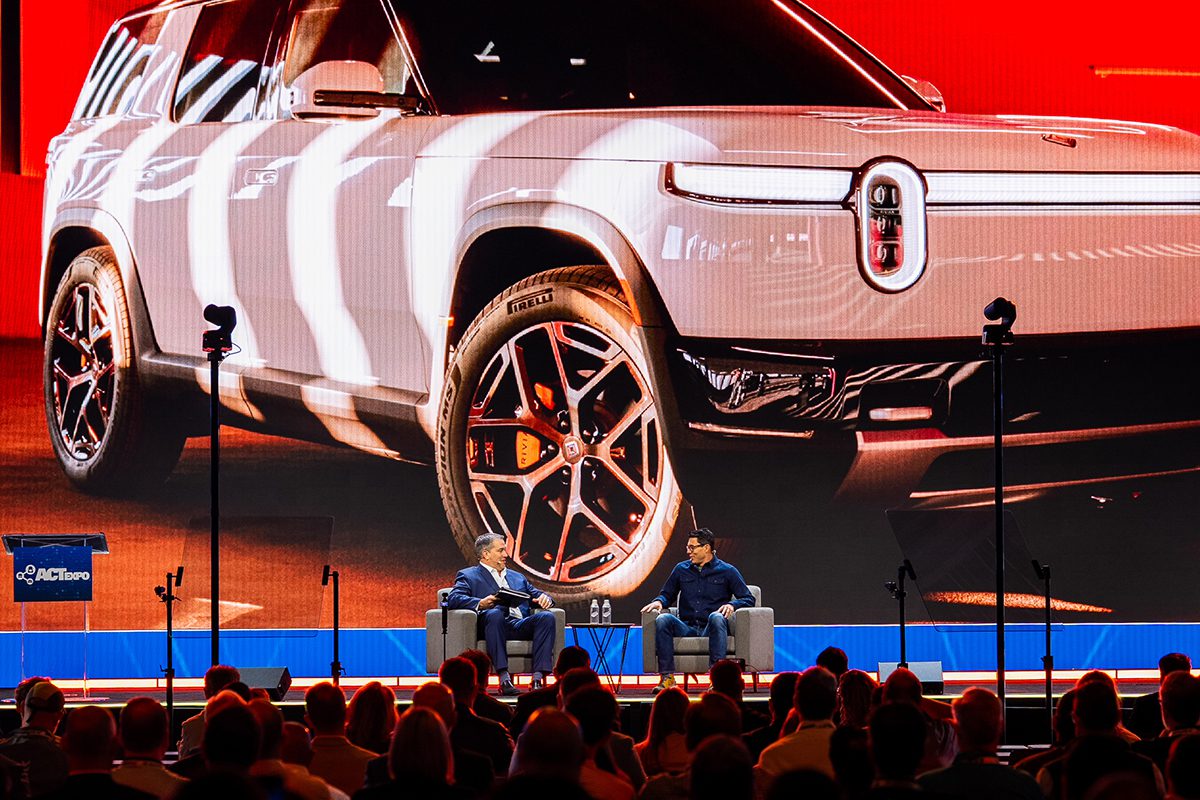
During a fireside chat at ACT Expo with Erik Neandross, president of TRC’s Clean Transportation Solutions team and founder of ACT Expo, Scaringe discussed Rivian’s early challenges, its commercial van program, the role of software in vehicle design, and how AI and autonomy could reshape both consumer and fleet transportation.
Neandross opened the conversation by framing Rivian as a company operating at the intersection of electrification, software and advanced vehicle manufacturing. He noted that Rivian has already delivered tens of thousands of EVs to commercial fleet customers and said the company is preparing to ramp both consumer and commercial products.
“The level of excitement is high around EVs,” said Neandross. He added that Rivian is “ready to really start to ramp that up and take it to the next level and get to some higher volume production in both of those markets.”
Scaringe said building a vehicle company from scratch requires a long sequence of progress across capital, engineering, manufacturing, suppliers, brand and product development.
“When you start a car company, it’s a complex endeavor,” said Scaringe. “You need a lot of highly interdependent things all at the same time.”
He said the company began with none of the pieces needed to launch a vehicle business, then gradually moved through iterations of product development, capital raising and technology building. Rivian launched its first products in 2021, including its flagship R1T, the R1S and a commercial van.
Looking back, Scaringe said one of the biggest lessons was the value of moving deliberately, even when the pressure to show progress is intense.
“Sometimes it’s more valuable to take a second to really plan out your course of action and be highly intentional on making progress, which sometimes means going a little slower,” said Scaringe.
He said that lesson applies especially to engineering decisions, including network architecture, platform architecture and technology strategy.
A major theme of the discussion was Rivian’s decision to build a large amount of vehicle technology in house. Scaringe said Rivian develops its computers, software platform, high-voltage architecture, battery packs, motors and power electronics internally. This strategy has created a large engineering organization and a high research and development budget, which Scaringe said only makes sense if Rivian grows well beyond low-volume production.
“The objective is to build millions of vehicles a year,” said Scaringe. He described Rivian’s R2 platform as the company’s first mass-market vehicle program, with pricing starting at $45,000.
Scaringe also pointed to Rivian’s partnership with Volkswagen as a way to extend the impact of Rivian’s technology beyond its own vehicles. Rivian is deploying electronics and software across Volkswagen’s EV fleet beginning in 2027 through a $5.8 billion software licensing deal.
“That’s enormously exciting to see the impact of what we’re building be driven not just into Rivian vehicles, but be driven into large businesses like Volkswagen,” said Scaringe.
For commercial fleets, Scaringe said Rivian began thinking about the opportunity before launching its consumer brand. The company saw advantages not just in electrification, but in connected vehicles with integrated software tools for reliability, diagnostics and fleet management.
“The big insight, the big recognition we saw, was just the cost advantages of being electric,” said Scaringe. “And more than just electric, being connected, having a whole host of integrated software features.”
That led to Rivian’s 2019 agreement with Amazon to deploy 100,000 electric vans. The program began at a whiteboard with Amazon and was designed from first principles around last-mile delivery.
“Our objective here is to build something that is the most cost effective and most productive tool for performing last mile delivery tasks,” said Scaringe.
The van also had to be approachable, easy to use and suitable for neighborhood operations. Since launching in 2021, the program has grown significantly.
“Today, there’s well over 30,000 of these deployed,” Scaringe said. He added that Rivian has said deliveries are “going to be stepping up quite significantly from where they’ve been.”
Scaringe described the Amazon fleet as a signal to other commercial operators that electric vehicles can work at scale.
“It’s a billboard, if you will, for the commercial space and for the fleet space,” he said.
Neandross pushed on total cost of ownership, noting that Rivian’s pitch to fleets appears to go beyond fuel savings. Scaringe agreed, saying fuel costs are only one part of the value equation.
“When I was talking about cost, I think everyone’s immediately jumping to fuel savings and thinking that is the primary driver of cost savings,” said Scaringe. “And of course, that is part of it.”
But the larger opportunity comes from rethinking the full vehicle and operating system, according to Scaringe. Rivian’s commercial vans include FleetOS, a subscription-based fleet operating system that supports fleet services for Amazon.
Rivian is now focusing on understanding customer cost structures and integrating vehicle software with the software systems fleets already use. as well as having a strong software orientation.
“We have more software engineers than any other type of engineer at the company,” said Scaringe.
Asked whether Rivian is a technology company that builds vehicles or a vehicle company with strong technology, Scaringe said future automakers will need to be both.
“Going forward to continue to exist at scale as a vehicle company, you’ll need to be a technology company, and you’ll need to build great vehicles,” said Scaringe.
The conversation then moved to software-defined and AI-defined vehicles. According to Scaringe, traditional vehicle architectures evolved around many separate electronic control units, often built and programmed by different suppliers. That structure makes over-the-air updates and cross-domain features more difficult.
Rivian, by contrast, has developed a zonal architecture that consolidates vehicle computing into fewer systems, making it easier to update vehicles, launch new features and improve performance over time.
“We issue, in the case of Rivian, about every month we have new features we add onto the vehicle,” Scaringe said.
He said that software foundation is also necessary for AI-defined vehicles, which use data from across the vehicle to make decisions and improve performance.
“When we talk about AI integration, I think it’s a very narrow view when you think of it just as putting ChatGPT into the screen,” said Scaringe.
Instead, he described AI-defined vehicles as platforms that use information from many vehicle endpoints to inform decisions related to service, maintenance, features and performance.
“It’s the integration of foundation models into the vehicle to do decisioning that improves the performance,” said Scaringe.
That concept is especially important for commercial vehicles, where fleet data can create significant operational value.
Autonomy was another major focus of the fireside chat. Neandross referenced Rivian’s recently announced 50,000-unit autonomous partnership with Uber and asked how the company is thinking about autonomy across its platforms.
Autonomy has gone through a major technology inflection point, according to Scaringe, as earlier autonomous systems were largely rules-based, with sensors identifying and classifying objects before handing that information to a human-coded planner. Newer systems use large neural networks and data from deployed vehicles to create more capable driving systems.
“In the case of autonomy, I strongly believe we’ve just gone through one of those [inflection points],” Scaringe said. “Between, let’s say 2026 and 2031, the progress we will see in autonomy is going to look nothing like the progress we saw from 2021 to 2026.”
Rivian has invested heavily in autonomy, including in-house inference platforms and semiconductor development. Scaringe noted that the same platform can be used in delivery bots, commercial vans and robotaxis. Rivian plans to launch a robotaxi version of the R2 in 2028.
For commercial fleets, Rivian is as bullish on autonomy as it is for consumer vehicles, though last-mile delivery will require additional innovation because goods still need to move from the vehicle to the customer’s door.
Scaringe also discussed a robotics company he recently started, describing it as an industrial robotics business born from work and research inside Rivian.
“Being able to supplement our human workforce with a robotic workforce is going to really fundamentally change not only how we look at our cost structure, but importantly, it will allow us to bring certain types of manufacturing back to the United States,” said Scaringe.
Looking toward 2030 and 2035, Scaringe said he expects a significant portion of vehicles to be electric, connected, intelligent and capable of driving themselves. He said large-scale vehicle manufacturers that lack those capabilities could struggle to maintain market share.
“By 2035, if you’re a large-scale vehicle manufacturer, whether it’s on the consumer side or the commercial side, and you don’t have a connected, highly intelligent platform … and the vehicle doesn’t have self-driving capabilities, it’s hard to imagine maintaining market share,” said Scaringe.
He compared the shift to the transition in mobile phones.
“Imagine trying to sell a phone today that’s not connected,” Scaringe said. “I’m saying the same thing about vehicles.”
In the longer term, Scaringe said AI, robotics, autonomy and new vehicle form factors could reshape how people and goods move. He pointed to micro-mobility, drone delivery, robotaxis, electric vertical takeoff and landing aircraft, and autonomous vehicles of different sizes as part of a future transportation ecosystem.
“We’re going to see changes that are maybe the most significant from a societal impact in the history of the developed world,” Scaringe said.
Neandross closed the conversation by returning to the near-term business case for fleets. While the future vision includes autonomy, AI and robotics, he said one of the most important points from the discussion is that commercial EVs can already make financial sense.
“There are significant cost savings today, and it pencils out,” Neandross said. “For the customer that is out there making deliveries that can use applications like you’re selling, it works just on the financial aspect of it right now.”
For Rivian, that near-term commercial message is tied to a longer-term view of the industry: electric vehicles that are not only battery powered, but connected, intelligent, updatable and eventually autonomous.