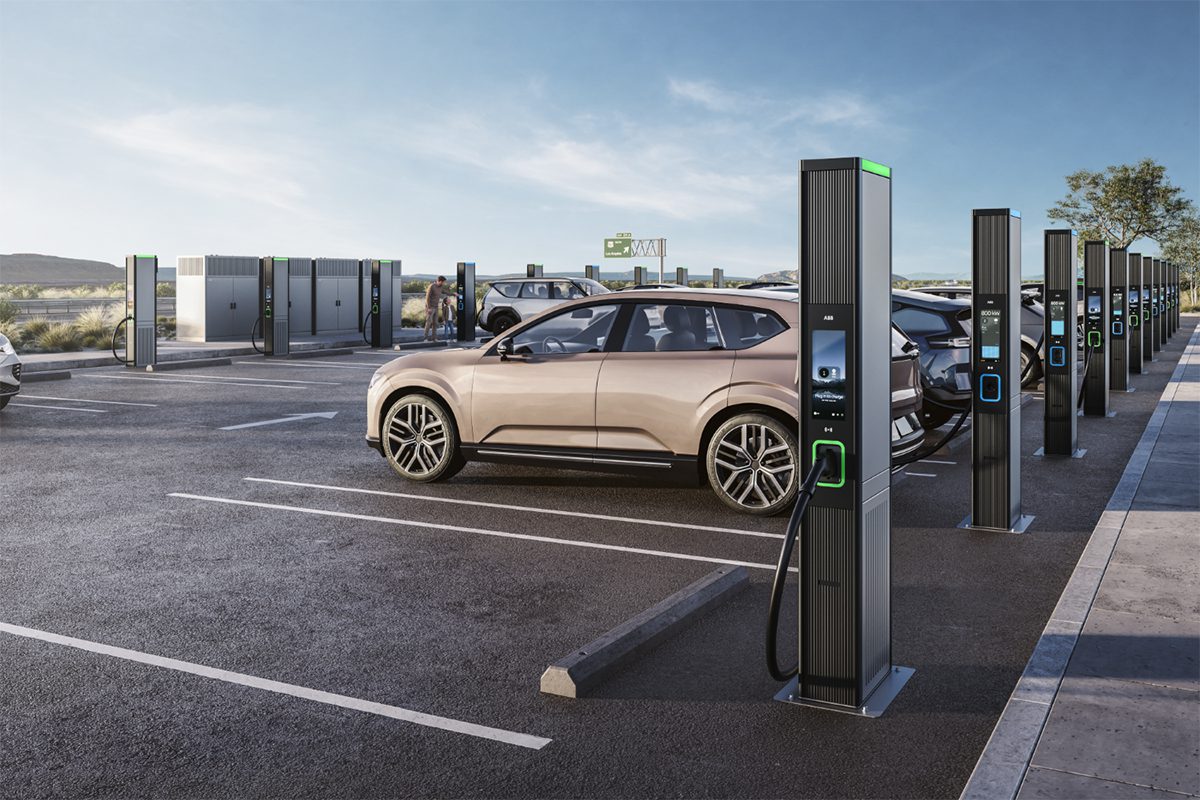
ABB E-mobility used ACT Expo 2026 to launch the OM X-Series, a distributed charging system designed for the highest-duty-cycle fleet applications, including transit depots, logistics hubs and public charging corridors.
The new platform is built around a coordinated site architecture rather than isolated charger clusters, allowing operators to scale from 800 kW to 10 MW and beyond across more than 100 charge points. ABB E-mobility positioned the system as a solution for sites where growing charging demand can create energy losses, operational friction and infrastructure complexity if capacity is added without a broader site-level strategy.
The X-Series builds on ABB E-mobility’s recent charging architecture roadmap. The company introduced the A-Series in 2024 as a high-power charging platform, followed by the OM M-Series in April 2026 for site-level split systems. The X-Series extends that approach into megawatt-scale applications with sustained duty cycles, multiple mission profiles and shared power management across a single site.
At the center of the system is an end-to-end liquid-cooled power path that includes a power cabinet with an integrated cooling unit, proprietary liquid-cooled power modules and liquid-cooled cables. ABB E-mobility said the system carries thermal management through every conversion stage, allowing the modules to achieve more than 98% conversion efficiency as a continuous operating condition rather than a rated peak.
“Charging is moving toward mission profiles where systems must operate under sustained load for years, not just peak moments,” said Michael Halbherr, CEO of ABB E-mobility. “At that level of utilization, thermal stability and energy efficiency are not specifications; they are the economics. The X-Series is built for that standard from the architecture up.”
The system uses three integrated elements to support high-utilization charging sites: a site-level DC bus, liquid-cooled silicon carbide modules and direct battery energy storage integration. The DC bus acts as a shared power spine, allowing cabinets and storage assets to coordinate and move capacity in real time to where demand exists.
Battery energy storage connects directly to the DC bus, which ABB E-mobility said improves round-trip efficiency by more than 5 percentage points compared with traditional AC-coupled systems. That setup is designed to support peak shaving and demand management without adding extra conversion stages. The architecture is also designed to support vehicle-to-grid energy flows where regulations allow.
ABB E-mobility also emphasized future scalability. Because the X-Series separates AC/DC and DC/DC conversion and is specified for future power levels, a site commissioned with an X1600 can scale toward multi-megawatt operation using the same infrastructure, avoiding civil rework and stranded assets. The initial configuration includes two 800 kW cabinets connected through a DC bus for direct battery storage integration and supports up to 24 charge outputs.
The OM M-Series and X-Series share a common dispenser portfolio, giving fleets and charging site operators a path to begin with an M-Series deployment and move into an X-Series topology as charging demand and mission requirements increase.