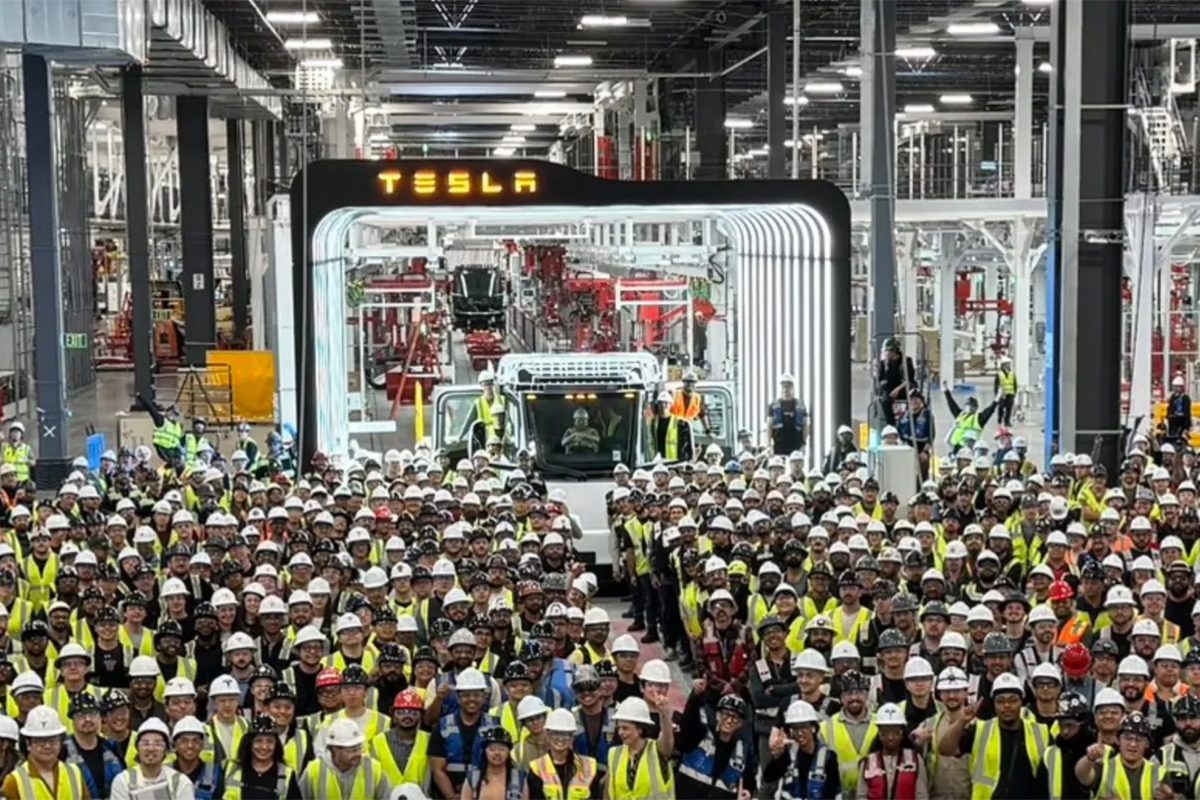
Tesla has reached a major milestone for its long-awaited battery-electric Class 8 truck, producing the first Tesla Semi from its high-volume production line at Gigafactory Nevada this week.
The first truck rolled off the line on April 29, marking a shift for the Semi program from limited pilot builds toward broader manufacturing. Tesla confirmed the milestone through its official Tesla Semi account on X, which occurred at its 1.7-million-square-foot facility adjacent to Gigafactory Nevada.
The milestone comes nearly nine years after Tesla first unveiled the Semi in 2017. The company initially targeted production in 2019, but the program faced repeated delays before early units were delivered to customers including PepsiCo in late 2022. Those earlier trucks were produced in limited numbers on a pilot line.
The production version of the Tesla Semi is expected to be offered in two configurations: a Standard Range model with an advertised 325 miles of range and a Long Range model with an advertised 500 miles of range. Tesla has said those range figures apply at a gross combination weight of 82,000 pounds.
For fleets, the move into high-volume production is significant because it could bring another major battery-electric option into the heavy-duty truck market at a time when operators are weighing emissions goals, infrastructure needs, cost pressures and vehicle availability. Tesla’s Nevada facility is designed for an eventual annual production capacity of up to 50,000 trucks, though production is expected to scale gradually.
Charging infrastructure remains one of the key factors that will determine how quickly the Semi can move from early deployments to broader fleet use. Tesla has begun building out Megacharger infrastructure for the truck, with early activity focused on major freight markets and corridors.
While the first truck off the high-volume line represents an important step, the next phase will center on execution. Fleets will be watching how quickly Tesla can ramp production, support vehicle service and expand charging access for real-world freight operations. For the commercial transportation sector, the Semi’s move into production adds momentum to the ongoing shift toward zero-emission heavy-duty vehicles.