Autonomous trucking is entering a new phase, according to executives from several of the sector’s most prominent technology developers.
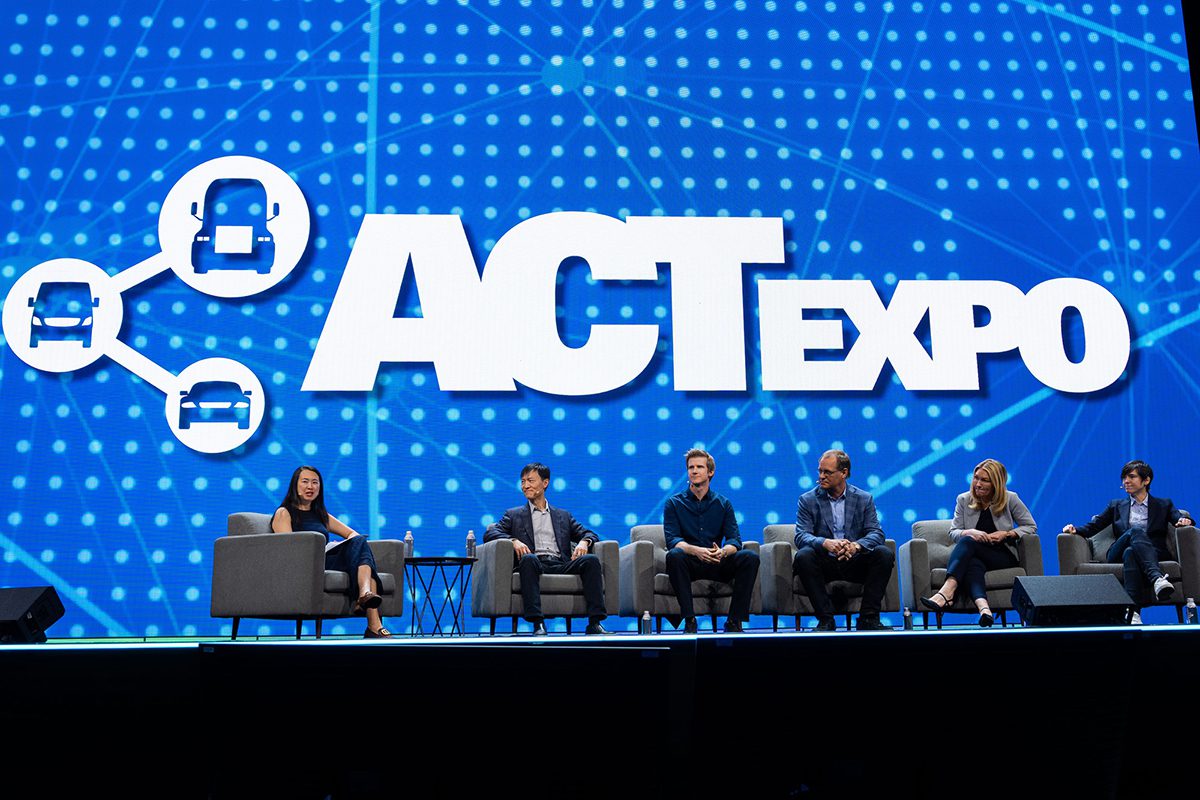
During the ACT Expo 2026 panel “The Virtual Driver Revolutionizing Trucking and Logistics,” moderator Olivia Hu, head of autonomous trucking at Uber Freight, led a discussion with David Liu, founder and CEO of PlusAI; Don Burnette, founder and CEO of Kodiak; Dr. Peter Vaughan Schmidt, CEO of TORC; Ossa Fischer, president of Aurora; and Raquel Urtasun, founder and CEO of Waabi on how autonomous freight is moving from pilots and technology validation toward commercial deployment.
Hu opened the session by putting autonomous trucking in the broader context of Uber Freight’s transportation network. Uber Freight, she said, manages approximately $17 billion of freight across its digital brokerage and managed transportation businesses. As part of that work, the company offers shippers access to multiple transportation modes, including trucking, rail, ocean, air and autonomous trucking.
“I’ve had the privilege of working with many of the leaders here with me today,” Hu said, adding that the discussion would focus on “latest updates, commercial development and, most importantly, what matters” to the audience.
Across the panel, the message was consistent: autonomous trucking companies are no longer trying only to prove that the technology can work. They are now working to prove that it can scale safely, reliably and economically inside real freight operations.
Liu said PlusAI entered the autonomous trucking market more than a decade ago with the belief that automation could improve one of the world’s largest industries.
“I’m a believer that we can use technology to make our lives better,” Liu said. “Automating transportation is one of the largest industries and most impactful things we can do in our generation.”
Today, Liu said, the debate has moved beyond whether autonomous driving can perform.
“It’s not a question that autonomous driving technology can drive a vehicle better than a human driver,” he said. “It’s a matter of, how do we widely deploy this at scale?”
For PlusAI, the answer centers on its virtual driver product, SuperDrive, and a strategy built around three forms of readiness: technology readiness, scale readiness and integration readiness. Liu said the company is operating across multiple geographies and working with global OEM partners to support factory-installed autonomous driving systems.
“Our product is a virtual driver called SuperDrive that can drive an 18-wheeler,” Liu said. “We need to be technology ready. We need to be scale ready, and we need to be integration ready.”
He said commercial pilots have helped prove the technology, but scaling will require a different distribution model.
“It’s one thing to make the technology work in pilot senses,” Liu said. “It’s another to be able to deploy the technology in a broader scale in a large industry like the trucking industry.”
Burnette said Kodiak is already learning those lessons through driverless customer deployments. Kodiak has deployed trucks with Atlas Energy Solutions in the Permian Basin, where the vehicles support sand hauling for oil and gas operations.
“We already have a driverless deployment,” Burnette said. “We’ve delivered over 20 trucks as of the end of last year, which are out operating 24/7, with nobody in the cab.”
Unlike a development fleet controlled by an autonomy company, Burnette said Kodiak’s vehicles are already owned and operated by customers. That changes the commercialization challenge.
“When you shift from a concept fleet or development fleet that you control … and you hand it over to a customer who’s effectively never touched a driverless system in their lives and say, go work with us, that’s a completely different paradigm,” Burnette said.
Kodiak’s experience in West Texas has shown that commercialization is not just about autonomous driving performance. It is also about making driverless trucks usable for the people who load them, dispatch them, maintain them and interact with them at customer sites.
Burnette said that in real operations, customers need simple answers to practical questions: how to inspect a truck with nobody in the cab, how to coordinate with an operations center, how to start the vehicle, how to dispatch it and how to bring it down for maintenance.
“You ultimately have to get that down to a button push,” Burnette said. “When the customer has one of these autonomous vehicles, they’re going to expect to walk up to a stopped truck that’s turned off, and they’re going to want to hit a button.”
He said the next major challenge for the industry is human-machine interaction in real freight environments.
“It’s one thing to make lane changes successful every time and navigate mergers and construction zones,” Burnette said. “But it’s where humans interact with the machines that you often will take shortcuts if you have a safety driver.”
Schmidt said TORC’s position as a majority-owned subsidiary of Daimler Truck gives the company a path toward building an integrated autonomous truck at scale. TORC, he said, can work directly with Daimler’s truck platform, engineering process and manufacturing expertise.
“We are majority owned by Daimler Trucks, and that allows us to create a fully integrated solution with them,” Schmidt said. “We believe this is a clear differentiator when it comes to what actually matters: build a safe and scalable product.”
Schmidt said the industry’s challenges have changed as sensors, compute and autonomy systems have matured. The next step is proving that autonomous trucks can meet the same operating standards fleets expect from human-driven equipment.
“The hurdles have shifted,” Schmidt said. “In the past, of course, you really had to prove that your technology is actually working.”
Now, he said, autonomous truck developers need to prove value against familiar fleet metrics.
“What’s the cost of your truck, and what’s the operation of your truck, the uptime, the maintenance, the fuel economy?” Schmidt said. “The KPIs that you have on a truck and on a driver today are the same KPIs you have in the future.”
Schmidt also said TORC is focused on production-intent embedded hardware and software, because commercial scale depends on building autonomous trucks through established manufacturing channels.
“We only want actual production-intent, embedded hardware and software, because that’s needed for scale,” Schmidt said. “You can pump it out of the assembly plants at low cost, at high quality and high volume.”
Fischer said Aurora has moved beyond proving the technology and is now focused on scaling driverless freight operations. The Aurora Driver combines software, hardware and services, and Aurora currently operates through a trucking-as-a-service model, in which the company owns and operates trucks to move freight for customers.
“The Aurora Driver is a combination of software, hardware and services,” Fischer said. “The way we operate today is a trucking-as-a-service model, where we own and operate the truck and deliver the freight on your behalf.”
Over time, Fischer said, the market is moving toward a driver-as-a-service model, in which fleet customers own and operate autonomous-ready trucks with the Aurora Driver installed.
“We know that the industry is moving, really, to a driver-as-a-service model,” Fischer said. “Our customers get to own and operate and, frankly, optimize the fleet as they see fit, with the Aurora Driver already installed.”
Fischer said Aurora is already operating driverless and expanding its commercial footprint.
“Aurora is on the road. We are driverless,” Fischer said. “We’ve been driverless for over a year now, with over 250,000 driverless miles under our belt.”
She said the company has expanded from a single lane into four states and is now focused on reliability, scalability and customer fit.
“We’ve moved beyond proving it’s real,” Fischer said. “This year is about scaling. We’ve gone from dozens of trucks to hundreds this year, thousands next year.”
Fischer also pointed to a growing customer base that includes Hirschbach, Werner, Schneider, FedEx and Uber Freight. She said Aurora and Volvo Autonomous Solutions also announced a new route to Oklahoma City for a large national retailer during ACT Expo.
Raquel Urtasun said Waabi is pursuing an AI-first approach with the Waabi Driver, which she described as an end-to-end, verifiable AI system designed for autonomous trucking and, eventually, other vehicle platforms.
“Our product is what we call Waabi Driver, which is basically an AI-first approach,” Urtasun said. “An end-to-end, verifiable AI system that is able to drive fully autonomously.”
Urtasun said customer conversations have made two priorities clear. First, autonomous trucking companies need to meet customers where they already operate. Second, they need to bring validated OEM platforms to market rather than relying only on retrofits.
“One of the things that was very clear is that there are two things that are very important for customers,” Urtasun said. “One is that you need to meet them where they are at.”
She said customers also want an autonomous truck that fits their purchasing and operating model.
“This has to be done together with the OEM,” Urtasun said. “This has to be a fully validated platform. Retrofit is not something that they want to buy.”
Urtasun said Waabi has been running commercial operations for nearly three years, including with Uber Freight, and argued that customer adoption is not the limiting factor for autonomous trucking.
“The limiting factor right now is not customer adoption,” Urtasun said. “It is really building those trucks at scale.”
AI was a central theme of the discussion, and Urtasun said the technology is reshaping both digital and physical systems.
“AI is transforming the world from the digital world to the physical world,” Urtasun said.
She encouraged companies to think beyond using AI to improve existing workflows and instead redesign their operations around AI-first principles.
“If you flip everything on its tail, and then you design everything for an AI-first approach, then suddenly you get the 10x, the 100x multiplier,” Urtasun said.
The panel also addressed economic tailwinds for autonomous freight, including diesel price volatility and fuel efficiency. Hu said Uber Freight has seen customers become more interested in alternative modes as fuel price fluctuations remind shippers of the need for greater resilience.
“Our customers are shippers,” Hu said. “We’ve worked very closely with bringing that demand to our autonomous trucking partners, and we’ve seen a lot of interest in other modes now that we are reminded of the volatility and the fluctuations of the price of oil.”
Schmidt said safety and the driver shortage remain key adoption drivers, but fuel economy is also becoming an important part of the value proposition. He said autonomous trucks can operate with consistency that may support efficiency gains.
“They run just so consistently, no micro movements, one speed, super defensive,” Schmidt said. “They don’t get nervous. All of this really pays off.”
Looking ahead, the panelists described a near-term future in which driverless freight begins to scale, though their timing and strategies vary.
Liu said commercial deployment is approaching quickly.
“The industry is coalescing around the time to start commercial deployment of driverless trucks in the next year or two,” Liu said.
He said broader scaling could follow rapidly.
“We’re looking at tens of thousands, if not hundreds of thousands, of trucks on the road driverlessly in the coming five years,” Liu said.
Burnette said Kodiak will continue scaling its off-road and industrial autonomous business while also targeting driver-out highway operations.
“We’ve talked pretty publicly about our goal to get to driver-out highway driving by the end of 2026,” Burnette said. “This is a major milestone and goal for the company, with the plan to start scaling that commercially in 2027.”
Schmidt said TORC is preparing for launch next year and described the moment as a historic shift for trucking.
“It’s all about writing history,” Schmidt said. “How cool is that to be part of this?”
Fischer said Aurora views the market as past the point of debating whether autonomous trucking will happen.
“It is no longer a question of if. It is no longer a question of when,” Fischer said. “It is really a question of how quickly and how broadly do we scale to become the autonomous backbone of American transportation.”
Urtasun said Waabi is focused on launching with a fully validated OEM platform rather than rushing to market.
“At Waabi, we believe that it’s very important that we don’t jump the gun,” Urtasun said. “It is very important to launch commercially when you have a fully validated platform from the OEM.”
Hu closed the discussion by returning to the future of the industry and the need to prepare now for scale.
“We’re still in the early innings,” Hu said. “We still don’t know for a fact how this is going to play out.”
But across the panel, the direction of travel was clear. Autonomous trucking companies are preparing for a future where virtual drivers are not experimental technology, but part of day-to-day freight operations. The next phase will be measured not only by driverless miles, but by uptime, safety, ease of use, OEM integration, customer adoption and the ability to move freight at scale.