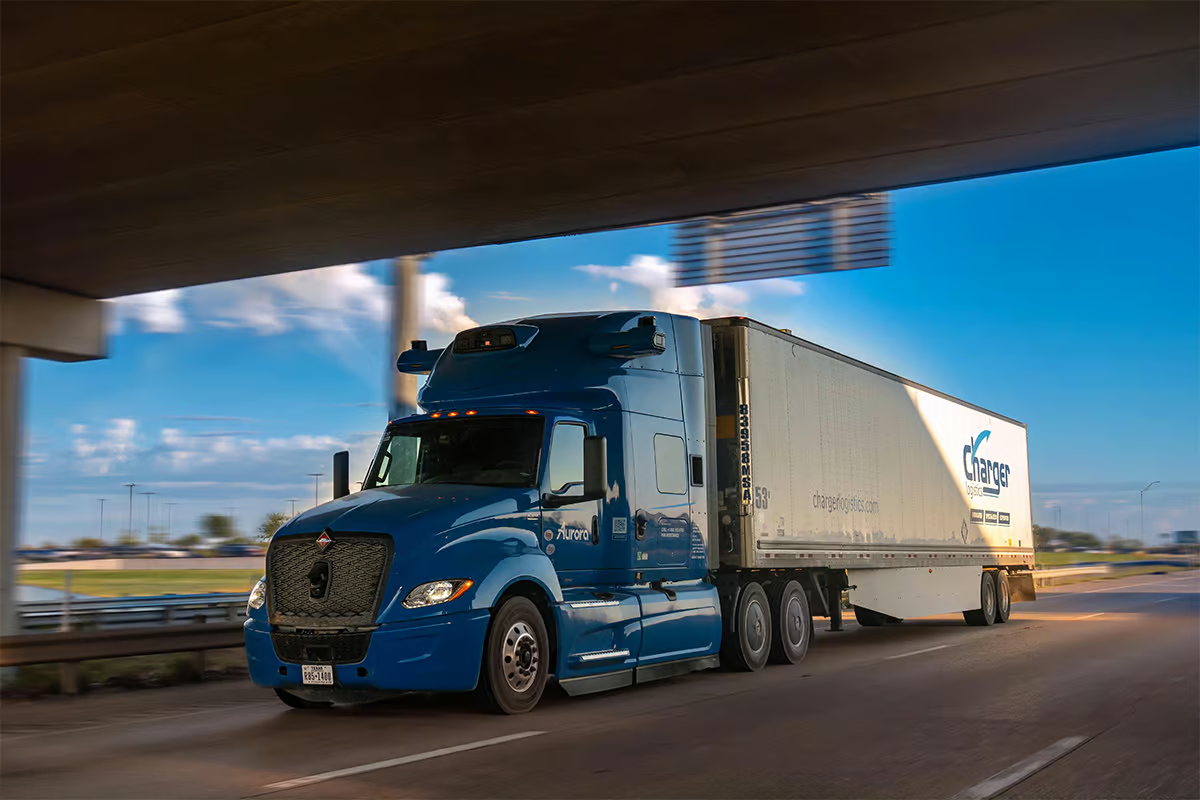
Charger Logistics plans to purchase up to 500 autonomous trucks equipped with the Aurora Driver under a new agreement with Aurora Innovation, expanding a relationship that began earlier this year. The proposed purchase would give Charger ownership of its driverless trucks while using Aurora’s autonomous driving technology through a subscription service.
The deliveries are planned for 2027 and 2028, subject to a final agreement, with Charger intending to deploy the trucks on existing and new high-volume freight routes near the U.S.-Mexico border and throughout the country.
The announcement follows the companies’ initial contract signed in July, which established their commercial relationship. Charger has since launched autonomous freight operations along the Laredo corridor, providing experience that the carrier plans to build upon as it expands its autonomous network.
“Since launching autonomous operations along the Laredo corridor, we’ve realized immediate operational benefits that point to a clear path to scaling,” said Andy Khera, president of Charger Logistics.
Charger operates across the U.S. and Mexico, providing truckload, dedicated, temperature-controlled and cross-border transportation services. Its customers include companies in the food and beverage, pharmaceutical, automotive and retail industries.
The carrier also operates its own transportation management system and supporting applications. As Charger expands its autonomous operations, the company intends to integrate the technology into its existing freight management network.
A central component of the proposed expansion is Aurora’s Driver as a Service (DaaS) business model.
Under the arrangement, Charger would purchase and own the trucks while subscribing to Aurora’s autonomous driving service. The model is intended to allow carriers to retain ownership of their transportation assets while pursuing reductions in total cost of ownership through autonomous operations.
Aurora has identified DaaS agreements as an important part of its longer-term expansion strategy, which targets 30,000 driverless trucks by 2030. The company also reported that additional customers are pursuing similar arrangements to own and operate autonomous fleets.
The proposed agreement reflects a potential shift toward a model in which established motor carriers own and operate larger fleets of autonomous trucks rather than relying entirely on transportation capacity provided by an autonomous technology developer.