The ask came at the Mid-America Trucking Show, and it was not a compliment.
Ratan Baid’s company had just built a concealed GPS tracker for trailers, and J.B. Hunt came to him about it. Then the carrier’s people explained what the entire product category still could not do for them.
“We get the notification … that the trailer got stolen at this point, but now it’s already gone,” Baid said, recounting the conversation in an October 8 interview with ACT News. “We need something that’s going to stop the movement of the trailer physically, not doing a notification.”
Baid is CEO of ELD Mandate and Trinetra Guard, two trucking technology brands of Bizringer Inc. The first has sold compliance software, telematics, dash cams, rugged tablets and GPS hardware to owner-operators and small and midsize fleets since the federal electronic logging device rule arrived. The second is the trailer security and automation division built on top of it. The request from J.B. Hunt sent Baid looking for the one place on a trailer where a lock would actually mean something.
He ruled out the brakes early. “There was another company who has been working on jamming the brakes of the trailer, which is kind of a little bit dangerous,” he said. “And there are ways to override that.”
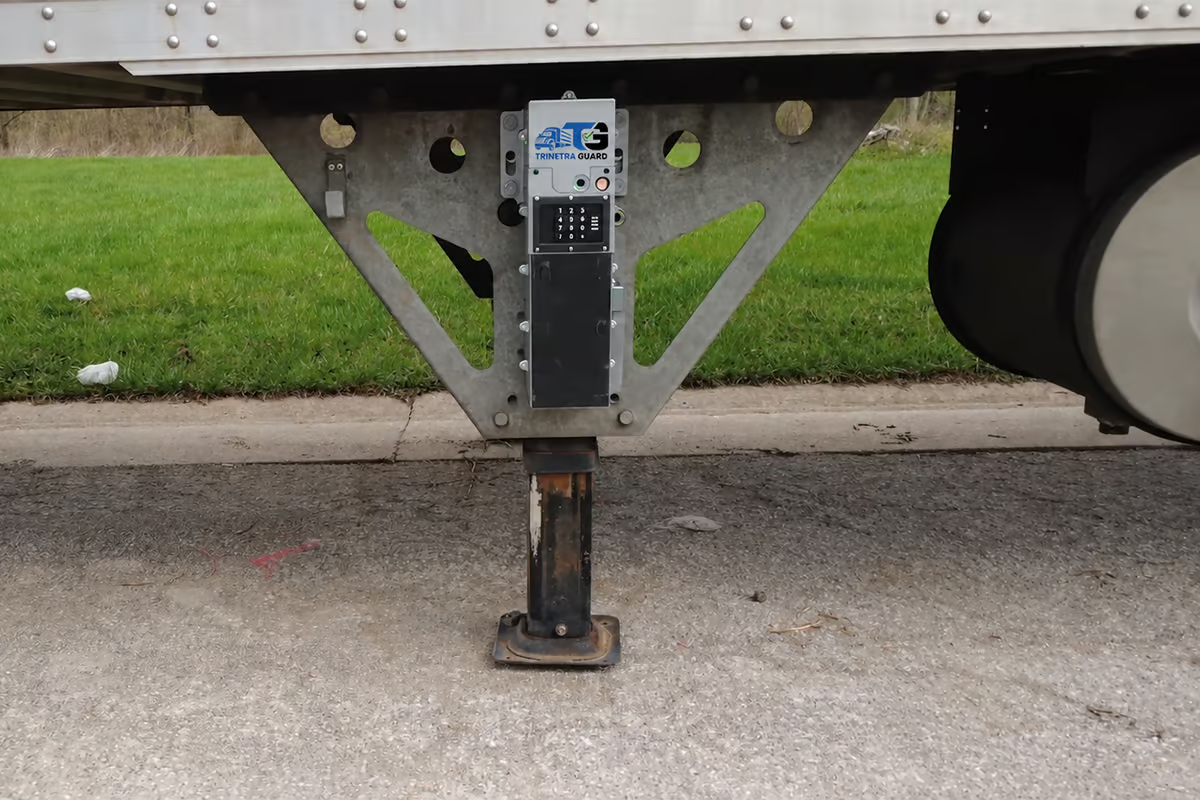
What he settled on instead is the part of the trailer nobody thinks about until they are standing in front of it in bad weather. “Every trailer has a landing gear,” Baid said. “And if I lock down the landing gear, and if I only unlock it based upon authorization, the trailer cannot move.”
That is the premise of EM6000Auto, the system Trinetra Guard will demonstrate at the American Trucking Associations Management Conference and Exhibition at the Charlotte Convention Center later this month. The device is an attempt to solve two problems that have nothing obvious to do with each other, using the same piece of hardware.
The first problem is structural. A trailer has gone a century without electronics of its own, and the coupling that holds it in place is purely mechanical. “Nothing stops it from being stolen,” Baid said. “That’s how all trailers have been built for almost 100 years now. Anyone can hook it up and drive it off.”
The numbers around that have moved in a direction fleets notice. Verisk CargoNet counted 2,646 confirmed cargo theft cases across the United States and Canada in 2025, up 18% from 2,243 the year before, with estimated losses of nearly $725 million, a 60% increase. The average value of a theft reached $273,990, up 36%. Total supply chain crime incidents over the same period were close to flat, 3,594 against 3,607, which means the money moved while the volume did not. The pattern carried into this year with a different shape. CargoNet documented 677 supply chain theft incidents in the second quarter of 2026, a 26% decline from the same quarter of 2025, while estimated losses more than doubled to $304.6 million from $135.7 million. The average value among thefts with a reported commodity value reached $564,009, a figure the company said was heavily influenced by a small number of extreme, multimillion-dollar losses.
“Lower incident volume should not be mistaken for lower risk,” said Keith Lewis, vice president of operations at Verisk CargoNet, this past August.
The security side of EM6000Auto works by putting an electronically controlled lock on landing gear operation. Authorization can come through a mobile app, an RFID card, a keypad entry using a one-time passcode sent to the driver’s phone, a Bluetooth connection, a pairing with a specific trusted tractor, or a remote command from the back office. Lock and unlock events are logged. The company says fleet managers can set rules governing which drivers, which tractors and which locations are approved, and that APIs are available to connect the records to existing fleet systems.
The device is built to stay where it is put. Trinetra Guard says installation uses one-time screws that cannot be backed out, and Baid describes the result as close to welded. Tamper detection sends an alert on forced access. A bypass that returns the gear to manual cranking exists for the case nobody wants, a loaded trailer and a device that will not respond, and Baid said it has to be authorized through the company’s around-the-clock command center rather than triggered at the trailer.
Then there is the second problem, which is the reason the product on the stand in Charlotte is not the product Baid originally planned to sell.
The first device, EM6000, did what J.B. Hunt asked. The carrier piloted it for several months, and multiple unlock methods worked. Baid was preparing for commercial production when he stopped.
“That device works for the trucking company,” he said. “But for the driver, it’s just one extra step now he has to unlock.”
Cranking landing gear by hand is one of the more reliably injurious routine tasks in trucking, and two independent assessments of it point the same direction. A case study published on OSHA’s website, describing a Northeast retailer with 88 outlets and 12 distribution centers, put typical manual operation at more than 50 crank revolutions at up to 100 foot-pounds of force and attributed about nine injuries a year to the task. The retailer piloted air-powered landing gear automation on two units, expanded the test to 100 more over a year and converted its full 700-trailer fleet in the third year. The case study reports no such injuries afterward.
Baid’s own count runs higher than either assessment, which is unsurprising given that the figures move with trailer height, load and how far the gear has to travel.
“It’s like 50 cranks one way and then another 50 cranks another way,” he said. “The drivers are like, ‘I need to get it done, I need to get out of here.’ And they start doing it too fast, that’s when they get hurt.”
So Baid shelved the launch.
“I decided we don’t want to rush into the commercial production of this device,” he said. “I want to make sure that we take care of this one big driver safety problem.”
The version that replaced it motorizes the task the lock was going to complicate. An authorized driver raises or lowers the landing gear from a phone or a keypad instead of a handle, which means the security layer arrives attached to something a driver has a reason to want.
Baid said the units carry multi-network SIM cards covering all three major carriers, and that the company is adding satellite communication as an option for fleets that want it. The system reports GPS position, supports configurable geofencing, and sends alerts on movement, tampering, lock and unlock events, low battery and motor faults. Optional sensors cover door open and close, temperature and humidity, and an interior camera that Baid said is used for cargo space utilization. A G-sensor is specified to flag landing gear deployment onto soft or unstable ground.
Sitting on top of that sensor set is the part Baid describes as the newest. The device was made to “have good amount of intelligence built where we see anything unusual, then that’s where the AI comes in,” he said. The machine learning layer watches for events that fall outside a trailer’s established pattern and raises them directly rather than leaving them in a log. “If there is something which happens which is out of ordinary, it will immediately inform the fleet manager with the trailer,” he said.
What Baid did not anticipate was which buyers would move first. At MATS this spring, leasing companies pushed to the front of the line, and it took him a while to understand why.
“I said, why are leasing companies so interested in it,” he said. “They said, ‘if I don’t get my rent, I can lock it down with your device.’”
Nobody has to be near the trailer to do it. A fleet management team can lock a unit from a computer.
Trailer manufacturers followed, with multiple OEMs attending demonstrations, and even one company offering to handle aftermarket installation nationwide. The system is intended to be sold both as an aftermarket retrofit and as a factory option on new trailers. Installation takes about 20 minutes, Baid said, and has to be done by an authorized installer rather than by a driver, a departure from the do-it-yourself model that works on the ELD side of the business.
What exists today is a product the company describes as fully tested and that has not entered mass production. Baid said commercial production is targeted for the end of this year or the first quarter of 2027, and that Trinetra Guard is accepting pilot orders of any size in the meantime, down to a single unit. The J.B. Hunt relationship that started all of it produced a written testimonial, sent at the company’s request, from Jean-Claude Boattini, the carrier’s vice president of equipment and properties, who wrote that Baid’s team “quickly grasped, reverse-engineered, and, in my opinion, solved one of our most complex asset management challenges.”
Trinetra Guard has a press briefing scheduled for 9:45 a.m. on Sunday, October 18, in Room E217, and will run installed-product demonstrations at booth 20008 once the exhibit hall opens at 1:15 p.m. that afternoon. Baid said the unit on the stand will be a working one, retracting, extending and locking with nobody touching a handle.