Fuel prices are trucking’s top concern for the first time since 2022, according to the American Transportation Research Institute’s 22nd annual Top Industry Issues report, released October 18 at the American Trucking Associations’ Management Conference and Exhibition in Charlotte.
Fuel climbed 17 spots to displace the economy, which had held first place for three years and dropped to sixth. The rest of the ranking runs lawsuit abuse reform, Compliance Safety Accountability, insurance cost and availability, driver shortage, economy, artificial intelligence in trucking, diesel emissions regulations, driver compensation and driver retention. Nearly 3,100 stakeholders participated, ranking three issues from a list of 27. Motor carrier executives and personnel made up ~49% of respondents, drivers ~26%.
The number behind the ranking has kept climbing since the survey closed. The U.S. average retail price for on-highway diesel reached $6.276 a gallon the week of October 19, up 9.7 cents from the prior week and $2.656 above the same week a year earlier, according to the Energy Information Administration. The weekly series record of $6.529 was set September 21.
Thirty percent of respondents put fuel among their top three concerns. ATRI reports that fuel surcharges do not fully insulate carriers from a price spike, citing gaps in surcharge coverage, delays in spot-market adjustments and empty miles that generate no surcharge revenue. Budgets have little room to absorb the difference. ATRI’s operational costs research found non-fuel expenses reached a record $1.854 per mile in 2025, up 4.2% from the prior year, with truckload and refrigerated operating margins below 1%.
What fleets told ATRI they want is a policy response rather than a different fuel. Among respondents who selected fuel as a top concern, 65.2% chose federal action to stabilize supplies and limit price increases as their preferred strategy. Diesel emissions regulations held eighth place on the list, and the preferred approach among respondents concerned about it was identifying the financial impact of compliance.
The economics of the alternatives have moved on a separate track, and they have moved further than the ATRI ranking suggests.
The 2026 State of Sustainable Fleets Market Brief reported that compressed natural gas averaged $3.43 per diesel gallon equivalent nationally at public stations in 2025, against $3.72 a gallon for diesel at public stations over the same period. That was an 8% average advantage. By March 2026, the brief reported, the cost savings over diesel had reached 36%. Among fleets running the Cummins X15N, 71% reported cost savings relative to diesel. Of surveyed CNG users, 65% reported using renewable natural gas for 78% of their fueling volume.
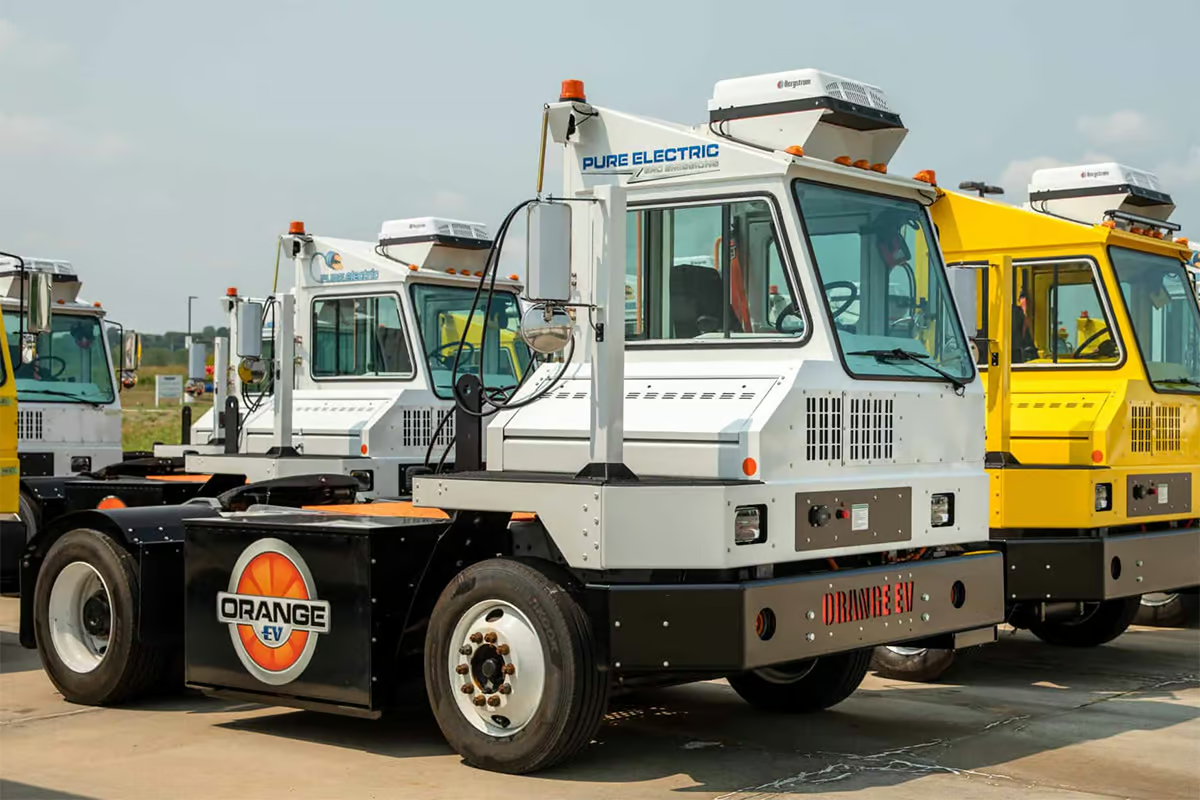
In the yard, the shift has already been measured. NACFE published research in September finding that 76% of surveyed fleet operators reported at least moderate operating-cost savings from electric terminal tractors compared with diesel, and that direct economic benefit rather than sustainability commitments is now the most cited reason fleets adopt them. The report drew on 62 respondents, 44 of them fleet operators and 18 industry partners, along with interviews with seven fleets. One fleet with nearly a decade of side-by-side data reported roughly 50% lower maintenance cost per operating hour and 75% to 95% lower energy cost per operating hour. NACFE also found that 58% of surveyed fleet operators either adopted electric terminal tractors before any other battery-electric vehicle type or have electrified terminal tractors exclusively. Orange EV, which manufactures electric terminal tractors, helped fund the research.
The constraint on both paths is capital rather than operating cost. NACFE found that 63% of fleets cited higher upfront vehicle cost as the single largest barrier to scaling, and identified grid connection timelines as a second obstacle that does not shrink with the size of the vehicle. Natural gas carries its own purchase premium and depends on fueling access, which remains concentrated in specific corridors and regions.
Where a fleet operates may matter more than which technology it picks. For the week of October 19, EIA put diesel at $8.242 a gallon in California and $7.394 across the West Coast, against $5.740 in the Lower Atlantic. That is a spread of more than $2.50 a gallon between regions within the same week, on the same fuel. The next EIA weekly reading is scheduled for October 27.