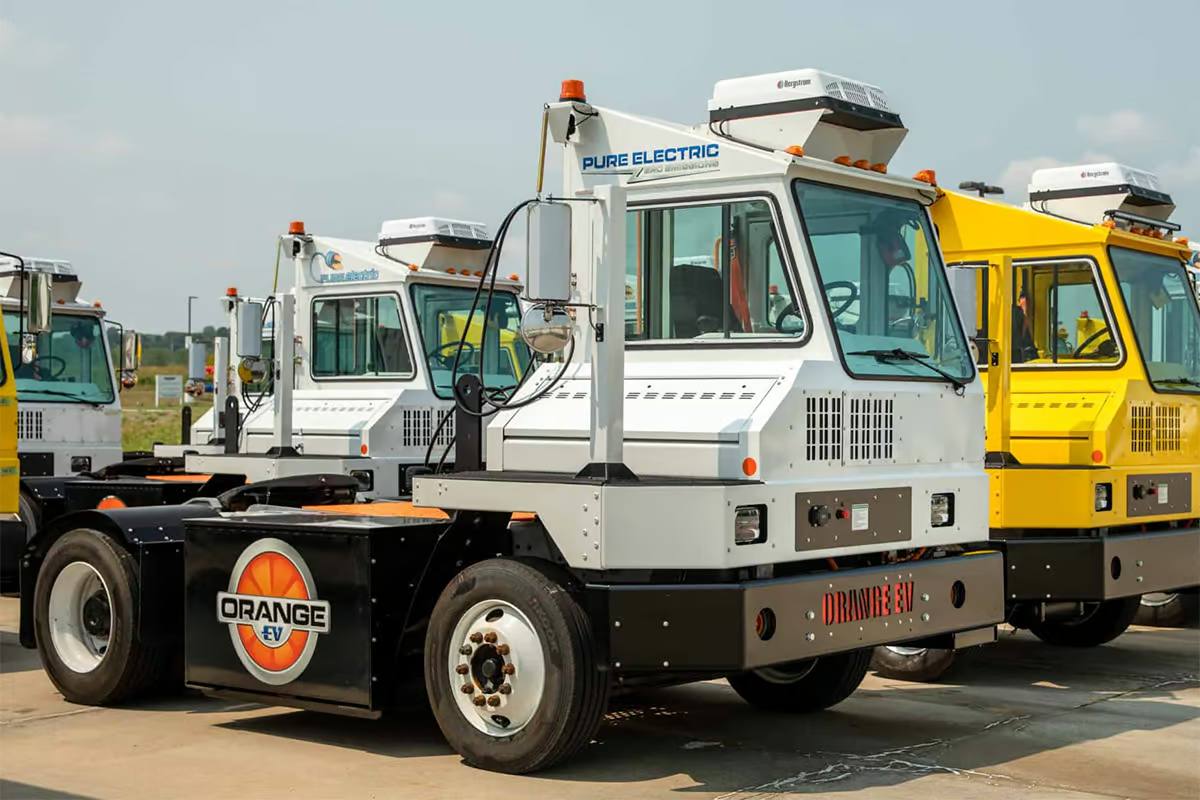
The trucks had been on the ground outside Toronto for three days when the yard found out what a Canadian January does to a terminal tractor.
Lazer Logistics was running both powertrains at the site, diesel and electric, side by side. The diesels were on block heaters. Anti-gel agent was already in the tanks. They would not start.
“Versus the site manager going in, flipping the key on the EV, and five minutes later, the cabs are nice and toasty,” said Chris Bennett, vice president of EV, energy and sustainability at Lazer Logistics, who told the story during a recent North American Council for Freight Efficiency webinar. Lazer has validated its electric units operating down to -22 degrees Fahrenheit in Canada on multiple occasions, Bennett said, against an engineering rating of -40 on most of the trucks it operates.
The survey behind that webinar puts a number on the tradeoff rather than dismissing it. Among fleet operators, 31% rate electric units below diesel in cold weather, and 35% of industry partners agree. The fleets living with it describe a known quantity: Wegmans measures a 10% to 20% range reduction and Bourassa Transport built an overnight charging contingency for winter, and NACFE reports the reduced range still comfortably covers the duty cycle for fleets generally.
Both things are in NACFE’s new report, and the gap between them is the useful part. Four years after its first look at the technology, Mike Roeth and his team went back to ask whether electric terminal tractors have proven out well enough for fleets to standardize on them. What they found is that most of the arguments fleets were having in 2022 about the equipment have been settled by operating data, and the argument that remains is about money and time.
Beyond the Pilot: Electric Terminal Tractor Adoption, Four Years Later, draws on 62 survey respondents, 44 of them fleet operators and 18 industry partners, along with interviews with seven fleets: Bourassa Transport, Coke Canada Bottling, Lazer Logistics, PITT Ohio, Wegmans, YMX Logistics and one large carrier that requested anonymity. Orange EV helped fund the research and connected NACFE with some participants.
Bruce Stockton, NACFE senior fleet consultant, put new terminal tractor production at roughly 5,000 units in a normal year and perhaps 3,000 in 2026. According to CALSTART, 519 new zero-emission terminal tractors were deployed in 2025, approximately 3% of the total terminal tractor population. This makes it the highest share of any zero-emission truck segment NACFE tracks.
Orange EV argues the current-year picture has moved further than those numbers suggest. The company is on pace to deliver approximately 1,000 trucks in North America in 2026, said Zack Ruderman, vice president of sales and marketing, in an interview with ACT News. That is a full-year forecast supported by orders already received, he said, including a 600-truck order that delivers this year, across a customer base now above 370. Set against Stockton’s estimate of total new-unit volume, Ruderman puts electric at somewhere between one in three and one in four new yard trucks sold in North America this year.
“This market is well past the early-adopter stage,” he said.
Among fleet operators, 76% reported at least moderate operating cost savings compared with diesel. Just over half, 54%, have moved past the pilot stage into partial deployment or full standardization. Direct economic benefit, meaning fuel and maintenance savings, is now the top reason fleets give for adopting the technology at 60%, narrowly ahead of corporate sustainability goals at 57% and well ahead of regulatory compliance at 37%.
And then there is the number that complicates all of them. Asked whether the full business case has proven out, including the higher purchase price of the vehicle, 52% of fleet operators said it is still too early to tell. Industry partners were considerably more confident, with 53% calling it a strong case already.
A fleet watching real savings accrue every month while declining to call the investment proven is not contradicting itself. The two questions measure different things. Operating cost savings are line items a fleet can read off a maintenance system and a utility bill. The full case is payback against capital, and roughly half the sample has not run an electric unit long enough to close out a depreciation cycle. Wegmans, one of the few fleets in the research at full standardization, took five to six years to get there and still frames its return in a three-to-five-year window rather than a completed one.
The line items themselves are not in much dispute. Drawing on close to a decade of data covering roughly 4 million miles, more than 8 million trailer moves and 1.7 million key-on hours, Lazer reports a roughly 50% reduction in maintenance and repair cost per operating hour on electric units against diesel of the same model year, rising to as much as 75% in a unit’s early years, with tires included in the figure. Net energy cost per operating hour runs 75% to 95% lower, excluding the capital cost of charging infrastructure.
“Because we operate behind our customer’s fence lines, that cost per kilowatt hour tends to be extremely low compared to going out to a public charger or to a shared fleet services charging location,” Bennett said.
Ruderman walked the fuel arithmetic through a generic two-shift operation during the webinar: 4,000 hours a year at two gallons an hour is 8,000 gallons, which at $5 diesel is $40,000 a year on a single truck. Electricity claws back perhaps 10% to 20% of that. On the maintenance side he made the structural argument rather than the statistical one.
“When you think about the diesels, the parts that are the most expensive to repair are things like the engine, the transmission, the radiator, the emission control systems, and none of those are in our trucks,” he said.
That last item has moved from a theory in NACFE’s 2022 report to a confirmed cost driver in this one. Every fleet interviewed that discussed diesel maintenance confirmed that emissions aftertreatment is now standard equipment on new diesel units and a real source of repair cost and downtime, a shift NACFE says has pulled realistic diesel depreciation schedules well below the 12-year assumption it worked from four years ago.
The assumption that did not survive was about charging. In 2022 the open worry was that a fleet would need two electric units for every diesel it replaced, because an eight-to-12-hour charge would strand a truck that a yard needs running most of the day.
“The key thing that came out of the survey and the results was that opportunity charging every time that truck was stopped, with that opportunity, was enough to keep that truck alive, more than enough to keep that electric truck alive and work all day long,” Stockton said. “And then so that was a myth that I think has been busted in this 2026 report.”
Among fleet operators, 52% now name a blended opportunity-and-overnight approach as their most effective charging strategy, more than three times the share favoring opportunity charging alone. Among industry partners the figure is 82%. Every electric replacement at Lazer has been one for one, with no spare units bought to cover charging downtime, and the company has pushed past original OEM guidance of one Level 3 charger per two trucks in a 24/7 environment to a confirmed four trucks per charger, with five- and six-truck ratios now in testing.
But not every technology is a fit for every fleet or every site. Ruderman put the floor on it from the manufacturer’s side during the webinar.
“If you’re only using the truck four to six hours a day, then the fuel savings is a lot less, and the M&R savings is a lot less. So it really extends the payback.”
Asked where that line actually falls, he named a number.
“If a yard truck runs fewer than about 1,000 hours a year, we’ll tell you a new electric truck purchase probably isn’t your best option on cost savings alone,” Ruderman told ACT News. Below that threshold he pointed fleets toward a used unit, a lease, a rental, or a grant. For a yard running four hours a day, he sketched a used Orange EV truck at about $200,000, roughly a $50,000 premium over a new diesel, where hard-cost savings of about $15,000 a year from fuel and maintenance pay the premium back in a little over three years. The exact threshold moves with diesel price, consumption, electricity rates, charger cost and how long a fleet keeps the truck.
The clearest illustration of a fleet below that line is the large carrier in the report that looked at electric terminal tractors and said no. It runs roughly 400 units six to eight hours a day, about 250 days a year, with idle time tracked above 50% on some of them, which is close to a description of the problem the technology is built to solve. Leadership raised it internally and set it aside.
One executive’s response to a proposal addressing idle time was “just stop the idle time, next subject.” A senior leader said any real initiative would have to be board-driven rather than operational, and that the company would have no interest in a pilot unless a manufacturer supplied the truck and the charging system at no cost, which no OEM interviewed for the report offers. The carrier had separately parked 10 electric Class 8 delivery trucks after a pilot it described as poorly supported.
That carrier’s instinct about idle time was not wrong, which is the part worth sitting with. Lazer cut idle across its own diesel terminal tractor fleet from 52% in 2017 to 16% today through a multi-year operational discipline program that had nothing to do with electrification, and a follow-on technology project targeting under 5% is due to report in early 2027.
What separates the fleets that standardized from the fleets that piloted one truck, NACFE concludes, is less often a unit economics threshold than an identifiable internal champion or mandate. Wegmans traces its three-site, 18-truck conversion to a company sustainability commitment dating to 2013 rather than to a payback calculation.
Which brings the argument back to capital. Capital budgeting is the top-ranked barrier to moving from pilot to scale, cited by 63% of fleet operators and 77% of industry partners, ahead of utility and grid delays at 40% and 53%. The gap runs from roughly $150,000 for a new diesel unit to roughly $300,000 for a new electric one, and 63% of fleet operators acquire these trucks through capital purchase rather than any leasing structure. A grid upgrade can be sequenced over time. A fleet either has approval for a $300,000 unit in a given budget cycle or it does not.
Leasing is the way around that, and the largest buyer and the largest manufacturer in this market describe its availability differently.
“It goes to there really not being a secondary market,” Bennett said on the webinar. “So I know the lessors are having a tough time placing some kind of residual value on these units.” He expects the first generation of units to start reaching the secondary market in the next three to five years, which is when the industry gets hard residual data.
Orange EV says the financing is already there. Outside of port orders and its largest single order, about a third of the company’s 2026 orders have been leases, Ruderman said. Orange EV writes operating leases directly, multiple financing partners write capital leases, and all of them carry residual value assumptions.
It also produced the first public figure on what a used electric terminal tractor sells for. Orange EV has resold more than a dozen used trucks at around $200,000 each, Ruderman said. Set against roughly $300,000 for a new electric unit and roughly $150,000 for a new diesel, that is the only resale number either source put on the record, from a single seller in a market Ruderman agrees is still maturing.
Underneath the residual question sits battery replacement, and nobody in NACFE’s research has reached one. Wegmans expects seven to 10 years of battery life. PITT Ohio’s units carry a seven-year warranty and its maintenance savings remain, in its vice president of vehicle maintenance’s words, still to be determined. Coke Canada has not built maintenance savings into its return at all, citing unknown future battery costs.
Orange EV says that cycle has not arrived in its own fleet either, for a different reason.
“We’ve never had to replace a battery pack,” Ruderman said, including on trucks more than a decade old that shipped with a three-year battery warranty. The current generation carries a standard 7.5-year warranty.
One finding in the report drew a direct response. An anonymous parcel fleet told NACFE that no manufacturer offers an on-road-capable, DOT-legal electric terminal tractor rated for highway-adjacent speeds, which NACFE calls a real product gap.
Ruderman disputes the framing rather than the facts. The vast majority of Orange EV units are already built to on-road spec and can be registered, he said, and many customers do not register them because the trucks never leave the site. Top speed is about 32 mph, which he said covers how the vehicles are actually used, keeping them inside the sub-33-mph category where electronic stability control is not required.
“Our trucks already go on the road. They just don’t go on the highway, because terminal tractors don’t need to.”