Ask Peter Voorhoeve what a fleet gets out of the platform Volvo’s three new trucks share, and it does not start with steel.
“The new platform had a completely new electric architecture,” the president of Volvo Trucks North America said in an interview at the press preview for the all-new Volvo VNX. “We went from a 12 volt to a 24 volt system, and the reason we did that is that there is significantly more software in the truck, so there are significantly more ECUs in the truck. We had four in the previous one. Now we have almost 24 or 30.”
The point of all that computing power, he said, is what it lets the truck do.
“Why have we done that? Because we have significantly more safety. We have a proprietary safety suite in that truck. We have fuel efficiency, engine management,” Voorhoeve said. “It’s a more software-driven truck, where maybe the previous one was more hardware-driven. The software helps operators, be it long haul, be it vocational, to run the truck in a better way. It’s better for the connectivity. It’s better for the information, the data you get out of there. It’s a more intelligent setup.”
For the vocational buyer, that architecture is the whole difference between the truck Volvo has been selling into the segment and the one it is launching.
“If you look at the safety suite that we have on the VHD versus the safety suite that we have on the all-new VNX, that’s a very, very big difference,” he said.
The truck brings safety systems common on highway and city tractors into a jobsite application, including pedestrian detection, automatic emergency braking, forward collision avoidance and lane keeping. The design also adds to the safety aspect.
“The way we’ve built the truck, the visibility around the truck is significantly better than there was on the previous, so the driver sees more because of the panoramic windshield and the aerodynamic shape of the hood,” he said
Connectivity also moves Volvo from fixing things to flagging them.
“Since all the trucks are connected, we are able to work proactively,” said Voorhoeve. “We follow a couple of ECUs and components, and when we see something needs to be maintained, we shoot out the message to the dealer or to the owners.”
Connectivity addresses what happens after a truck is in service. The more immediate question for vocational buyers is which engine they can order, and under which rule. Model year 2027 federal standards cut the NOx limit to 0.035 grams per brake horsepower-hour, and Volvo will sell into that transition two ways.
“We will offer our trucks as of January 2027 with EPA ‘27 engines, but also with the current engines with an NCP,” he said. “So they have the choice of both.”
An NCP, or nonconformance penalty, exists so far only in a proposed EPA rule published in July 2026 and still without a final rule, so the second of those two paths is contingent on a rulemaking that has not concluded. The VNX sidesteps it entirely.
Asked where zero-emission options fit into the vocational lineup, he started with the diesel.
“The trucks that we’re producing right now, the engine that we’re producing right now, are significantly more sustainable than they have ever been,” said Voorhoeve. “And not only that, they also drive on HVO. They also drive on biodiesel up to B20. So there is a lot of opportunities for job site owners to further reduce CO2.”
An electric VNX is not on the schedule.
“We have the VNR Electric, which by the way you can also use in a straight truck,” he said. “By the end of this year we will launch the new VNL Electric.”
Volvo has sold vocational trucks outside North America for decades, and Voorhoeve was careful about claiming the transfer was mechanical.
“It’s a little bit difficult to pinpoint exact components, but if you design a truck and you talk about durability and safety, how heavy does this have to be, how heavy does that have to be?” he said, pointing to the steel grille and three-piece bumper as the visible answers, alongside a cab carrying one-third more ultra-high-strength steel than legacy vocational products. “We know where to reinforce it.”
The tow hook, rated to 40 tons, came with a story. Volvo once hung an FMX from one by a hoist. “The whole truck was hanging on the hook,” Voorhoeve said, “and our president was standing on top of the truck.”
The relationship with Volvo Construction Equipment runs past the design studio, and the part Voorhoeve thinks matters most to a buyer is administrative.
“We have a common back office,” he said. “If you finance your yellow equipment, you can finance the VNX with the same Volvo Financial Services, so you have combined financing. If you talk about uptime, we have the same uptime technology. And if you look at spare parts distribution, the spare parts for the yellow machines and the spare parts for the Volvo trucks all come out of the same warehouse. So there is a lot of common back office that makes it easier for the customer to do business with us.”
One feature came over from the machines outright. Direction change, which lets a driver shift between drive and reverse without touching the brake, came off Volvo wheel loaders. “That indeed is something as a truck driver you would not come up with,” Voorhoeve said, “because you don’t do it that often.”
Remote Steer, which lets an operator run the truck from outside the cab, traces to an older idea.
“If you look at very specific jobs like cement, the moment you start unloading, you need somebody else, somebody to give you directions,” he said. “We’ve designed these trucks so that the driver can keep his eye on the job. And if you can keep your eye on the job, then the chance for mistakes and accidents significantly decreases.”
He connected it to Stop, Look, Wave, a Volvo program that teaches young children to stop at a curb, look, meet the driver’s eye and wave before crossing.
“In principle, remote steering is not so far away from that,” Voorhoeve said. “The whole idea behind it is that the driver has full focus on the job he’s doing. And in the vocational case, it is not only behind the steering wheel, it’s also behind the body.”
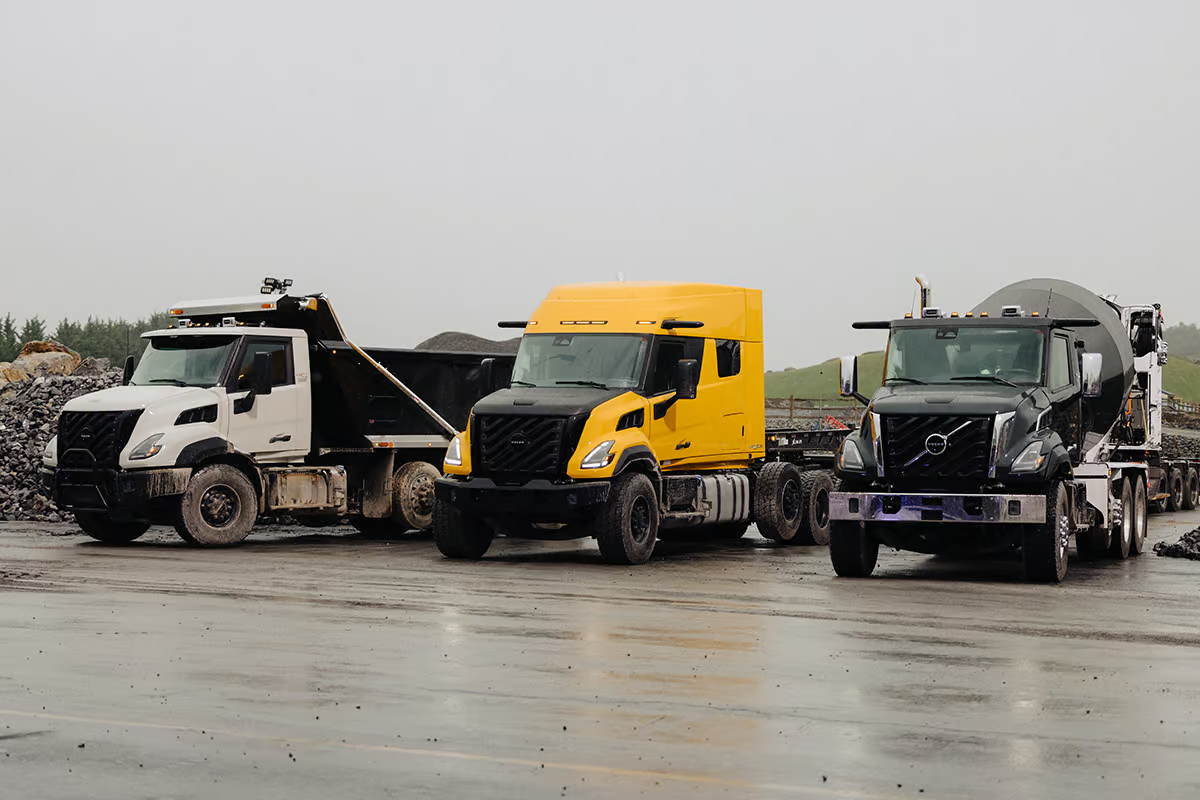
The VNX is the third all-new truck Volvo has put into North America in under three years, and the only one of them engineered to work off the pavement as well as on it.
“It’s not a highway truck that tries to be a construction truck,” he said. “This is a construction truck, and that’s what I’m very excited about.”