Updated April 17, 2026
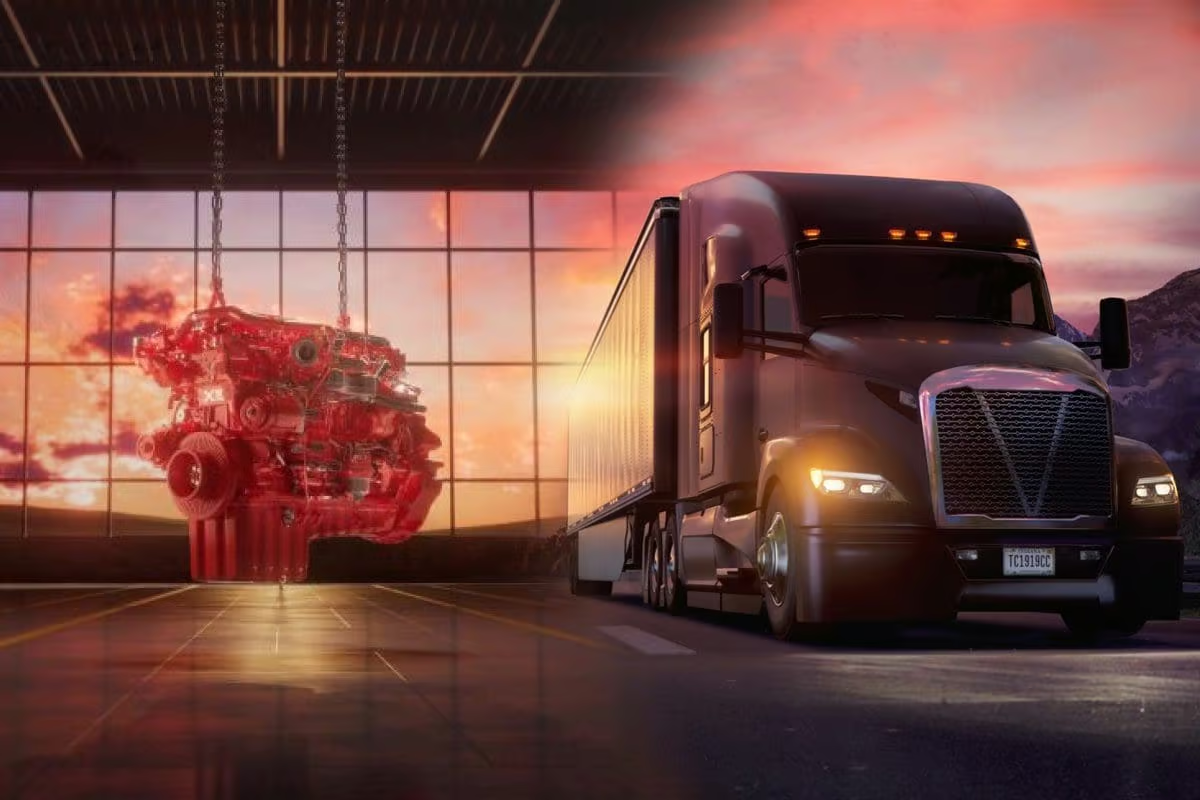
Natural gas has long been strongest in applications where the limits were manageable — refuse, transit and regional haul, where predictable routes and centralized fueling could offset tradeoffs on power and range. Cummins and Hexagon Agility say those limitations are easing, with the arrival of a 15-liter engine and improved fuel-system design helping natural gas compete in heavier-duty freight applications.
“The X15N is a significant upgrade in performance from its predecessor the ISX12N, which opens up much more of the HD on-highway market which was not available due to the limited power of the 12L,” said Dave King, X15N product manager at Cummins. “The initial launch in 2024 was exciting with lots of demand with many fleets placing early orders… Interest from shippers and carriers continues to remain high.”
That shift is starting to show up in fleet evaluations as well.
“We’re focused on lowering operating costs while advancing sustainability,” said Doug Glenn, senior manager of fleet maintenance at Giant Eagle. “The X15N allows us to do both without compromising performance.”
Giant Eagle recently completed X15N demo trials and has secured new truck orders, adding to a broader alternative fuel strategy already underway across its fleet.
“During our trials, our drivers experienced diesel-like horsepower and torque,” Glenn said. “From a driver’s perspective, the experience is very comparable to diesel.”
For Cummins, that parity with diesel is critical. King called diesel-like performance “one of the key attributes” driving fleets to take a closer look at natural gas.
“The power, torque and performance that the X15N brings to the market is a game changer,” he said. “The X15N now has the power, torque, and performance needed for some of the most demanding duty cycles.”
That capability is beginning to extend natural gas beyond its traditional footprint. While refuse and regional operations remain strong use cases, fleets are now exploring how the technology fits into broader freight networks.
“Regional and return-to-base routes with predictable fueling access have proven to be the best fit,” Glenn said, pointing to how fleets are still aligning deployments with operational realities.
Infrastructure continues to play a central role in that equation. Cummins points to growing availability of public CNG fueling, while fleets with longer experience are building out their own networks.
“With the right infrastructure in place, it fits naturally into our daily operations,” Glenn said. “Since our initial deployment in 2010, we’ve built two private and one public access station to support our fleet of natural gas trucks.”
RNG is also shaping the conversation. For Cummins, it strengthens the emissions case for natural gas by enabling fleets to reduce lifecycle carbon intensity without changing vehicle platforms.
“RNG is really the key element to making the argument that CNG powered trucks have a part to play in reducing carbon emissions in transportation,” King said.
Fleets are reaching the same conclusion.
“Very important,” Glenn said of RNG availability. “RNG enables immediate emissions reductions using proven technology, which aligned with our goals.”
Giant Eagle now operates its natural gas trucks exclusively on RNG as part of a broader strategy to reduce emissions across its operations, including a goal to reach net-zero carbon emissions by 2040.
Hexagon Agility sees RNG as a critical enabler as well.
“RNG provides fleets with a practical pathway to significantly reduce lifecycle carbon emissions while using proven engine technology and existing fueling infrastructure,” said Ian MacDonald, senior vice president of sales, Americas. “It allows fleets to pursue both sustainability goals and operating cost savings without waiting for future technologies to mature.”
While emissions remain a key driver, economics continue to shape adoption decisions.
“Fuel cost stability has been a key advantage, and overall TCO is trending favorably compared to diesel,” Glenn said.
Cummins acknowledges that upfront costs remain higher but argues operating economics can close the gap over time.
“While the Capex cost of an X15N powered vehicle is higher than a comparable diesel… Opex cost is very comparable and… the X15N powered truck is very competitive,” King said.
Fuel-system advancements are also helping address one of the longest-standing barriers: range.
“The introduction of the 15-liter Cummins X15N has been a major catalyst for natural gas adoption in heavy-duty trucking,” MacDonald said. “We’re seeing strong interest in fuel system configurations that allow fleets to achieve 800-mile day cab range and over 1,200 miles in sleeper trucks.”
Those improvements are already influencing fleet deployment strategies.
“The available range and tank configurations allow us to deploy these trucks in real-world operations without disruption,” Glenn said. “Collaborating with Hexagon Agility… has enabled our trucks to run more than 750 miles before refueling.”
Driver acceptance is reinforcing that progress.
“Today, we operate 82 RNG-powered tractors,” Glenn said. “Feedback has been positive — comparable performance, quieter operation, and an easy transition.”
Still, fleets note that the transition requires some adjustment.
“There’s an initial learning curve around fueling and maintenance, but it’s been manageable with the right support,” Glenn said.
For Hexagon Agility, those operational considerations are exactly where the conversation has shifted.
“Today’s fleets evaluate the entire operational equation: range, weight, fuel system configuration, payload impact, fueling infrastructure, and total cost of ownership,” MacDonald said.
That broader evaluation reflects how natural gas is evolving from a niche solution into a more integrated option within the heavy-duty market.
“We see it playing a growing role, particularly where it delivers both economic and environmental value,” Glenn said.
Taken together, the message from engine manufacturers, system providers and fleets is consistent: natural gas is no longer being evaluated on whether it works, but on where it works best—and how quickly it can scale.