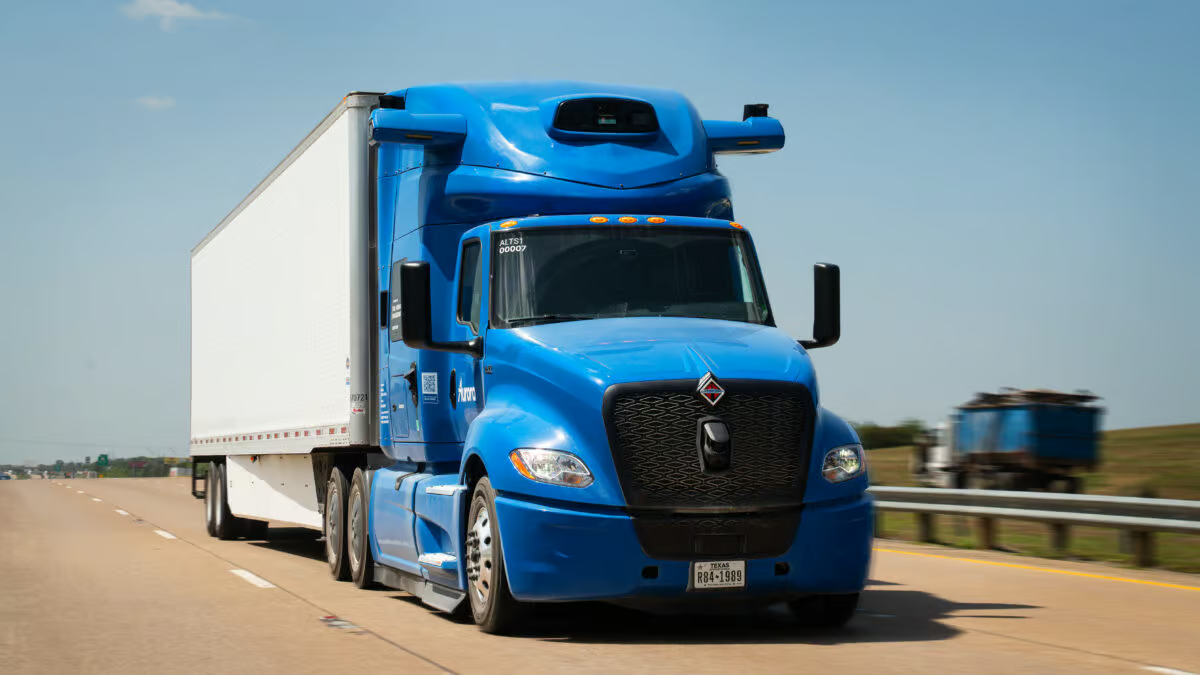

Torc Robotics has announced a strategic partnership with Mila – Quebec Artificial Intelligence Institute, marking what the company says is the first autonomous-trucking partnership within Mila’s ecosystem. The collaboration is designed to strengthen Torc’s artificial intelligence and autonomy research as the company continues developing self-driving trucks for long-haul freight applications.
Through the partnership, Torc will establish a presence within Mila’s Montreal-based ecosystem, gaining access to academic researchers, faculty, and students working across machine learning and applied AI. The collaboration also includes dedicated research space on site and will focus on advancing physical AI capabilities that can support real-world autonomous vehicle deployment.
For commercial transportation, the announcement reflects the growing role of advanced AI research in moving autonomous trucking from controlled testing environments toward scalable freight operations. Torc said the partnership will support work in areas including generative world models, multi-agent behavior modeling, reinforcement learning, and foundation models for physical AI systems.
“Torc is focused on building safe, scalable autonomous trucks, and advancing the next generation of physical AI is central to that mission,” said Felix Heide, head of artificial intelligence at Torc. “As a long-time Mila collaborator, I can definitively say that partnering enables deeper collaboration at the intersection of research and real-world deployment, collaboration that supports continued progress toward commercializing autonomous trucking at scale.”
Mila, based in Montreal, is a leading AI research center that is recognized for its work in deep learning and machine learning. By embedding within Mila’s research environment, Torc is seeking to deepen its work on AI systems that can better connect simulation, perception, decision-making, and real-world vehicle performance.
Christopher Pal, core academic member at Mila, scientific co-director of IVADO, and professor at Polytechnique Montréal, said the partnership creates opportunities for students and researchers to work on practical challenges in physical AI while contributing to the development of autonomous systems.
The collaboration builds on Torc’s existing presence in Montreal and an affiliation with Mila that dates back to 2020.