
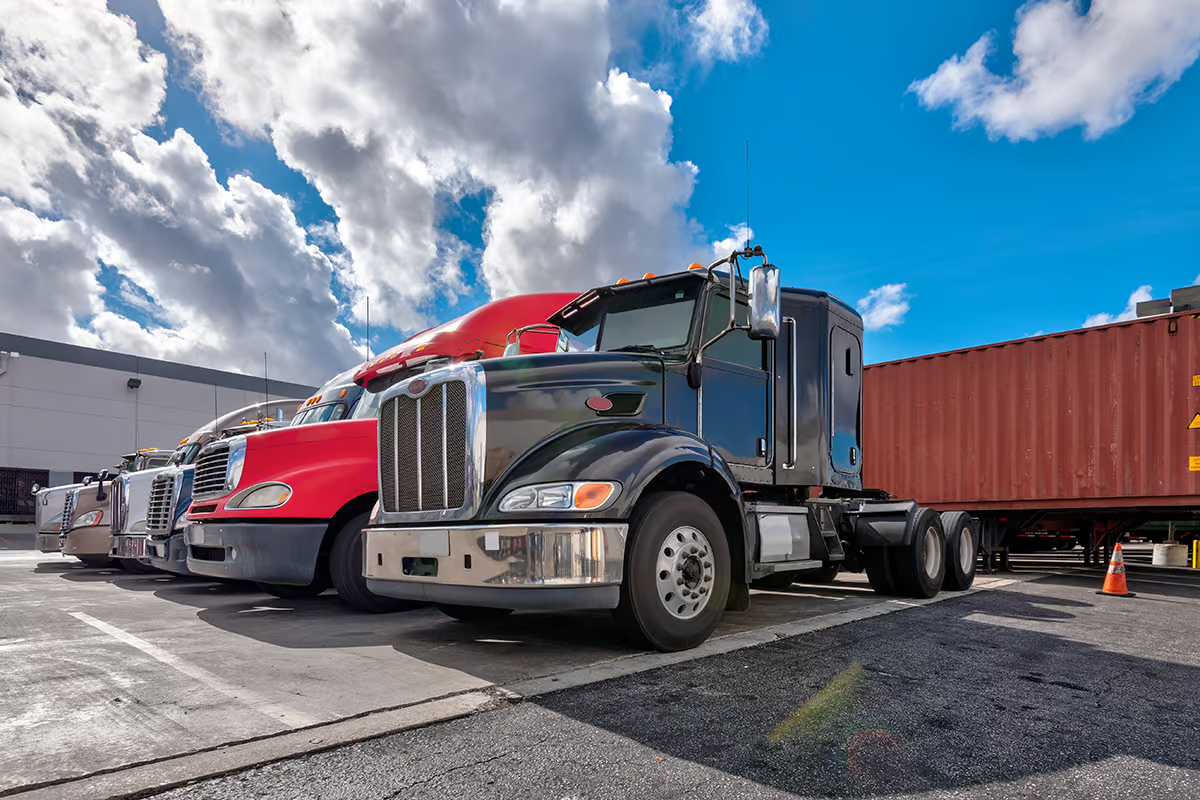
The U.S. House has voted to extend the federal Diesel Emissions Reduction Act program through fiscal year 2029, keeping alive a funding mechanism that has helped replace and retrofit older heavy-duty diesel vehicles and equipment for nearly two decades.
The House passed H.R. 2140, the Diesel Emissions Reduction Act of 2025, by a 343-79 vote on September 15. The legislation changes the program’s authorization expiration from fiscal year 2024 to fiscal year 2029.
For fleets, however, reauthorization does not mean $100 million in new federal funding automatically becomes available each year.
The legislation authorizes Congress to appropriate $100 million annually through fiscal year 2029. Actual funding still has to be provided through the annual appropriations process. The Congressional Budget Office, in its analysis of the identical Senate legislation, calculated the authorization at $100 million for each fiscal year from 2026 through 2029.
That distinction is particularly relevant heading into the next federal budget cycle. EPA’s fiscal year 2027 budget justification shows $90 million for the DERA Grant Program in the fiscal year 2026 enacted operating plan, but the administration’s fiscal year 2027 budget proposes eliminating that funding. Congress ultimately determines the program’s annual appropriation.
DERA provides funding for voluntary projects aimed at reducing emissions from older diesel engines and equipment. Under EPA’s most recent national grant guidance, eligible equipment includes Class 5 through Class 8 highway vehicles, along with school buses, locomotives, marine engines and certain nonroad equipment. Eligible projects have included early vehicle and engine replacements, verified emissions-control retrofits, idle-reduction equipment, aerodynamic technologies and low-rolling-resistance tires.
Private fleets generally are not direct applicants under the national grant program. Eligible applicants include state and local agencies, tribal governments, port authorities and qualifying nonprofit organizations. Those organizations can structure projects involving companies that own or operate diesel fleets. Approximately 30% of annual DERA appropriations are also allocated to state and territory programs.
EPA’s latest report to Congress provides a longer-term look at the program’s reach. From fiscal years 2008 through 2020, EPA estimates that nearly $960 million in DERA funding supported the replacement or retrofit of approximately 76,900 vehicles and engines. The agency estimates those projects reduced nitrogen oxide emissions by approximately 499,000 tons and particulate matter emissions by 16,600 tons while saving 572 million gallons of diesel over the lifetime of the affected vehicles and engines. Those figures are based on data reported by grant recipients and include estimates for projects that had not yet reached final closeout.
EPA also reported that every federal dollar invested through the program leveraged approximately $2.30 from nonfederal sources. Demand has historically exceeded available funding; in fiscal years 2019 and 2020 alone, applications requested approximately $220 million more than DERA appropriations could support.
The House action does not complete the reauthorization. A Senate companion, S. 2235, was also introduced. The Senate Environment and Public Works Committee approved that legislation by voice vote in October 2025, and it was placed on the Senate legislative calendar. As of September 18, no Senate floor vote has occurred.