
Fleet electrification discussions focus on propulsion. Less attention goes to a problem affecting nearly every vehicle already in service: the truck that keeps drawing power after the operator has gone home.
Telematics, GPS, cameras, sensors and keyless entry modules all pull current while a vehicle sits. Individually the loads are small. Over a weekend or holiday shutdown, they are enough to leave a battery too depleted to start Monday morning, triggering dead batteries, premature replacements, roadside calls and accelerated wear on alternators and starters.
Vanair’s EPEQ® Solar Assist™ targets this directly, a patented mobile solar system that functions as a continuous battery tender, keeping vehicles ready when crews are.

Built for Trucks, Not Adapted to Them
Most solar panels reaching the vocational market were designed for stationary applications and modified for vehicles afterward. That heritage shows up in the failure modes. Glass cracks. Rigid frames often require raised mounting platforms that add height, wind resistance and noise. Conventional busbar architecture means a single break can take out a section of the panel.
Solar Assist™ takes a different approach. The panels use flexible, frameless, all-polymer construction with no glass to crack or break, and they weigh roughly 80 percent less than traditional glass panels. At an eighth of an inch thick, they conform to cab roofs, service body tops and other curved surfaces without added structure to maintain OEM aerodynamics; saving fuel in the long run.
Durability is engineered into the electrical architecture as well. The panels use more than 2,100 independent grid connections and over 180 redundant interconnects, a design Vanair® reports is 50 times more durable than conventional busbar solar panels. The system has been tested to withstand winds exceeding 150 mph.
Producing Power When Conditions Are Not Ideal
Rated wattage tells you what a panel produces under laboratory conditions. Work trucks don’t operate this way – they park in partial shade, sit at odd angles, and push through overcast stretches that flatten output from conventional panels.
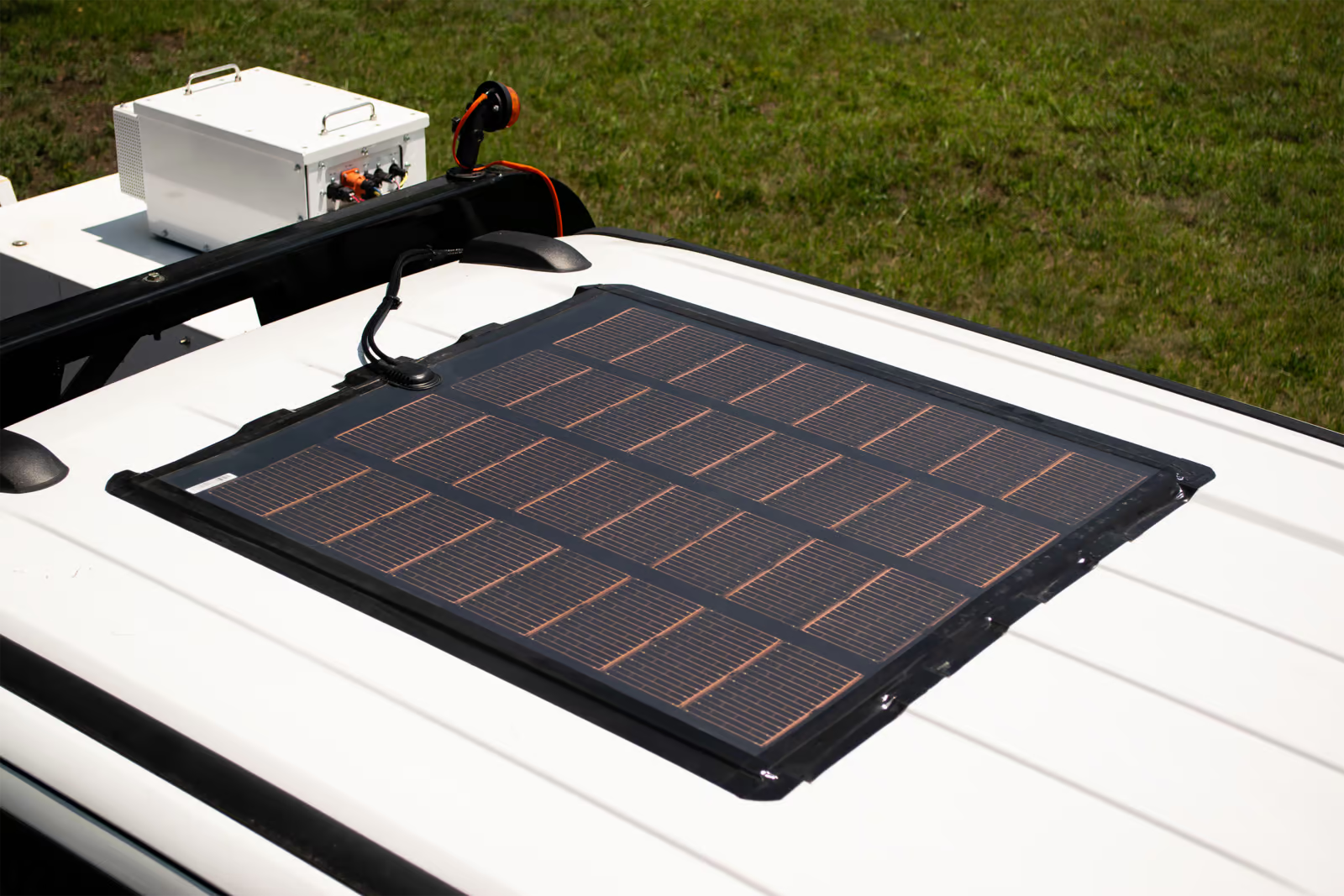
Vanair’s patented light-capturing technology pulls in sunlight from more angles, extending production earlier in the morning and later in the day, with up to 20 percent more real-world energy as a result.
Every system pairs with a Maximum Power Point Tracking (MPPT) charge controller, not the Pulse Width Modulation (PWM) approach common in entry-level solar. MPPT continuously adapts to changing conditions, delivering up to 45 percent more usable energy than PWM, with stronger performance in low-light and cloudy weather.
What Fleets Get Back
Vanair® reports typical battery life of approximately 18 months without solar tending, extending to three to four years with EPEQ® Solar Assist™ in place. A battery that lasts three to four years instead of 18 months can eliminate a replacement cycle, reducing battery and labor costs.
The system maintains average battery voltage above 13.2 volts, keeping batteries in a healthy state of charge rather than cycling through repeated deep discharges. That translates to fewer jump starts and roadside service events, significantly lower alternator replacement rates and reduced starter wear.

There is a clean transportation angle here that goes beyond the obvious. Every parasitic load offset by solar is a load that does not require an engine start to recover. For fleets working toward idle reduction targets, battery tending removes a common reason to start a truck when it does not need to be moving.
Two Configurations, Two Paths to Deployment
Solar Assist™ is available in two kits. The 55W system produces approximately 330 watt-hours daily, suits single 12-volt battery maintenance, telematics and sensor loads, and installs in about an hour and measures 30 by 16 by 1/8 inches. The 110W system produces approximately 660 watt-hours daily and is built for multiple battery systems, liftgate applications, broader auxiliary power demands and idle mitigation programs. Its panel measures 34 by 31 by 1/8 inches with roughly a two-hour installation. Both carry a typical return on investment of around 15 months, depending on vehicle utilization and operating conditions.
Deployment Options
Ordered on Vanair® equipment, Solar Assist™ arrives factory-installed, wired and integrated via a patent-pending equipment-mounted solar architecture, adding no upfitter labor, wiring or truck space. The integration stays with the equipment, so it transfers when machines are remounted or vehicles are replaced. Fleets can also install standalone kits on existing vehicles in one to two hours.

Solar Assist™ provides continuous auxiliary charging for both the 12V and 48V EPEQ® platforms. The charge controller supports 12V through high-voltage applications, covering liftgates, electric APUs, deep-cycle, lighting and trailer refrigeration batteries. Vanair® holds exclusive North American rights to this technology for vocational truck applications.
The Case for Starting Here
Solar battery tending is unusual among clean transportation investments: it solves a problem fleets already have, on vehicles already in service, with payback measured in months rather than years.
It will not decarbonize a fleet on its own. But it keeps trucks starting, reduces service calls and extends the life of components fleets replace on a predictable and expensive schedule. For operations building toward broader electrification, it is a reasonable place to begin.