
The 2026 State of Sustainable Fleets Market Brief frames today’s commercial transportation market as one defined by disruption, uncertainty, and the need for fleets to spread risk across multiple powertrain and energy pathways.
Released at ACT Expo 2026 in Las Vegas, the seventh annual Market Brief finds that fleets pursuing a diversified technology strategy are better positioned to manage tariff disruptions, reduced federal funding, and a freight recession that has now entered its third consecutive year. The report was authored by TRC Companies, a WSP member company, with Penske Transportation Solutions and Volvo Trucks North America serving as title sponsors.
According to the report, fleets are operating in what industry analysts describe as “the most complex operating environment in modern trucking history.” The Market Brief points to a convergence of pressures, including prolonged freight weakness, tariff-driven cost increases of up to $35,000 per new truck, federal policy reversals, geopolitical volatility, and changes to clean transportation funding and regulations.
Federal policy shifts have reshaped the market. The report cites the expiration of zero-emission vehicle tax credits worth up to $40,000 per eligible medium- and heavy-duty vehicle, the cancellation of federal clean transportation funding, the rollback of federal greenhouse gas vehicle standards, and the nullification of California clean truck regulations. Together, those changes have moved the market away from a federally driven framework and toward a more decentralized mix of state policies and market-driven factors.
Still, the report does not characterize the industry as retreating. Instead, it describes a market in “structural adaptation,” with more than $5 billion in state, local, and utility program funding estimated to remain available annually through 2028 for clean fleet investment.
The central finding of this year’s Market Brief is that fleets managing total cost of ownership across a portfolio of powertrain technologies are showing greater resilience than those relying on a single solution or waiting out the current uncertainty. In a market where external shocks can quickly change the economics of any fuel or drivetrain, including diesel, the report identifies powertrain diversification as both a financial strategy and a risk management imperative.
“In a very short time we’ve moved from ‘what’s the best AI-enabled drivetrain’ to ‘how do I utilize each where it works best’ to manage cost and uncertainty,” said Nate Springer, vice president of market development for TRC’s Clean Transportation Solutions group. “Adoption of multiple advanced, clean technologies for medium- and heavy-duty fleets has emerged as the defining strategy instead of the retreat that many had predicted.”
The Market Brief also finds that artificial intelligence is quickly moving from pilot projects into mainstream fleet operations. About half of surveyed fleets report using AI for route optimization, dispatching, predictive maintenance, and maintenance diagnostics, with users reporting cost savings, improved uptime, and stronger fleet utilization. Survey respondents expect 35% of their fleets to be AI-enabled by 2027, up from an estimated 20% in 2025.
“This year’s Market Brief accurately captures the continuing use of AI in fleet technology and how it allows for fleets to drive enhanced fleet and MPG performance and ultimately sustainability,” said Paul Rosa, senior vice president of procurement and fleet planning at Penske Truck Leasing.
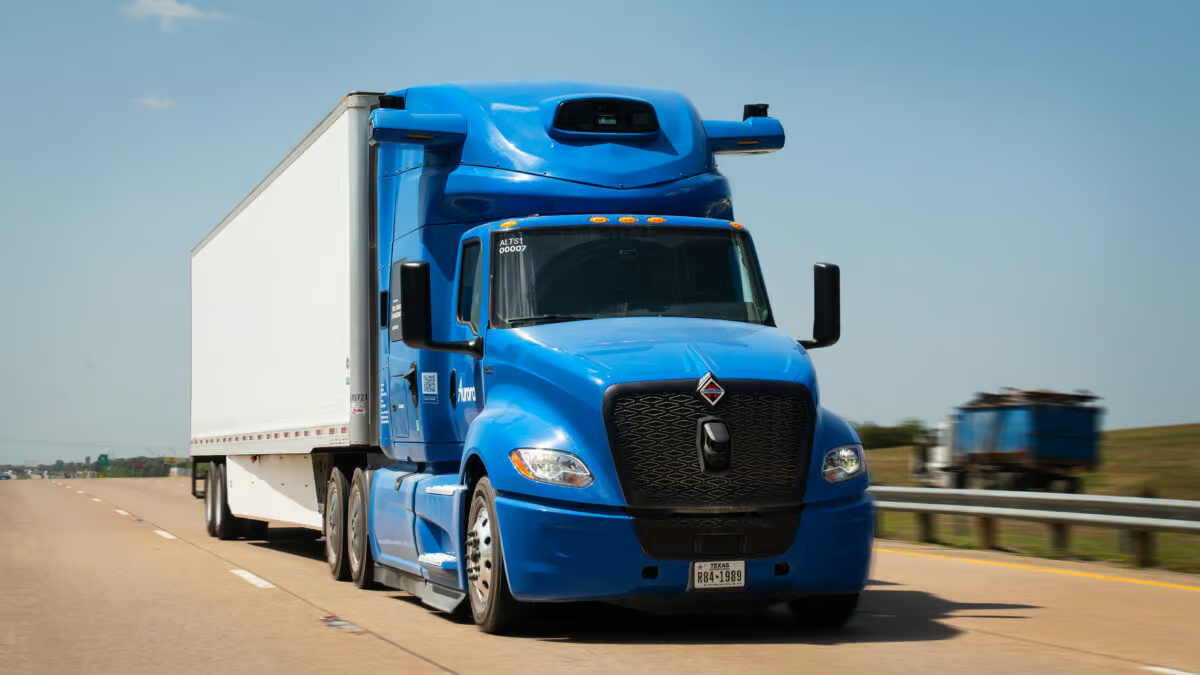
Autonomous freight is also moving from Sun Belt pilots toward commercial-scale operations, according to the report. Heavy-duty autonomous trucks entered commercial freight service in 2025, with broader rollouts across more routes and regions expected by the end of 2026.
The report’s diesel findings reflect both the pressure of the freight recession and the continued role of efficiency. New Class 8 tractor registrations declined 16% in 2025, while more than one-third of survey respondents reported using efficiency technologies. The report notes that leading heavy-duty adopters in logistics are achieving more than 8.5 mpg, while best-in-class operations are reaching 11.5 mpg or higher.
Renewable diesel and biodiesel are also scaling as drop-in fuels. The report finds that the two fuels replaced 74% of conventional diesel used in California transportation in 2024 and 71% in the first three quarters of 2025. More than half of annual fleet survey respondents now report using renewable diesel or biodiesel.
Natural gas vehicles remain part of the diversified fleet strategy. The report highlights the Cummins X15N 15-liter natural gas engine, which completed its first full year of commercial availability in 2025 and delivered diesel-equivalent performance, range, and payload capacity with fuel cost savings. Renewable natural gas accounted for 97% of all natural gas fuel used in California transportation in 2025, while 65% of surveyed fleets using natural gas vehicles report RNG use.
Propane vehicles also continued to grow, with the propane vehicle fleet increasing 3.1% in 2025. The report finds that 39% of propane fleet operators reported operational cost savings compared with the vehicles they replaced, while renewable propane use rose to 32% of propane-using fleets in 2025, up from 10% in 2023.
Battery-electric vehicle adoption continued to advance in segments where duty cycles and infrastructure align. Medium- and heavy-duty BEV registrations increased in 2025, led by pickup trucks and delivery vans that set a new record in the medium-duty segment. Fleets operating medium-duty BEVs and heavy-duty electric yard tractors reported total cost of ownership benefits compared with the vehicles they replaced.
Hydrogen faced a more difficult year. The report notes that hydrogen fuel cell electric vehicle registrations dropped 12% in 2025, while the cancellation of much of the Hydrogen Hub funding removed a key development resource and two prominent Class 8 fuel cell electric vehicle manufacturers exited the market. Even so, the report says real-world deployments continue to show hydrogen’s fit for long-haul, heavy-payload duty cycles, with some deployments achieving more than 400 miles per day and faster refueling times than EVs.
“Volvo Trucks has been clear and consistent in our commitment towards zero emissions,” said Peter Voorhoeve, president of Volvo Trucks North America. “We continue to invest across a broad range of technologies because we believe meaningful progress requires more than a single solution.”
For fleets navigating a freight recession, shifting policy landscape, and rapidly evolving technology market, the Market Brief’s message is that resilience will come from flexibility. Rather than waiting for one dominant solution, the report finds that fleets are increasingly matching technologies to the applications where they deliver the strongest operational and economic fit.