
Small and medium-sized business fleets may represent one of the biggest untapped opportunities for accelerating transportation electrification, according to a new national study released by Mitra EV. The DOE-funded research finds that while SMB fleets account for roughly 99% of U.S. fleet operators, they remain largely overlooked in current EV policy and deployment strategies.
Released by Mitra EV and funded in part by the U.S. Department of Energy, the report, Small Fleets, Big Impact: A National Study of EV Adoption, examines how small and medium-sized business (SMB) fleets view electrification and what is preventing broader adoption. The research combines nearly 300 survey responses with in-depth interviews conducted with fleet operators in California, Colorado, Georgia, and Ohio.
The study highlights a critical gap in the current electrification strategy. SMB fleets represent about 99% of U.S. fleet operators, yet most public policy and industry focus has centered on large corporate or public-sector fleets. According to the research, commercial EV adoption nationwide remains around 2%, driven largely by large fleets, while adoption among small fleets is likely significantly lower.
Researchers found that awareness, not ideology, is the primary factor slowing adoption. Only 26% of SMB fleet managers say they feel knowledgeable about electric vehicles (EVs), even though many electric pickups and vans are already cost-competitive on a total cost of ownership basis.
“Pickups and vans are market-ready, charging is straightforward, and most fleets operate at this scale,” said James Tong, co-founder and chief strategy officer of Mitra EV. “Start here, and electrification moves faster.”
The findings show that once fleets begin using EVs, adoption tends to accelerate. Among operators who describe themselves as extremely knowledgeable about EVs, 93% have already adopted or seriously considered electrification.
The study also found that EV adoption among small fleets is politically balanced, with adopters nearly evenly split between conservative and liberal respondents.
Instead, the research identified several operational and practical barriers that continue to slow adoption.
Nearly half of SMB fleet operators say EVs carry higher upfront costs than conventional vehicles, and installing charging infrastructure can require complex permitting processes and costly electrical upgrades. Only 10% of respondents described charging installation as inexpensive or straightforward.
Vehicle availability also remains a concern. Only about one-third of survey respondents said they were satisfied with the size, hauling capability, or range of current commercial EV offerings. Range anxiety remains significant, with fewer than 30% of fleets confident that electric vehicles could complete daily routes without mid-shift charging. Despite those concerns, the research suggests electrification could scale quickly if the initial adoption hurdle is lowered.
Cost savings remain the most important motivator for fleets. Forty-four percent of respondents believe EVs can reduce long-term operating costs through lower fuel and maintenance expenses.
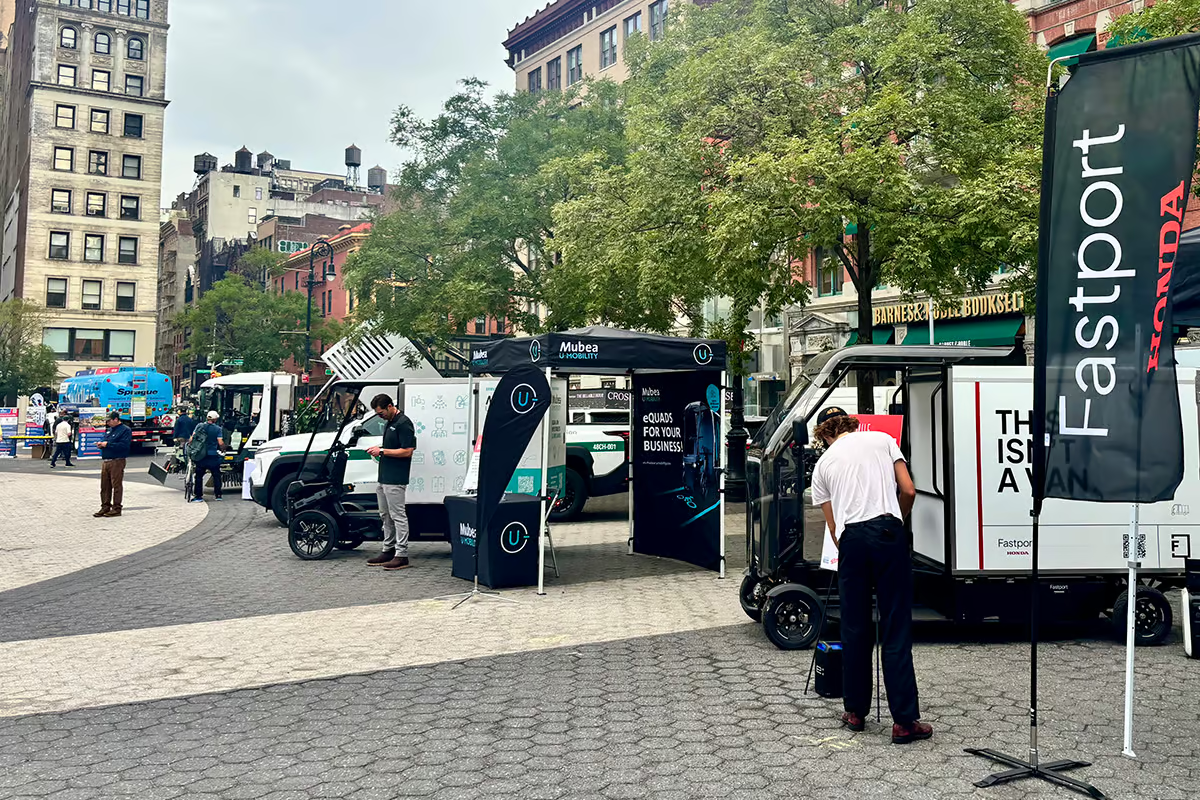
The report recommends prioritizing smaller commercial vehicles, particularly pickups and vans, as the entry point for electrification. These vehicles are widely used by small fleets and require less complex charging infrastructure than heavier trucks.
Researchers also suggest that incentive programs should focus on reducing complexity rather than simply increasing subsidy levels. For many small fleets, navigating vehicle procurement, charging installation, and available incentives is often more challenging than the upfront cost itself.
The study recommends expanding turnkey electrification services, investing in shared charging hubs that multiple fleets can access, and strengthening the role of dealerships as trusted sources of EV information and procurement. Dealerships already handle about 80% of vehicle purchases and serve as a primary information source for 62% of SMB fleet operators.
“These findings extend beyond small business fleets,” said Cynthia Maves, board vice president of Clean Fuels Ohio. “They offer practical guidance for policymakers, utilities, and market participants seeking to accelerate electrification in a cost-effective way.”
Researchers conclude that lowering the barrier to a fleet’s first EV purchase may be the most effective strategy for scaling adoption. Once fleets deploy their initial vehicles and charging infrastructure, electrification often accelerates with far less public support as private investment follows.