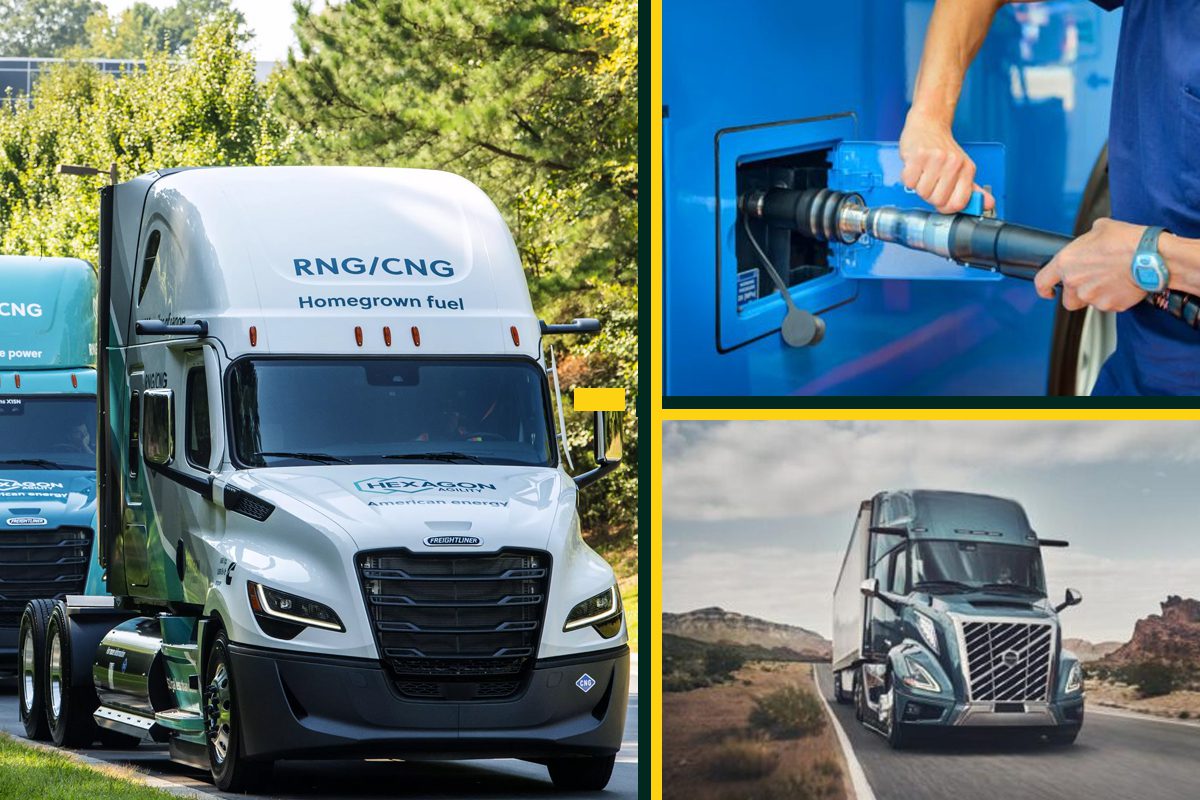
As fleets navigate the complex transition toward lower-emission freight operations, renewable natural gas (RNG) is increasingly being evaluated as a practical near-term solution. This was a central theme of the first two webinars in a three-part Renewables Academy series hosted by State of Sustainable Fleets, which brought together fleet operators, fuel providers, and industry experts to discuss the economics, operations, and environmental impacts of RNG-powered trucking.
The series opened with a discussion focused on the cost, operational, and sustainability benefits of renewable natural gas. The webinar featured speakers from Love’s Alternative Energy and Paper Transport, a Midwest-based freight fleet with years of experience operating natural gas trucks.
For fleets already familiar with compressed natural gas (CNG), RNG can be deployed without significant operational changes.
“Renewable natural gas is a chemically identical drop-in to compressed natural gas,” said Marc Rowe, director of sales at Love’s Alternative Energy, emphasizing that fleets using CNG trucks can use RNG with the same vehicles and infrastructure.
That compatibility has made RNG an attractive option for fleets looking to lower emissions without fundamentally changing vehicle platforms or fueling systems.
Speakers also highlighted the environmental advantage of RNG, which is often produced by capturing methane from agricultural waste, landfills, or other organic sources. If that methane were not captured, it would otherwise escape directly into the atmosphere.
“We’re using common manure to power trucks. You capture that methane and you use it,” said Jared Stedl, chief commercial officer of Paper Transport, adding that once captured and processed, the methane becomes pipeline-quality natural gas that can be used in vehicles.
Because RNG production captures emissions that would otherwise enter the atmosphere, the lifecycle carbon intensity of the fuel can be extremely low, in some regulatory frameworks even falling below zero.
Beyond environmental benefits, the webinar also examined how fleets and shippers track and account for RNG usage. In many cases, fleets rely on fuel providers to verify the origin of the fuel and document emissions reductions for customers.
“We use our fuel providers to confirm…that the source is a renewable natural gas source,” explained Stedl, noting that fleets often pass those verified emissions reductions through to shippers as part of sustainability reporting.
For some fleets, RNG adoption has also been a long-term operational strategy. Stedl noted his company has been operating natural gas trucks for more than a decade.
The second webinar in the series shifted the focus from fuel supply and sustainability accounting to the operational performance of the latest natural gas truck technology, particularly Cummins’ new 15-liter natural gas engine designed for heavy-duty freight.
The session brought together representatives from fleets including Gazelle Transportation and Certarus, alongside technology partners from Cummins and Hexagon Agility, to discuss how the platform is performing in real-world trucking applications.
Historically, natural gas engines were more commonly deployed in transit and refuse fleets, where centralized fueling and shorter routes made them easier to integrate. But speakers noted that the latest engine platform was designed specifically to expand natural gas into long-haul freight operations.
“This new engine basically was designed from the get-go to mimic diesel power and numbers,” said Patrick Campbell, business development sales manager, Alternative Power, Cummins, adding that the performance profile was intentionally engineered to match diesel engines as closely as possible. “The horsepower and torque curves lay over the top of the diesel curves, so there’s almost no difference in power or feel.”
Fleet operators participating in the webinar reported that the latest generation of natural gas trucks is meeting expectations in real-world operations.
“From a performance perspective, the 15-liter has been a game changer performance wise,” said Ron Lallo, CEO, Gazelle Transportation, highlighting the torque and horsepower improvements, as well as increased engine braking power, which was echoed by Ian MacDonald, senior vice president of sales, Hexagon Agility.
“The feedback for the X 15 N has been overwhelmingly positive,” said MacDonald, adding that the significantly improved engine braking has been a real benefit for fleets that move in mountainous regions. “We’ve also got customers that haul much heavier weights and the 12-liter just wasn’t an option for them. We’ve got a lot of fleets that…are pretty excited to get into natural gas now and haul those heavier weights, and that’s been exciting for us.”
Beyond performance, speakers also emphasized that the engines share significant mechanical commonality with diesel platforms, which can simplify maintenance and service for fleets already familiar with conventional truck systems.
“Eighty percent of the engine is diesel. All the parts are the same as a diesel engine,” pointed out Campbell.
Across the discussion, speakers emphasized that the combination of RNG fuel and higher-power natural gas engines is expanding the range of applications where fleets can consider the technology, from regional freight to some long-haul operations.
“I don’t see us ordering a lot of diesel trucks moving forward for our fleet,” said Dan Messina, vice president of growth and strategy at Certarus. “As we are looking for replacements for the for the diesel engines, I think we’ll be looking to really route everything over to the 15-liter natural gas engine moving forward.”
For fleets evaluating decarbonization strategies today, participants suggested the technology offers a pathway to reduce lifecycle emissions while maintaining familiar vehicle performance and operations. Across both webinars, a consistent theme emerged: Fleets are evaluating RNG not just as a compliance strategy, but as part of a broader operational and economic decision framework.
The final session in the three-part series, scheduled for next week, will examine drop-in renewable fuels for diesel vehicles and how they fit alongside technologies such as RNG in the evolving fleet decarbonization landscape.