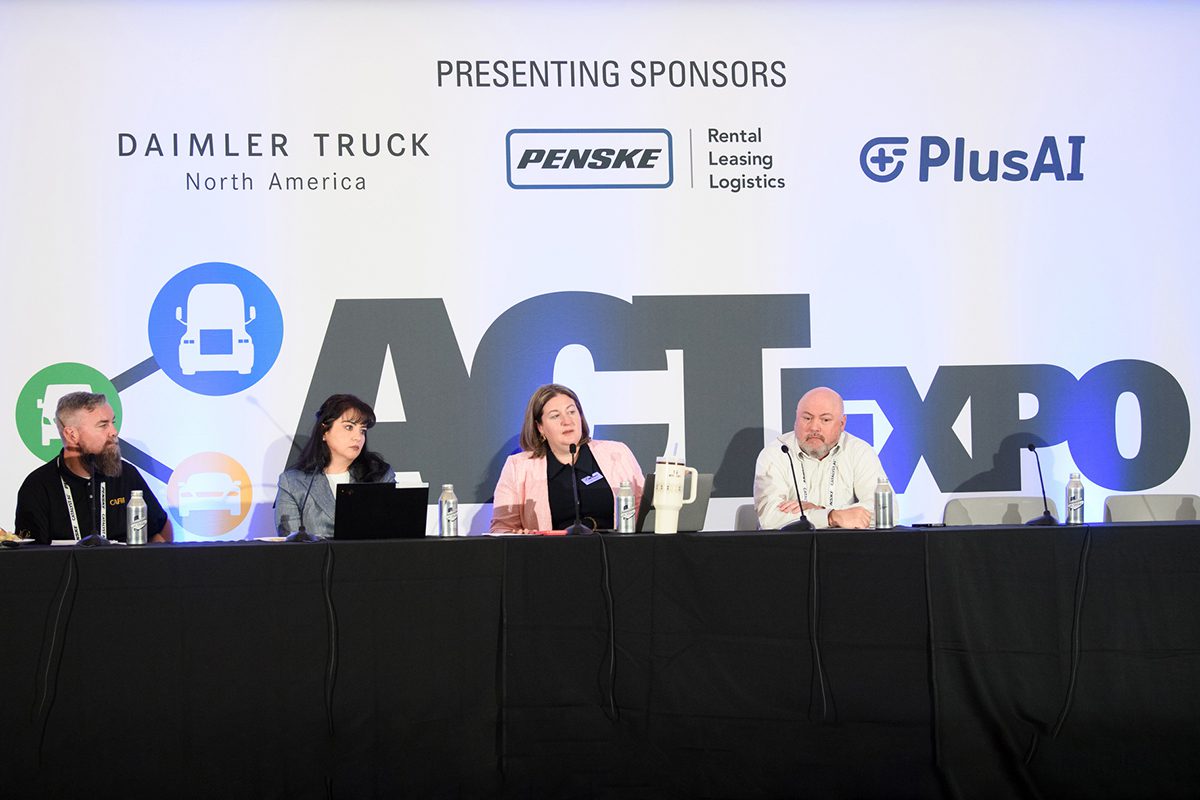
At ACT Expo 2026, a workshop hosted in partnership with NAFA and MEMA sparked one of the event’s most practical and forward-looking conversations: what would it take to create a true “Greenbook” standard for public fleet procurement?
The discussion brought together public fleets, manufacturers, dealers, suppliers, upfitters, and procurement leaders to tackle a growing challenge across the transportation industry: fragmented procurement requirements that increase costs, slow deployment timelines, and make it harder for agencies and suppliers alike to scale clean transportation solutions.
The concept draws inspiration from the original “Greenbook” created for public works construction projects in the 1960s—a standardized framework that helped reduce disputes, improve consistency, and streamline procurement processes across agencies and regions. Participants at ACT Expo explored whether a similar model could now help modernize fleet procurement, particularly as agencies navigate electrification, advanced vehicle technologies, infrastructure deployment, and increasingly complex operational requirements.
“Everybody wants customization, but customization at scale becomes incredibly difficult,” noted one participant during the workshop. “What we heard consistently is that agencies and suppliers both want more predictability.”
Throughout the session, attendees repeatedly emphasized the need for clearer, more transparent demand signals from the public sector. Manufacturers shared that uncertainty around purchasing volumes, inconsistent specifications, and varying regional requirements often make it difficult to justify investment in production, service infrastructure, and workforce development.
“If OEMs knew there were 10,000 vehicles annually moving toward a common standard, that changes the economics completely,” one manufacturer representative explained during the report-out discussion.
The workshop was structured around four major discussion areas:
- What a “bid-ready” Greenbook framework would require
- What level of demand aggregation unlocks supplier participation
- Which vehicle platforms are best suited for standardization first
- The biggest barriers preventing implementation at scale
Several themes emerged consistently across breakout groups.
Standardization With Flexibility
Participants were careful to distinguish standardization from rigidity. The goal is not to eliminate agency flexibility, but rather to establish a consistent baseline framework that suppliers can efficiently respond to while still allowing customization where operationally necessary.
Attendees discussed the need for standardized terminology, common vehicle classifications, consistent safety requirements, and baseline procurement language that could dramatically reduce inefficiencies in today’s bid processes.
Many agencies acknowledged that procurement teams are often navigating electrification and advanced vehicle technologies without standardized guidance or shared frameworks.
“City attorneys would love if we had a standard set,” one attendee remarked, referencing the growing complexity of fleet procurement requirements.
Transparency From Manufacturers and Suppliers
One of the strongest calls from fleet operators centered on pricing and configuration transparency.
Participants proposed a “Greenbook-style” procurement structure where OEMs would provide:
- Base vehicle configurations
- Standardized option lists
- Clear add-on pricing
- Volume discount structures
- Delivery timing assumptions
- Service support expectations
Fleets noted that too much time is currently spent in back-and-forth clarification between agencies, manufacturers, dealers, and upfitters.
“There’s a lot of friction that could be removed simply through more upfront transparency,” said one municipal fleet participant.
Suppliers, meanwhile, emphasized the importance of agencies providing clearer operational requirements earlier in the process, particularly around terrain, range expectations, payloads, charging assumptions, and service timelines.
Focus on Realistic, Scalable Vehicle Segments
The discussion also highlighted where standardization efforts may be most practical initially.
Vehicle categories repeatedly identified as strong candidates included:
- Pickup trucks
- Class 2b utility vehicles
- F250/F350/F550 platforms
- Class 5 and 6 service trucks
- Medium-duty vocational applications
Participants acknowledged that highly specialized vehicle applications may remain difficult to standardize broadly, but many common-use municipal and utility platforms appear well positioned for alignment.
“There was a lot of agreement that we should start where the market already has some convergence,” noted workshop leaders.
Demand Aggregation Could Be a Game Changer
Another major theme was aggregated purchasing power.
Manufacturers stressed that regional or national demand visibility could help accelerate:
- Product development
- Production planning
- Service network expansion
- Technician workforce investments
- Inventory availability
At the same time, agencies emphasized the need for cooperative procurement structures that preserve flexibility while helping unlock economies of scale.
Participants also raised concerns around unrealistic expectations in some procurements.
“One takeaway was that fleets and suppliers both need to compromise a little more and stop chasing unicorn solutions,” one attendee summarized during the report-out session.
ACT Expo as a Year-Round Collaboration Platform
Perhaps the clearest outcome from the workshop was the desire to continue the effort beyond a single conference session.
Attendees called for:
- Ongoing working groups
- Regional procurement collaboration
- Additional ACT Expo workshops
- Expanded engagement with procurement officials
- More agency/OEM alignment discussions
- Continued partnership with organizations like NAFA and MEMA
“Have more of these,” one participant said during closing remarks. “ACT has a platform—it can be used to advance this work year-round.”
As public fleets continue balancing operational realities, budget pressures, electrification mandates, and rapidly evolving technologies, the conversation around a Greenbook for Fleets may prove to be one of the most important long-term initiatives emerging from ACT Expo 2026.
The challenge now shifts from discussion to implementation. But based on the energy in the room, industry stakeholders appear increasingly aligned around one central idea: creating a more transparent, scalable, and standardized procurement ecosystem could benefit everyone involved—from fleets and procurement officers to manufacturers, suppliers, and ultimately taxpayers themselves.