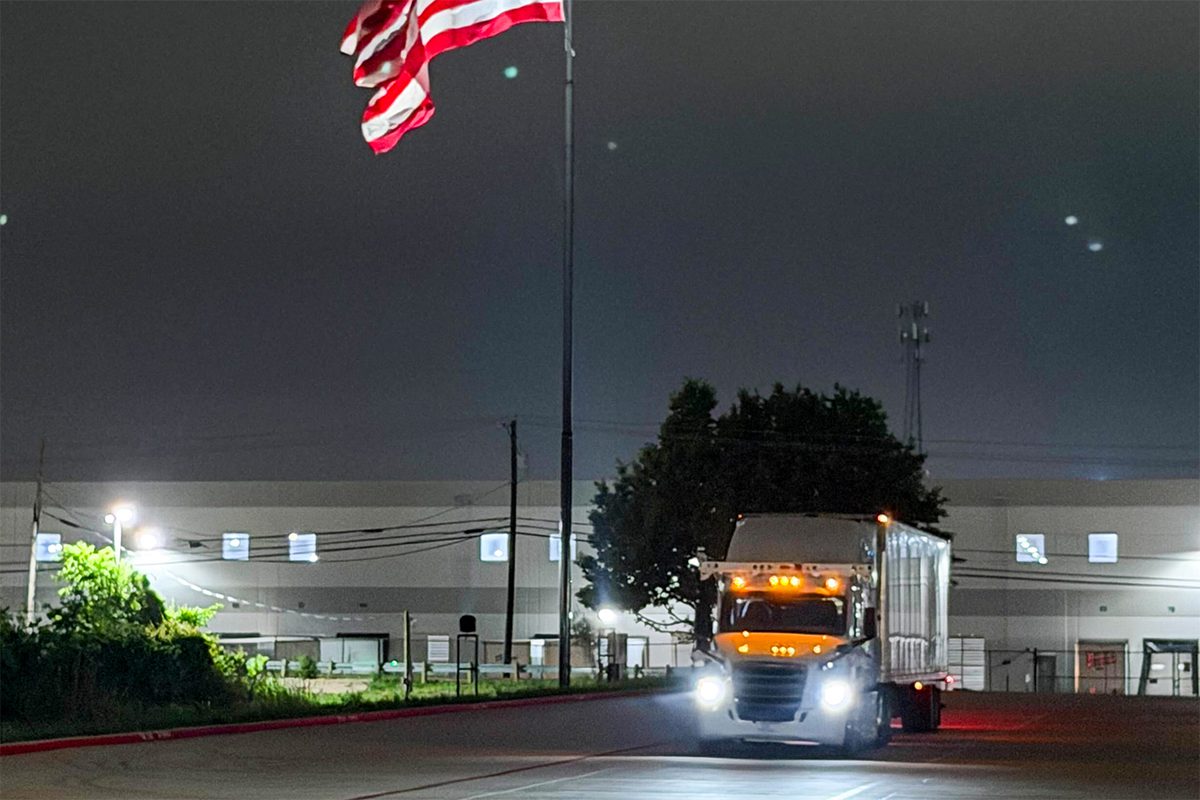
Bot Auto recently announced it will staff the remote assistant function across its autonomous trucking operations exclusively with personnel based in the U.S., a commitment the Houston company framed around communication with first responders and law enforcement.
The company was specific about what the role is not. Remote assistants do not perform any dynamic driving task, and the vehicle operates autonomously at all times. Their function is communication and coordination, including direct contact with first responders and law enforcement in the field, along with a limited set of vehicle functions used to assist an incident response.
Assistants working from its mission control already confirm vehicle status, provide cargo and routing information, remotely actuate functions such as hazard lights, and can facilitate a vehicle shutdown at an officer’s direction. According to the company, keeping the function onshore delivers consistent language fluency, familiarity with U.S. traffic laws and emergency protocol, and reliable connectivity.
The commitment lands against a Texas requirement that took effect this year. Since May 28, 2026, an operator running automated vehicles on Texas roads must hold authorization from the Texas Department of Motor Vehicles, and one condition of that authorization is that the Texas Department of Public Safety has been given a copy of a plan specifying how firefighting, law enforcement, ambulance, medical, and other emergency services should interact with the vehicle.
Captain (ret.) Bart Teeter, director of fleet and operational safety at Bot Auto, described the job in those terms. “Our remote assistants aren’t driving the truck, but they are the voice on the other end of the line when an officer needs one,” he said.
“Miscommunication or poor connections can potentially cost valuable time in addressing emergency conditions,” said Major Omar Villarreal of the Texas Department of Public Safety. “Autonomous vehicle operators committing to U.S.-based remote assistants convey that they are committed to their responsibility in engaging first responders by making effective communications a priority.”
Federal law does not currently require remote support staff to be located in the United States, though pending legislation would for a different category of worker. H.R. 8870, the BUILD America 250 Act, would require any remote or fallback driver to be qualified and licensed to operate a commercial motor vehicle and physically located in the U.S., would count time spent monitoring an autonomous vehicle as driving time under hours-of-service rules, and would direct a rulemaking committee to recommend limits on how many autonomous commercial vehicles a single remote or fallback human may be responsible for. The House Transportation and Infrastructure Committee advanced the bill 62 to 2 on May 22. Whether provisions written for remote drivers would reach a role Bot Auto describes as non-driving is the distinction fleets and regulators will have to settle.