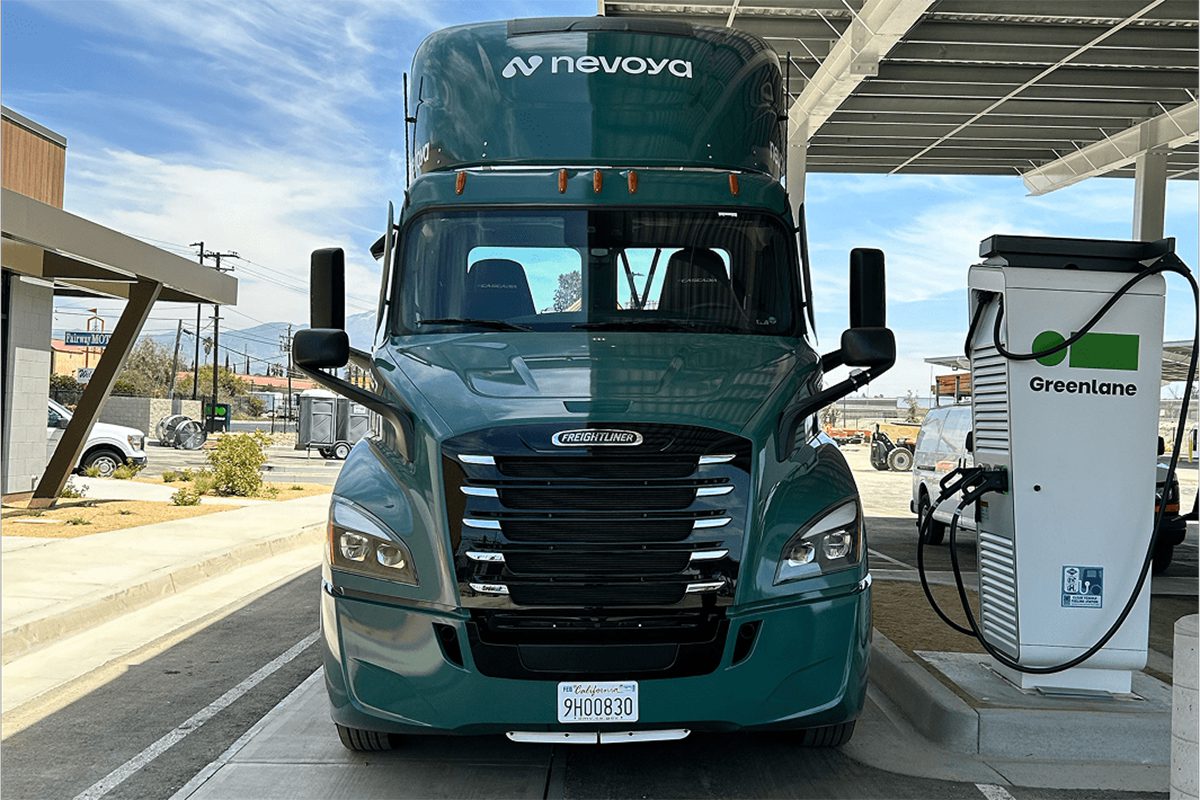
A new procurement model aimed at accelerating zero-emission freight is enabling what organizers say is the largest known deployment of Class 8 battery-electric trucks in Texas, with electric carrier Nevoya set to operate approximately 40 trucks on a Houston–Dallas corridor beginning in 2026.
The deployment is the result of the first-ever trucking procurement led by the Center for Green Market Activation (GMA) in partnership with Smart Freight Centre (SFC). The pilot brings together major corporate buyers, including Amazon, eBay, Etsy, Green Worldwide Shipping, and Meta, through a shared purchasing structure designed to unlock large-scale zero-emission trucking capacity.
Under the model, participating companies commit to multi-year offtake agreements for verified zero-emission trucking attributes. Those commitments enable Nevoya to deploy battery-electric Class 8 trucks at scale, even when the physical movement of freight is not directly tied to each buyer. The structure uses a book-and-claim system, allowing companies to claim greenhouse gas reductions associated with zero-emission trucking services while addressing geographic and operational constraints that have limited adoption to date.
According to GMA, the electric fleet is expected to travel up to 7 million miles annually, avoiding an estimated 60,000 metric tonnes of CO₂e while also reducing diesel pollution and noise along one of the country’s busiest freight corridors. All electricity used for charging will be matched with Green-e Renewable Energy Certificates, and emissions attributes will be independently verified and tracked through an accredited registry.
GMA CEO Kim Carnahan said the pilot demonstrates how early demand commitments can translate into real-world deployment of zero-emission trucks. The organization views the procurement as a repeatable model for scaling electric trucking in other regions and lanes.
Nevoya will operate the trucks using its AI-enabled logistics platform, which the company says is designed to optimize routing, utilization, and fleet performance. Nevoya CEO Sami Khan said the Dallas–Houston lane reflects a new phase of trucking that combines zero-emission vehicles with software-driven operations.