European truck manufacturers are pushing battery-electric vehicles farther into long-haul freight, with several new models unveiled around IAA Transportation 2026 offering more than 400 miles of maximum range and charging times designed around a driver’s break.
Volvo Trucks, MAN, Scania and DAF introduced or detailed new heavy-duty electric trucks with ranges from approximately 342 to 447 miles, while Mercedes-Benz Trucks expanded its eActros lineup with a 621-kilowatt-hour tractor designed for high-volume applications.
Across the launches, the direction is similar: more battery capacity, faster charging and vehicle configurations designed to preserve payload while extending the distance an electric truck can cover between charging stops.
The announcements were focused primarily on European markets, but the underlying challenges are familiar to North American fleets evaluating electric trucks: range under load, charging time, payload, infrastructure availability and total cost of ownership.
Volvo Trucks has started series production of its latest heavy-duty electric trucks, including the Volvo FH Aero Electric with Extended Range, which is rated for up to 700 kilometers (435 miles) on a charge. The truck uses a new e-axle that creates additional space for battery capacity and supports megawatt charging. Volvo also introduced a configuration for heavier combinations with 640 kilowatt-hours of usable energy.
At 64 metric tons, Volvo rates that version for up to 450 kilometers (280 miles). Using a 680-kilowatt megawatt charger, the battery can go from 20% to 80% in approximately 36 minutes, compared with roughly 70 minutes on a 360-kilowatt CCS2 charger.
“We are now turning groundbreaking technology into industrial reality,” said Roger Alm, president of Volvo Trucks. “Starting series production of our new electric trucks is a clear proof of our commitment to lead the transformation to more sustainable truck transport.”
MAN is also pushing beyond the 400-mile mark. The latest eTGX is rated for up to 660 kilometers (410 miles) as a 4×2 tractor and as much as 720 kilometers (447 miles) in a 6×2 configuration equipped with a seventh battery pack.
Its newest battery generation provides 10% more usable energy and a 3% improvement in efficiency. MAN began producing trucks equipped for megawatt charging in July and reports that the system can take a battery from 20% to 80% in about 30 minutes.
MAN is pairing the vehicles with charging infrastructure investment, adding 50 locations to its Charge&Go network in the Czech Republic, Slovakia, Hungary and Portugal.
The manufacturer is also putting more emphasis on the business case. Its “Beyond Diesel” analysis estimates an electric truck could provide a total cost advantage of as much as 13% over diesel after five years when combined with managed charging, onsite solar generation and battery storage.
Scania reached a similar 720-kilometer (447-mile) maximum range by changing where the batteries are located. The manufacturer added battery packs behind the cab to supplement chassis-mounted packs. Two additional packs provide approximately 356 kilowatt-hours of installed capacity.
“Electric trucks are already part of the transport system, but long-haul operations place very different demands on range, payload and charging,” said Lars Gustafsson, senior vice president and head of solutions management at Scania. “With this solution, Scania is showing how those pieces can come together in a practical way for customers who want to electrify demanding long-distance routes.”
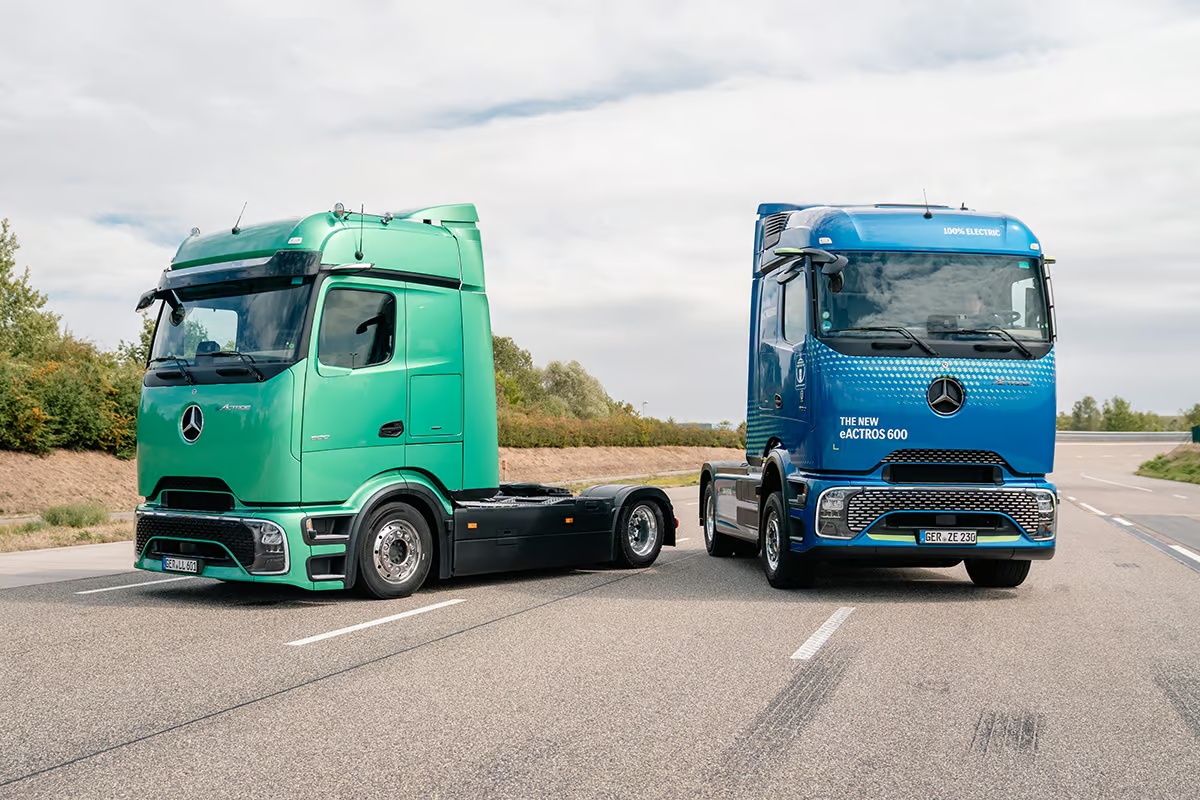
Mercedes-Benz Trucks took a different approach with its eActros Lowliner, a lower-chassis tractor intended for high-volume transport.
The eActros 600 Lowliner carries three lithium iron phosphate battery packs totaling 621 kilowatt-hours and is rated for approximately 500 kilometers (311 miles) at full payload, increasing to 560 kilometers (348 miles) under optimal conditions.
Megawatt charging is scheduled for the second half of 2027. Mercedes-Benz Trucks plans to offer charging at up to 1,000 kilowatts on the three-pack model, which would reduce a 10% to 80% charge to approximately 29 minutes.
The product push comes as European truck manufacturers face increasingly stringent CO2 requirements.
European regulations target a 43% reduction in CO2 emissions from new heavy-duty commercial vehicles by 2030 compared with 2019 levels.
Daimler Truck estimates that meeting the target would require battery-electric and hydrogen trucks to account for approximately 35% of new European truck registrations by 2030. Battery-electric trucks represented approximately 2% of the European heavy-duty market in 2025. Daimler also estimated that every percentage point it falls short of its regulatory target could carry approximately 120 million euros in penalties.
Battery-electric technology was not the only alternative powertrain highlighted around IAA.
Daimler Truck gave the Mercedes-Benz NextGenH2 Truck its public debut. The liquid-hydrogen fuel cell tractor is designed for more than 1,000 kilometers (621 miles) between refueling stops.
A 100-truck small series is scheduled to begin production at the end of 2026, with logistics provider Dachser receiving the first vehicle.