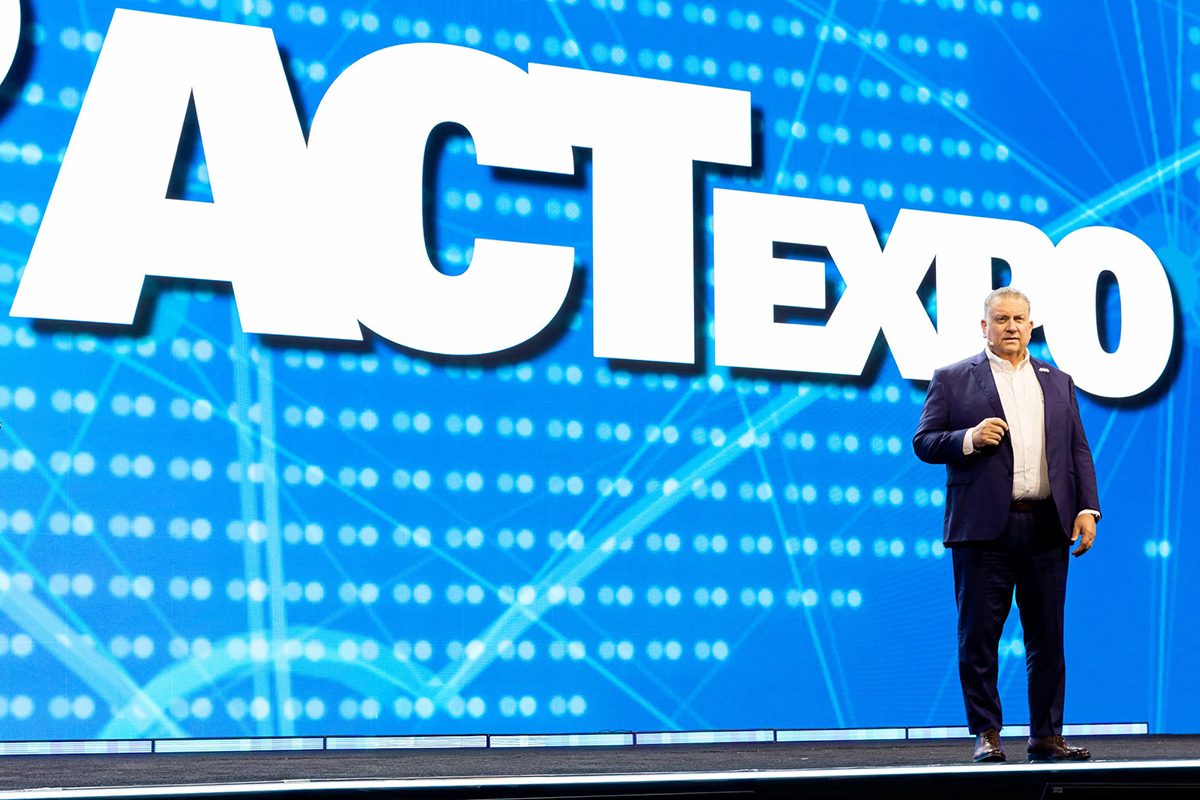
ACT Expo 2026 opened with a strong focus on the realities facing fleets as they work to balance sustainability, technology adoption, safety, and profitability. In his mainstage keynote address, FedEx Freight incoming CEO John Smith delivered a clear message to the industry: clean transportation progress depends not on promises, but on practical, scalable solutions that work inside real freight networks.
Smith, who is set to lead FedEx Freight when it becomes a standalone independent company on June 1, said the less-than-truckload sector is entering one of the most significant periods of change in decades. Technology, sustainability goals, customer demands, and cost pressures are all shifting at once, he said, while LTL networks remain large, complex, and capital intensive.
For Smith, the path forward begins with a basic operating principle.
“Sustainability is only sustainable if it makes business sense,” he said. “You can only make a difference if you stay in business.”
Smith said sustainability has moved from a “nice to have” to a core requirement for the LTL industry, but carriers must focus on technologies that match the operational demands of freight. FedEx Freight is not waiting for a single breakthrough solution, he said. Instead, the company is moving forward with a technology roadmap that includes CNG powered by renewable natural gas, targeted electric vehicle deployments, electric forklifts, electric hostlers, and continued evaluation of hydrogen fuel cells, hybrids, and other emerging technologies.
“As we speak now in the near term at FedEx Freight, we’re leaning heavily into CNG,” Smith said. “From our perspective, it is a ready-now solution that fits the rigors of our duty cycles.”
Electric vehicles are also beginning to find a place in the company’s operations, particularly in local pickup and delivery applications where range is predictable and charging can be more consistent. But Smith said electric equipment currently makes the most sense at FedEx Freight service centers, where the company is investing in electric forklifts and hostlers.
“Put it simply, from a fleet operator’s perspective, we need these new technologies to be just another truck, another tool that easily fits in our network,” Smith said.
Smith also made clear that fleet sustainability does not begin and end with new powertrains. FedEx Freight is pursuing near-term emissions reductions through operational improvements, including aerodynamic upgrades, low rolling resistance tires, advanced powertrains, and a “right truck, right route” strategy that matches equipment to duty cycles.
The company’s hub-and-spoke model, rail integration, and network optimization are also playing major roles. Smith said rail can cut emissions by up to 75% per ton-mile for long-haul freight, while dimensional planning has allowed FedEx Freight to improve how it fills trailers. The company’s dimensioning technology captures more than 90% of shipment dimensions in real time, helping increase cube utilization by 12% over the past year.
FedEx Freight has also been reshaping its physical network. Since 2023, the company has consolidated 39 service centers, removed 1,000 doors, and added nine new locations with 600 doors in strategic freight markets. During the past five years, Smith said FedEx Freight has removed 187 million linehaul miles from its network by design, equal to about a 5% reduction in total linehaul miles over that period.
Looking ahead, Smith said technology will be central to FedEx Freight’s next phase as a standalone company. Artificial intelligence and predictive analytics are already changing how freight networks are managed, shifting the industry from backward-looking reports to real-time decision-making.
“AI is transforming freight, shifting it from historical reporting to real-time visibility,” Smith said. “It allows you to be like a quarterback who can anticipate almost every blitz.”
FedEx Freight is using predictive analytics to improve demand forecasting, dock labor planning, linehaul scheduling, trailer allocation, and asset deployment. Smith said the company is also working with OEMs to use fault-code data to identify potential breakdowns before they happen and evaluating trailer-tracking technology that could support mileage-based maintenance rather than traditional time-based preventive maintenance.
Safety, Smith said, remains the company’s top priority. FedEx Freight has invested in cameras and driver assistance systems including active brake assist, blind spot monitoring, electronic mirror technology, rollover stability, collision avoidance, and soon, active lane assist. Those investments, combined with the company’s safety culture, have helped reduce accidents by 30% over the past five years.
“These safety systems use a combination of camera and radar for enhanced object recognition and braking capabilities far beyond what was ever imagined,” Smith said.
Smith closed by calling for broader collaboration across the freight ecosystem. OEMs, he said, must continue developing alternative-fuel equipment that matches diesel durability, payload efficiency, and aftersales support. Utilities must reinforce the grid to support fleet charging. Policymakers must provide targeted incentives and more consistent long-term rules.
“A carrier cannot build a sustainable ecosystem alone,” Smith said. “We are only one gear in a massive machine, and for that machine to turn, everybody must play their part.”
As FedEx Freight prepares to enter a new chapter as an independent company, Smith said the future of LTL will be shaped by electrification, alternative fuels, automation, AI, and changing customer expectations. But he emphasized that progress must be grounded in data, discipline, and economic reality.
“The path to a sustainable LTL industry isn’t paved with grand promises,” Smith said. “It’s paved with smart, data-driven decisions and innovative collaboration by all.”