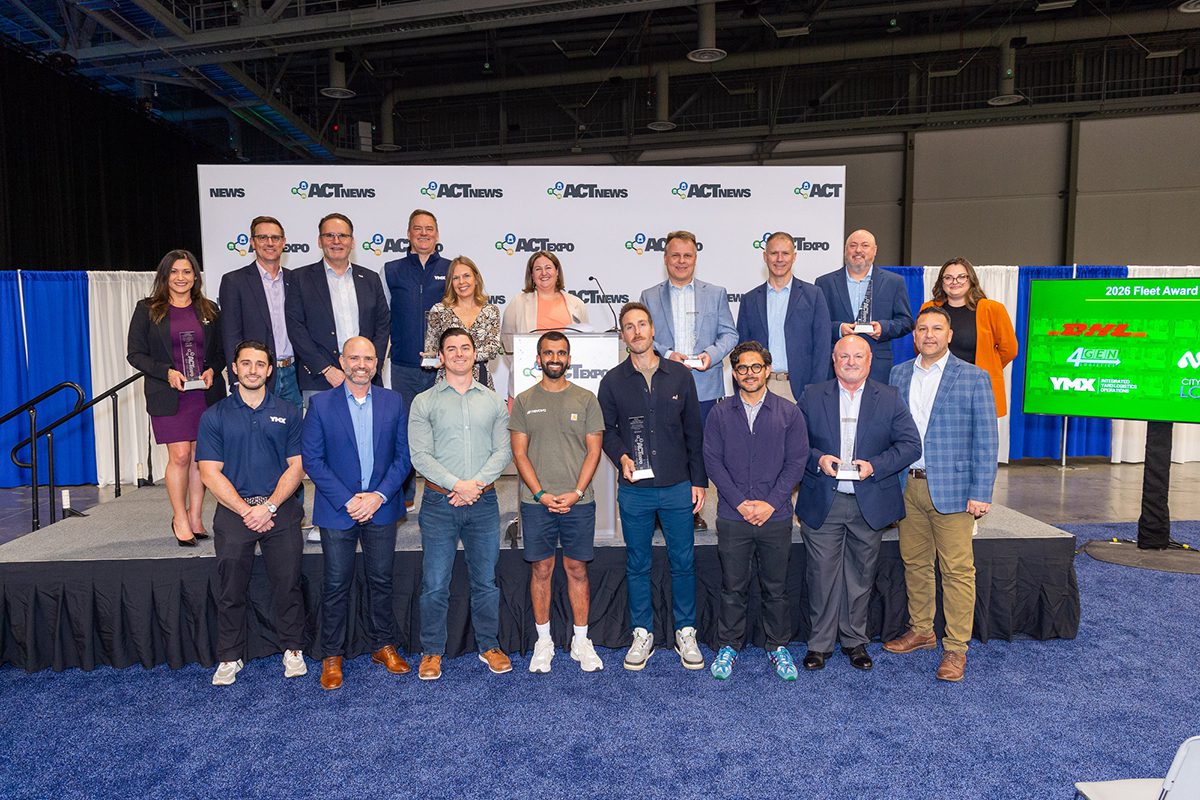
The ACT Expo Fleet Awards have long recognized fleets that are not only adopting cleaner transportation technologies, but also demonstrating how those technologies can be deployed at scale across real-world operations. The 2026 winners reflect that continued momentum, with honorees spanning global logistics, municipal operations, drayage, yard management, and digital fleet orchestration. Together, they show how sustainability strategies are evolving beyond pilots and into core business and public service operations.
This year’s winners represent a wide cross-section of the commercial transportation ecosystem, but each has advanced a clear vision for lowering emissions while maintaining performance, reliability, and operational readiness. From large-scale vehicle deployments and charging buildouts to software-driven optimization and long-term alternative fuel planning, the 2026 awardees underscore the growing maturity of the clean fleet transition.
Leading Global Fleet – DHL
DHL earned recognition as the 2026 Leading Global Fleet winner for its broad and highly visible commitment to decarbonizing logistics across its global operations. With a presence in more than 220 countries and a fleet that includes more than 50,000 electric vehicles, DHL has positioned sustainable transport as a central part of its long-term strategy. The company’s 2030 target of reaching 66% EVs in last mile delivery signals the scale of its ambition.
The company’s efforts extend beyond fleet counts. DHL Supply Chain adopted a global Green Transport Policy designed to reduce road transport greenhouse gas emissions in line with the company’s aspiration to be the Green Logistics of Choice. The policy mandates the most feasible sustainable alternative in key markets, including renewable diesel, renewable natural gas, electric and hydrogen-powered vehicles depending on factors such as availability, infrastructure, and cost.
In North America, DHL Supply Chain currently operates more than 150 heavy‑duty electric vehicles (EVs) across 15 U.S. states and Canada, deployed in 80 locations serving 50 customers, with plans for continued large-scale rollouts in the upcoming years.
Leading Public Fleet – City of Carson
The City of Carson was named the 2026 Leading Public Fleet winner for its rapid and deliberate expansion of fleet electrification across municipal operations. In just a few years, the city has grown its electric vehicle fleet from seven units to more than 43, including work-ready models such as Ford F-150 Lightnings, Chevrolet Blazer EVs, and Chevrolet Equinox EVs. The city has also begun deploying battery-electric buses, extending its electrification efforts into larger vehicle classes.
What distinguishes Carson’s approach is that vehicle deployment has been paired with an equally aggressive investment in charging access. The city has installed more than 160 public EV charging ports at civic facilities, parks, and other municipal sites, creating infrastructure that supports both fleet operations and the wider community. Carson has also secured support through Clean Power Alliance programs, including funding to help replace gas-powered fleet vehicles and an EV Charging Wallet pilot program aimed at helping residents without easy home charging access.
Leading Private Fleet – 4 GEN Logistics
4 GEN Logistics received the 2026 Leading Private Fleet award for building what it describes as a fully zero-emission drayage operation in the greater Los Angeles area. The fleet currently operates 79 zero-emission trucks, including 64 battery-electric vehicles and 15 hydrogen fuel cell electric trucks, and reached its goal of becoming a completely ZEV fleet by the end of 2025.
The company’s progress is notable not only for the size of its deployment, but also for the operational commitment behind it. According to the award submission, 4 GEN displaced more than 400,000 gallons of diesel in 2025 and its ZEV fleet has logged more than 3 million miles. The company has also invested in charging infrastructure at two facilities and is in the process of expanding their BEV fleet in the next year. In an industry where many fleets are still balancing diesel with early-stage zero-emission deployments, 4 GEN stands out for making a full transition and signaling no intention to return to diesel operations.
Digital Technology Leader – Nevoya
Nevoya was recognized as the 2026 Digital Technology Leader for showing how software can help make electric trucking not just cleaner, but operationally competitive. The Los Angeles-based fleet operates 40 electric Class 8 trucks and has built its model around AI-driven orchestration tailored specifically to the demands of EV operations, including range management, charger availability, dwell time, and time-of-use pricing.
Rather than treating digitization as a back-office function, Nevoya has positioned software as a core fleet performance engine. The company’s AI-powered transportation management approach is designed to improve routing, charging, visibility, and predictive decision-making in real time. According to the award materials, Nevoya has already demonstrated measurable outcomes, including hauling freight for 15+ Fortune 500 companies and reaching cost parity with diesel for comparable California service. Its model highlights how digital tools are increasingly becoming essential to scaling zero-emission freight.
Leading Off-Road Fleet – YMX Logistics
YMX Logistics earned the 2026 Leading Off-Road Fleet award for rapidly expanding an electric yard truck operation across large-scale logistics and manufacturing environments. The company, which specializes in enterprise yard operations, has grown its EV yard truck fleet by at least 100% this year. Its deployments are already active across California, Indiana, Illinois, Georgia, Texas, and Maryland.
Since beginning its electrification efforts in 2024, YMX has moved rapidly from early deployment to full production use. Rather than limiting deployments to pilot programs, the company has integrated electric terminal tractors into daily operations, where they are used to support demanding yard duty cycles and continuous throughput requirements.
In less structured yard environments, electric assets are often underutilized or constrained by reactive workflows, limiting their effectiveness regardless of equipment selection. In contrast, operations governed through a defined execution model are better positioned to maximize asset utilization, reduce idle time, and integrate charging requirements without disrupting service.
YMX’s approach reflects this shift. Its electric fleet is deployed as part of a broader operating framework that aligns fleet activity with labor planning, yard execution, and site-level performance metrics. This model enables more consistent throughput, improved asset efficiency, and a more predictable path to both cost and emissions reduction.
In It for the Long Haul – City of Long Beach
The City of Long Beach received the 2026 In It for the Long Haul award for its sustained, multi-technology approach to fleet decarbonization. Fleet Services manages a diverse fleet of more than 2,200 assets and has steadily built one of the more comprehensive municipal alternative fuel strategies in the country. Today, the city operates 300 Renewable Natural Gas Vehicles, 200 Renewable diesel vehicles and 200 EVs, with a long-term goal of transitioning the entire fleet to electrification where applicable over the next 10 years.
Long Beach’s strategy reflects the complexity of municipal operations. While electrification remains central, the city also relies on renewable diesel across all diesel applications, helping reduce lifecycle greenhouse gas emissions while maintaining readiness for heavy-duty and emergency-response use cases that are not yet ideal for full electrification. Sixty percent of all fuel purchased by Fleet Services is now renewable, and the city continues to expand charging infrastructure, including 136 city-owned charging ports, support for 86 additional public chargers, and plans for a gas-station-style DC fast charging hub for high-utilization vehicles.
Taken together, the 2026 ACT Expo Fleet Award winners show that clean transportation progress is no longer confined to a single pathway or fleet type. This year’s honorees include organizations pursuing electrification at global scale, proving out zero-emission trucking in drayage and yard operations, modernizing public fleets, and using digital tools to solve operational complexity. Their work reflects a broader market shift in which sustainable fleet management is increasingly defined by execution, infrastructure, and measurable operational results.