
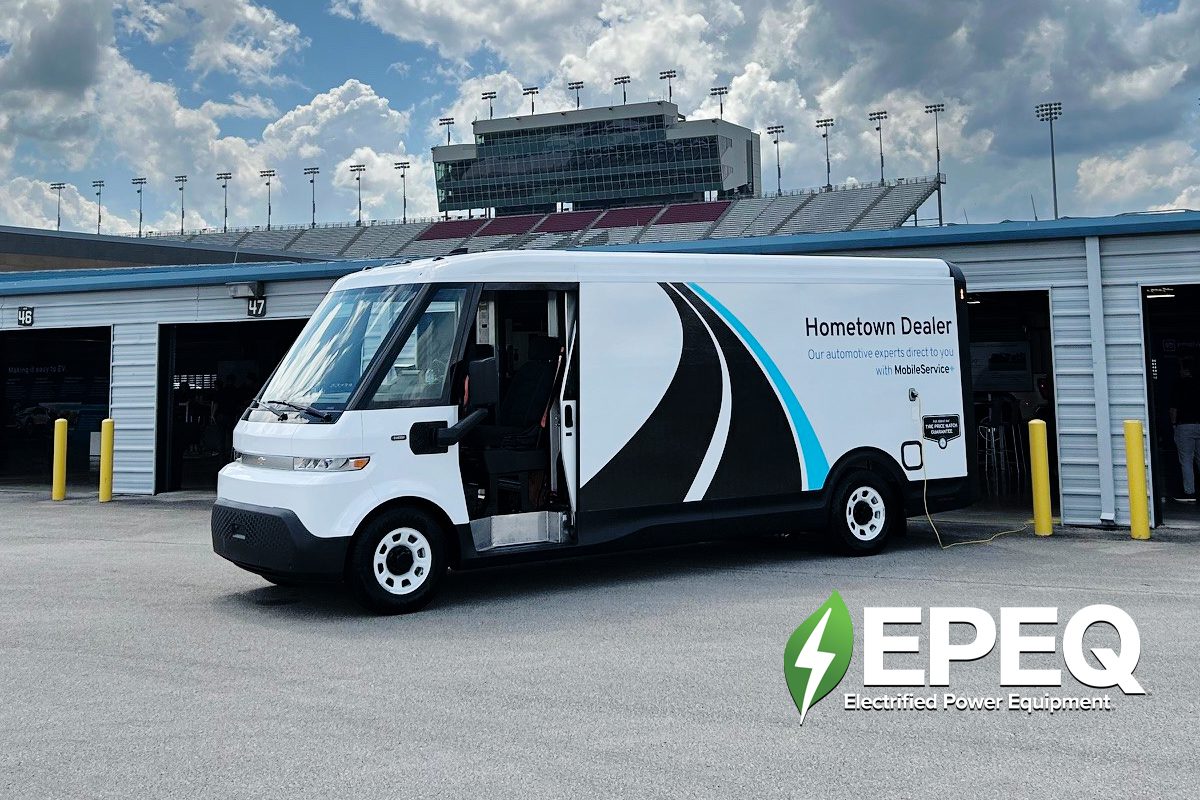
When General Motors launched its MobileService+ program with nearly 200 participating dealerships, the automaker faced a critical decision: how to equip its BrightDrop 600 EV fleet with enough power for all-day service operations without undermining the electric van’s fundamental value proposition. The answer came from an unexpected source — completely separating service equipment power from vehicle propulsion.
The resulting partnership between GM and Vanair represents a paradigm shift in how the industry approaches mobile service electrification. Rather than viewing EV limitations as obstacles to overcome, this collaboration demonstrates how intelligent auxiliary power design can unlock capabilities that surpass traditional combustion-powered service vehicles.
Decoupling Power from Propulsion
“Fleet managers consistently identify range as their primary electrification concern,” notes Chip Jones, Vanair’s National Sales Manager for Electrified Products. “Drawing service power from the traction battery creates an impossible trade-off between capability and mobility.”
Image: GM
The BrightDrop platform delivers commercial electric vehicles designed to transform last-mile delivery and mobile service operations.
Vanair’s EPEQ Electrified Power Equipment system eliminates this trade-off entirely. By maintaining complete electrical isolation between the vehicle’s drivetrain and the service equipment power supply, technicians operate tire changers, balancers and oil change systems throughout their shift while preserving all 178 miles of the BrightDrop’s driving range.
The architecture comprises dual ELiMENT Lithium Iron Phosphate (LiFePO4) batteries totaling 10.24kWh, managed through a sophisticated power distribution system. A 10kW 240VAC inverter handles heavy-duty equipment while a separate 3.6kW 120VAC inverter powers standard tools. The EPEQ AIR20 Reciprocating Air Compressor maintains 150 PSI across three aluminum receiver tanks, delivering consistent pneumatic power without the pressure fluctuations common in engine-driven systems.
The Silent Revolution
While zero-emission operation drives headlines, field deployment has revealed equally transformative benefits. Traditional service vehicles equipped with engine-driven compressors or standalone generators produce noise levels approaching 100 decibels—equivalent to a jackhammer. The EPEQ system operates below normal conversation levels.

GM’s MobileService+ brings professional maintenance directly to customers across all major GM brands through a nationwide dealer network.
“Noise restrictions initially seemed like a minor consideration,” explains Emily Zack, GM’s Program Support lead for MobileService+. “Now our dealers report it’s opening entirely new market segments.”
Hospitals, residential communities and urban centers with strict noise ordinances become accessible service territories. Dealers schedule appointments during previously off-limits hours—early mornings, evenings, even overnight shifts in commercial districts. One participating dealership reported a 30% increase in service capacity simply by extending operational hours into noise-restricted periods.
Performance Without Compromise
Laboratory testing rarely survives field conditions, yet GM’s real-world data exceeds initial projections. Service technicians complete 4-5 complete tire installations daily, including mounting, balancing and rotation, with battery capacity to spare. During validation testing, continuous tire service operations showed negligible power depletion across multiple cycles.
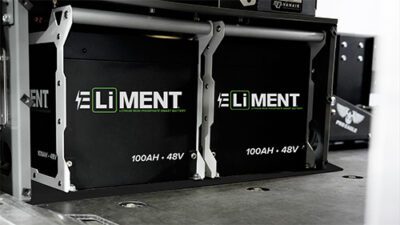
Two ELiMENT 100Ah LiFePO4 batteries deliver over 10kWh of independent power capacity for continuous service equipment operation.
The system’s intelligence extends beyond raw capacity. Vanair’s seven-inch Smart Display provides real-time load management, allowing technicians to optimize power distribution based on immediate needs. If multiple high-draw tools operate simultaneously, the system automatically prioritizes critical functions while queuing non-essential loads.
Most intriguingly, the EPEQ system transforms service vehicles into mobile charging stations. Using integrated Level 2 charging capability, technicians can provide stranded EVs with 15 miles of emergency range in just 25 minutes — enough to reach proper charging infrastructure — while retaining sufficient power for scheduled service appointments.
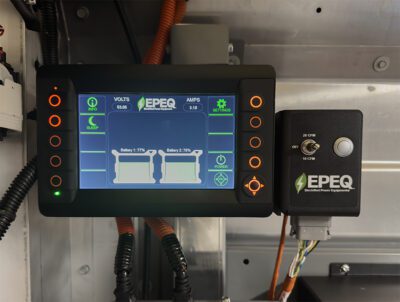
An advanced seven-inch Smart Display power management interface enables technicians to monitor system performance and optimize electrical load distribution during service operations.
Ergonomics Drive Efficiency
The BrightDrop 600’s expansive 614-cubic-foot cargo area addresses a chronic industry challenge: technician workspace. Unlike traditional vans requiring constant crouching and contortion, technicians stand upright throughout service operations. This ergonomic advantage translates directly to productivity metrics, with dealers reporting 15-20% faster service completion times compared to conventional mobile units.
“Technician retention improves dramatically when you eliminate the physical punishment of cramped quarters,” Zack observes. “We’re seeing experienced technicians specifically request assignment to BrightDrop units.”
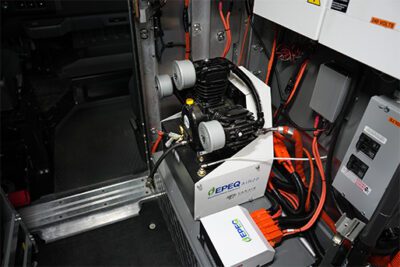
An EPEQ AIR20 reciprocating compressor maintains consistent 150 PSI pressure through triple receiver tank configuration for demanding service applications.
Economic Acceleration
Initial investment in a fully equipped BrightDrop with EPEQ system demands serious financial commitment. However, operational data reveals surprisingly rapid payback periods. Fuel elimination saves $4,000-6,000 annually per vehicle. Maintenance costs drop 40% without engine servicing requirements. The ELiMENT Batteries’ 5,000-cycle design life spans 7-10 years of normal use, potentially outlasting multiple vehicle generations.
State and federal EV incentives further accelerate ROI, while expanded service territories and operational hours generate previously inaccessible revenue. Several dealers report the quiet operation capability alone justifies the investment through premium service contracts with noise-sensitive facilities.
Scaling Beyond EVs
While designed for electric vehicles, Vanair’s approach addresses immediate needs for fleets not ready for full electrification. The EPEQ system installs equally well in conventional vehicles, eliminating idling and reducing emissions even on diesel platforms.
“We’re seeing mining operations, airports and rail yards adopt EPEQ technology on traditional chassis,” Jones reveals. “They achieve immediate emission reductions while preparing for eventual vehicle electrification.”
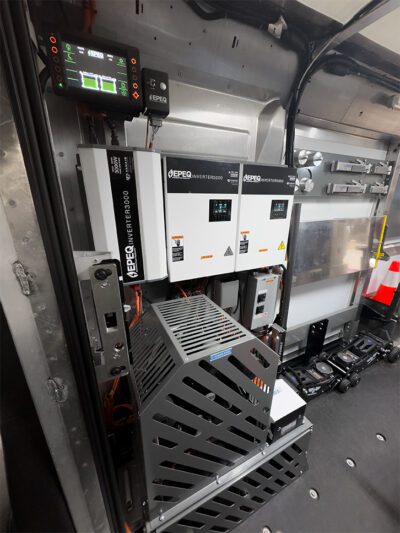
Dual inverter architecture delivers both standard 120V power for routine tools and robust 240V capacity for heavy-duty service equipment.
This transitional strategy provides fleet managers a practical pathway forward—implement clean auxiliary power today, transition to electric vehicles tomorrow and transfer the EPEQ investment between generations.
The Template for Tomorrow
The GM-Vanair collaboration establishes a replicable model for commercial electrification. By solving the fundamental power challenge through auxiliary battery systems, this partnership proves electric vehicles can exceed — not merely match — the capabilities of their combustion predecessors.
As mobile service demand accelerates alongside consumer expectations for convenience, the ability to operate silently, cleanly and continuously becomes competitive necessity rather than environmental luxury. The question facing fleet operators isn’t whether to adopt auxiliary power solutions, but how quickly they can capitalize on the advantages.
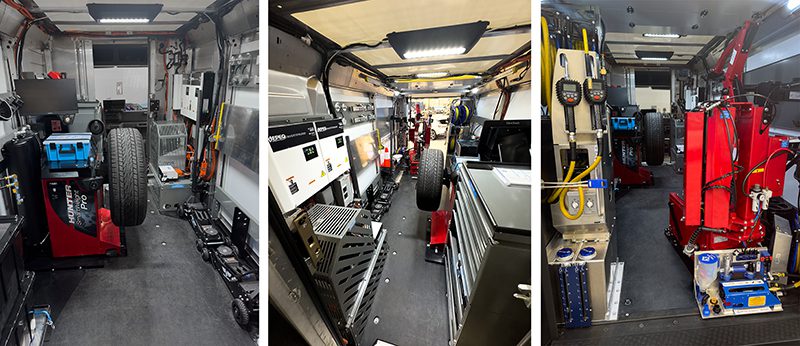
Complete mobile service capability includes professional-grade tire changing, wheel balancing and comprehensive oil service functionality in a single vehicle platform.
For More Information
Find out more about GM’s BrightDrop van and MobileService+ by contacting MobileServicePlus@GM.com. To learn more about Vanair’s EPEQ ecosystem by visiting https://vanair.com/epeq-electrified-power-equipment.