Ask any fleet operator what keeps them up at night and the answer is rarely about the truck itself. It’s about the job the truck needs to do, and what happens when it can’t. A missed concrete pour. A blown delivery window. A truck sitting in a service bay when it should be on a jobsite. Every hour of unplanned downtime costs money, disrupts schedules and erodes the margins that fleets work hard to protect.
That’s why, at Mack Trucks, our focus is well beyond building a great vehicle. We’re continuing to build an uptime ecosystem launched over a decade ago designed around a single goal: keeping trucks productive and on the job.
Uptime Is Not a Feature — It’s the Foundation
In 2014, Mack became one of the first OEMs to classify uptime as an independent customer service, devoting an entire organization to customer uptime, opening a dedicated Uptime Center in Greensboro, North Carolina. That investment reflected a simple conviction: a truck’s value isn’t just in its performance on the road, it’s in the system that keeps it there.
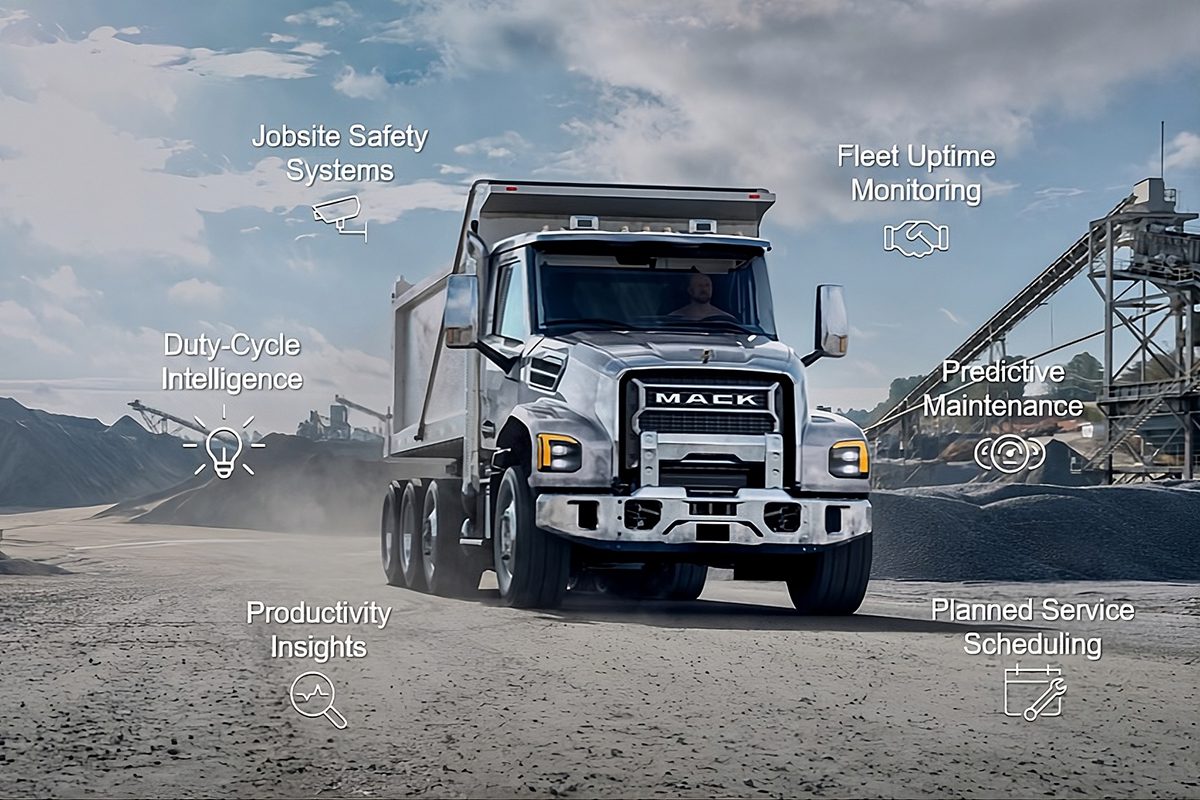
More than a decade later, uptime has evolved from a service commitment into the foundation for everything we do. Our Mack OneCall team operates 24/7, fielding approximately 20,000 calls per month, coordinating roadside service and managing repairs. Behind that team sits GuardDog Connect, our predictive technology that continuously analyzes truck health data and shares insights with the Uptime Center and the customer’s preferred dealer, often flagging issues before a warning light ever appears.
The results speak for themselves: an 87% reduction in diagnostic fault alerts, a 30% reduction in repair time and a 96% fix-it-right-the-first-time rate.
From Fix-as-Fail to Predict-and-Prevent
The real transformation in uptime is the shift from reactive to predictive. Through prognostics and advanced analytics, we can now identify with high certainty not just what a fault code means but what specific repair will address it, and increasingly, when that fault will trigger. That means recommending preemptive maintenance to customers before an unplanned breakdown disrupts their operation.
Over-the-air technology accelerates this shift. Our AutoSend platform, an industry first, automatically delivers software updates to eligible trucks without requiring a dealer visit. In 2025 alone, AutoSend completed approximately 150,000 successful updates, helping customers avoid an estimated 115,000 days of downtime and roughly $60 million in prevented revenue loss. With the eligible Mack fleet now approximately 80% current on software — up from 27% before AutoSend launched — over-the-air has moved from a convenience to a genuine productivity tool.
The Ecosystem That Wraps Around the Truck
Technology alone doesn’t deliver uptime. It takes an ecosystem. Our Mack Connect portal gives fleet managers a single platform for vehicle tracking, performance analytics and diagnostics. Service contracts provide tailored maintenance plans that have delivered a 38% reduction in planned downtime while eliminating the costly cycle of over- or under-maintaining vehicles. And our dealer network has invested more than $1 billion over the past decade in service capacity, resulting in a 41% increase in service bays and a 75% increase in Mack Master Technicians.
This is what we mean when we talk about value beyond the truck. Fleets don’t just need a vehicle that performs on day one, they need a system that keeps it performing for years.
Understanding the Job Behind the Truck
Everything we build starts with understanding what customers actually need. When we ask fleet customers what they’re hiring a truck to do, they don’t say horsepower or options. They say: “Keep my business moving without surprises.”
On most jobs, everything runs on tight sequencing. If a truck breaks down, it doesn’t just affect one load — it backs up the entire operation. Crews wait, equipment sits idle and the customer (ours and theirs) loses money. That’s why our uptime solutions are designed around the customer’s operation, not just the vehicle. The goal is to make downtime the exception, not the expectation. The pursuit of 100% uptime isn’t a marketing slogan. It’s an operational philosophy that drives how we develop products, invest in technology and support customers every day. For fleet leaders navigating an increasingly complex operating environment, it may be the most important competitive advantage available.
Jonathan Randall will join fellow OEM leaders on the CEO Panel — Navigating Complexity and Change Through Innovation — at 3:15 p.m. Monday, May 4, at ACT Expo 2026 in Las Vegas, where they’ll discuss how connected technologies, AI, automation and alternative fuels are redefining vehicle performance and fleet operations.