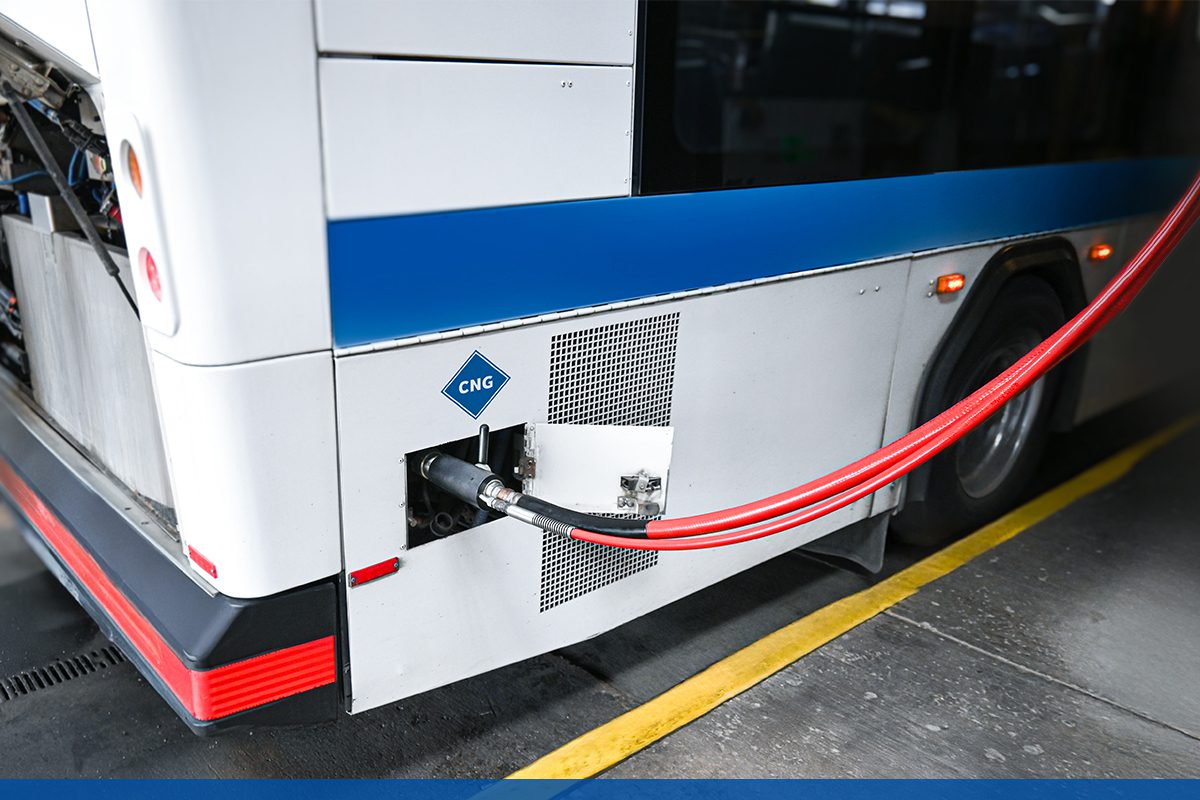

Compressed natural gas has experienced widespread utilization on a global scale. CNG combustion produces significantly less CO2 than gasoline or diesel, lower NOx emissions, and virtually zero particulate matter. And because CNG is in abundant supply and can even provide cost advantages than traditional fuels, it is ripe for widespread adoption as sustainability initiatives take greater root worldwide.
Seizing CNG’s full potential depends on the design and development of safe, reliable infrastructure—and that means minimizing the potential for leaks throughout critical CNG fluid systems, from production to refueling to on-vehicle applications. While some leaks may be minor nuisances, others can pose significant threats to health and safety, making leak prevention especially critical at the end-use level, where consumers will interact with CNG infrastructure.
Selecting high-performance fitting technology that has been designed for demanding applications is one of the best ways to minimize leaks throughout any application. Choose fluid system components—specifically, tube fittings—that deliver the specific performance criteria required in high-stakes transportation applications.
So, what are the critical characteristics of high-performance tube fittings that facilitate reliable, safe operation?
Seal Tightness
CNG is stored at pressures that can exceed 275 bar (4000 psi), meaning any leak can pose significant safety hazards for operators. Refueling stations must be fault-free and use high-quality components if end-users are to fill their tanks safely and easily. And those components need to exhibit a gas-tight seal.
Traditional bite-type and compression tube fittings, with both single- and two-ferrule designs, are suitable for many general industrial applications. However, they may fall short in demanding transportation applications. Instead, a fitting that creates a gas seal along multiple lines of contact can provide more robust protection from leaks in both refueling and on-vehicle connections.
Vibration Resistance
CNG fittings must be able to withstand continuous vibrations associated with a moving vehicle, virtual pipeline, and compressor station. A tube fitting featuring a two-ferrule design with hinging-colleting action can provide the vibration resistance required in transportation applications. The two-ferrule design creates a twin mechanical grip on tubing, effectively reducing the likelihood of fittings backing off, even when subjected to continuous operational vibration. This design also allows for a very small amount of movement in the fitting while maintaining the appropriate levels of grip and force. This movement, called “spring back,” creates robust vibration resistance, ideal for both on-vehicle operation and use within refueling infrastructure.
Thermal Performance
CNG fuel systems are subject to inherent thermodynamic challenges. Because the pressures at which CNG is stored are significantly higher than the pressures at which CNG travels from the dispenser into the on-vehicle fuel tank, as CNG depressurizes during the refueling process, the Joule-Thomson effect causes the gas temperature to drop drastically. This kind of temperature drop can also happen when compressed gas or liquid travels from the vehicle’s storage tank to the engine during operation.
All parts of the system must be able to withstand these sudden temperature changes, especially tube fittings throughout the system. In this case, it’s important to consider component materials as well as design. Lower-quality materials may expand and contract due to temperature fluctuations, which can contribute to leaks or other forms of failure.
Corrosion Resistance
CNG vehicles and fueling infrastructure are subject to a wide variety of environmental conditions that can contribute to corrosion. This means OEMs should seek to proactively prevent corrosion-related failures with high-quality materials of construction for every component in CNG systems.
For example, traditional carbon steel is susceptible to internal rusting. CNG fuels typically incorporate odorants, which better enable users to smell a leak if one happens. However, such odorants typically contain sulfur, which can contribute to premature corrosion and rusting in fuel systems. Natural gas also has an inherent humidity content that can contribute to higher corrosion levels and can become even more problematic in wetter and warmer climates. And because internal corrosion cannot be easily detected visually during general maintenance inspections, it can become a serious safety risk.
An elevated concentration of chromium and nickel can defend against these forms of corrosion by promoting greater ductility and corrosion resistance. American Society for Testing and Materials (ASTM) requires a minimum of 10% nickel in 316 stainless steel formulations, but higher-quality 316 stainless with 12% minimum nickel is better-suited for transportation applications.
Ease of Installation
An optimal CNG fitting should also be simple to install, enabling professionals to more efficiently and reliably build critical CNG systems.
For example, while they can provide the leak-tightness needed for CNG applications, cone and thread fitting assembly can be labor-intensive and time-consuming. Cone and thread fittings require specialized tools and materials for proper installation, as well as cutting lubricant to reduce friction during the process. By contrast, some available mechanical grip fittings are designed with preassembled cartridges. This enables installers to use common tools and requires minimal training to achieve rapid, error-proof assembly. When compared to traditional cone and thread fittings, these mechanical grip fittings can deliver significant installation and assembly benefits, including fewer opportunities for errors, increased consistency, and overall improved service life for the application.
Mitigating leaks is critical as CNG transportation scales to reach its full potential. For system designers, selecting and specifying high-performance tube fittings is one of the most impactful ways to reduce the potential for leaks and deliver long-lasting, reliable, and safe CNG infrastructure.
Chuck Hayes is a 30-year veteran of Swagelok Company, a world leader in the development of fluid system products, assemblies, and services. He has spent the last 25 years developing a wide range of fluid system products, including the past 20 years focused exclusively on fitting technology for alternative fuel applications. Chuck currently holds 7 patents in the U.S. and numerous patents internationally. He is an active member of Canadian Standards Association Group (CSA) committees for both CNG and Hydrogen and was recently the chair of Hydrogen Gas Vehicles (HGV) 4.10 for fittings. Chuck also sits on ISO-TC97 (Technical Committee) and participates in international working groups. He concentrates most of his time on the development of hydrogen mobility solutions for both infrastructure and on-vehicle applications.