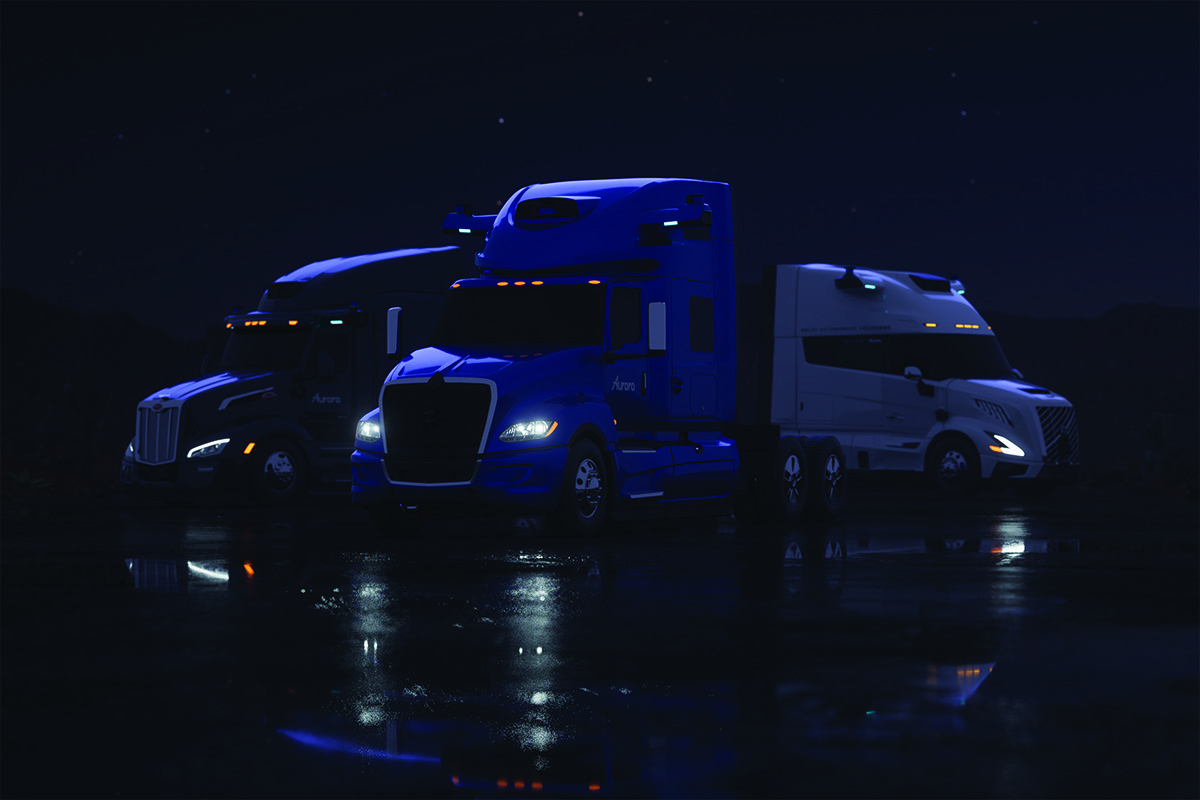
Aurora Innovation reported steady progress in expanding its commercial driverless trucking operations during the third quarter of 2025, including the launch of a second autonomous freight corridor and the completion of more than 100,000 driverless miles on public roads without any safety incidents. The company continues to focus on scaling operations, adding customers, and preparing new vehicle hardware to support broader deployment in 2026.
The company reported that its Aurora Driver surpassed 100,000 driverless miles on public roads with zero safety incidents attributed to the system, while maintaining 100% on-time performance for customers. Aurora also launched driverless operations on the 600-mile corridor between Fort Worth and El Paso, its second autonomous freight lane and the fastest expansion to a new market in the U.S. self-driving industry.
The Fort Worth–El Paso lane complements Aurora’s existing Dallas–Houston operation and will soon connect to Phoenix, forming a continuous 1,000-mile multi-state driverless corridor expected to go live in early 2026. Additional expansions are planned along the I-20 corridor, including Dallas–Laredo and Dallas–Atlanta, extending Aurora’s driverless reach to roughly 2,000 miles across the Sun Belt.
Aurora said the Phoenix route required validating operations in dust storms and heavy rain, testing the truck’s ability to safely slow, pull over, or reroute when visibility deteriorates. The company’s multi-sensor system demonstrated it could “see through dense dust at twice the range of cameras,” highlighting what Aurora calls a major safety advantage.
With the Fort Worth–El Paso launch, Aurora expanded driverless operations for Hirschbach Motor Lines and added two more carriers to its customer group. A new partnership with McLeod Software, whose technology serves more than 1,200 fleets, was also announced to streamline integration for mid-sized carriers. The collaboration led to Russell Transport becoming one of the first U.S. asset-based carriers to deploy autonomous trucks in live freight service.
Aurora expects to introduce its second-generation commercial hardware kit in mid-2026, reducing hardware costs by more than 50% while doubling the range of its proprietary FirstLight lidar to 1,000 meters. The upgrade will support hundreds of driverless trucks operating by late 2026.
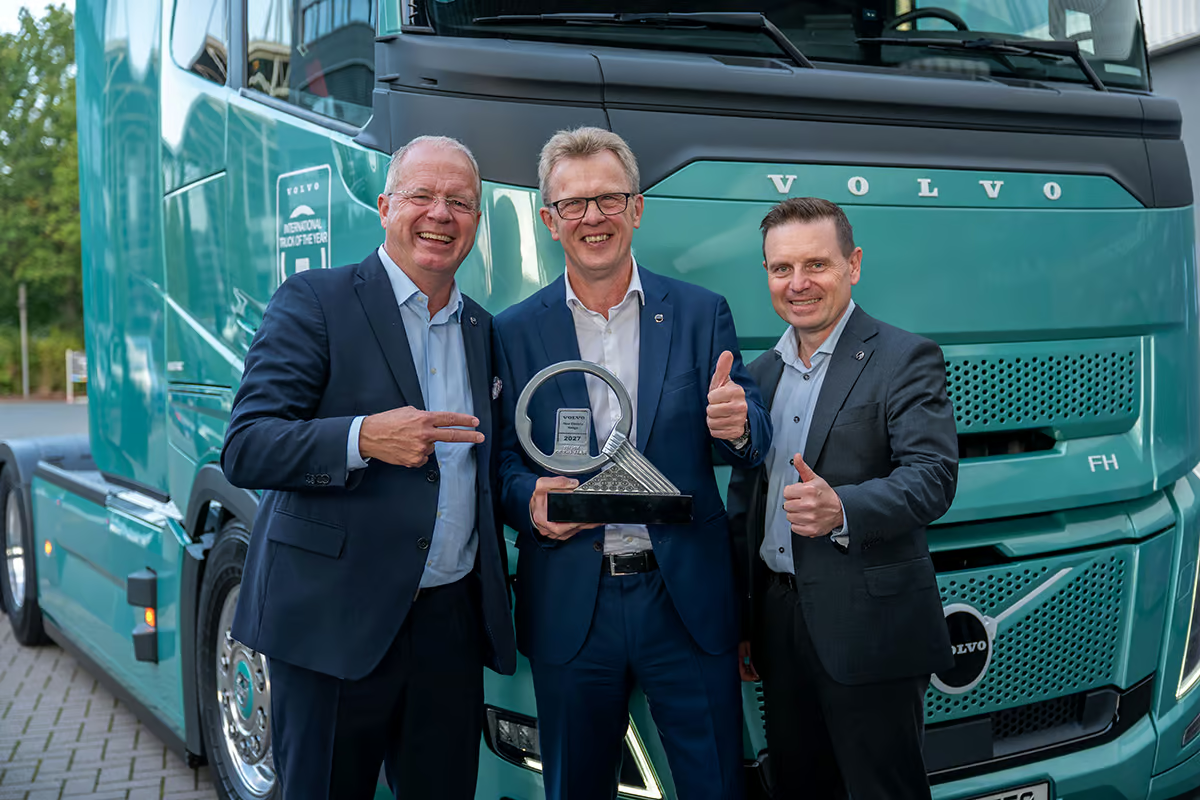
The company also highlighted partnerships with Volvo and PACCAR, noting that Volvo has begun integrating Aurora’s second-generation kit into the Volvo VNL Autonomous model at its Virginia factory, an industry-first for on-line manufacturing of driverless trucks. Continental’s newly spun-out mobility unit AUMOVIO will produce Aurora’s third-generation hardware beginning in 2027 at its expanded New Braunfels, Texas plant.
Regulatory tailwinds continued in Q3, as Aurora received U.S. DOT approval to replace roadside reflective triangles with cab-mounted beacons for stopped vehicles. The AMERICA DRIVES Act, which would establish a federal framework for autonomous trucking, also gained new bipartisan support.
Financially, Aurora reported $1 million in Q3 revenue, driven by loads for partners including FedEx, Schneider, Hirschbach, and Uber Freight. The company ended the quarter with $1.6 billion in cash and investments, which it expects will fund operations into the second half of 2027.
“We’ve proved the technology works and are now channeling our momentum to support lasting customer value and our path to scale,” said Chris Urmson, Aurora co-founder and CEO in the shareholder letter.