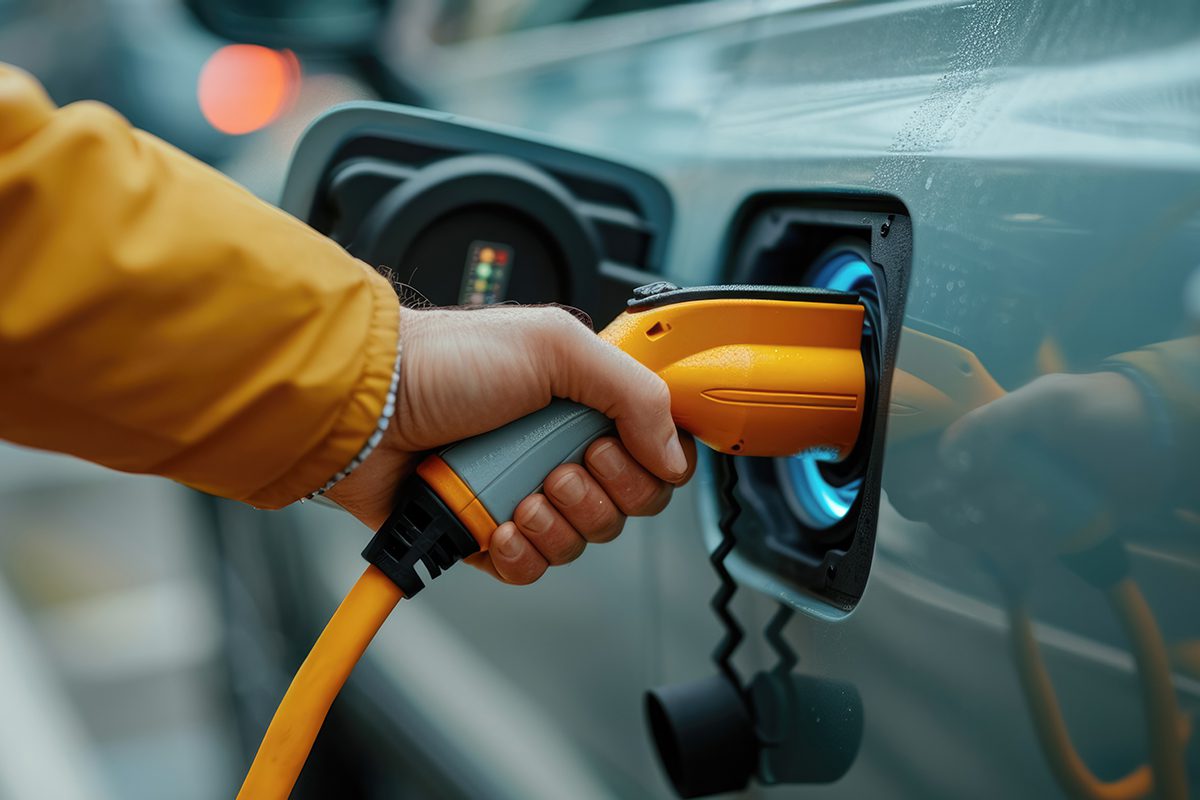


Created with the sole goal of building a national, interconnected network of high-powered, electric vehicle (EV) charging stations across America’s major roadways, the National Electric Vehicle Infrastructure (NEVI) program aims to create a network that reduces gaps in available charging, catalyzes the deployment of EVs, and stimulates local economies by providing jobs and economic opportunities.
Throughout 2025, the road to NEVI has had its twists and turns, starting with a broad-sweeping cancellation, state-government lawsuits, and court-mandated renewal. Ultimately, this has led to the program, which has built out at least 384 charging ports, to a newfound present outlook that’s worth following.
History of NEVI
Passed in 2021 under the Bipartisan Infrastructure Law, NEVI is a funding program with an allocated $5 billion from FY 2022 through FY 2026, to establish a network of charging infrastructure across targeted alternative fuel corridors (AFCs) in all 50 states, the District of Columbia (D.C.), and Puerto Rico. Since the program was enacted, 44 states have released at least one solicitation for funding the build-out of chargers. An accumulated $3.3 billion has been allocated to states, which in turn has awarded an estimated $670 million for projects.
In February 2025, the Federal Highway Administration (FHWA) announced a review of the NEVI program with the intention of revising the program guidelines to align with the current administration’s policies and priorities, which resulted in the existing and previous NEVI program guidance being rescinded and a freeze of new funding to states. A subsequent legal battle ensued led by a coalition of 16 states and D.C., with Washington, Colorado, and California as three of the plaintiffs, requesting the release of their allocated federal funding. A federal court order made in June 2025 forced the federal government to release these funds. Following the court order, by August, the FHWA released new interim NEVI guidance. A move, which in turn signaled the release of all remaining funding to states.
Following the issue of new NEVI guidance and a directive for states to submit their final FY 2026 NEVI plan to the FHWA by September 12, 2025, multiple states have opened or plan to open their respective programs in the coming months. TRC has been closely monitoring the status of each state and territory’s funding and the future of the NEVI program.
Current Status of State-NEVI Programs
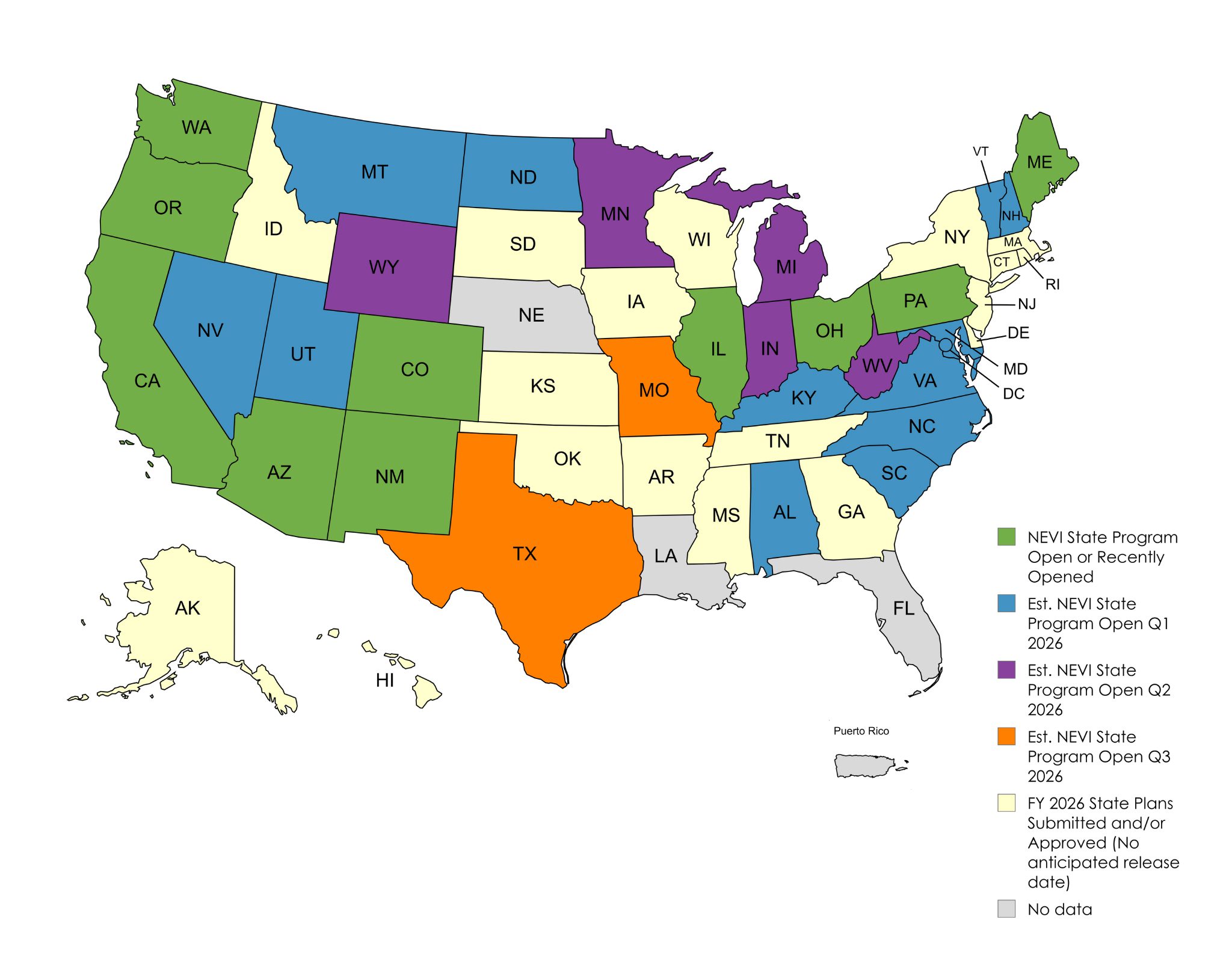
In October 2025, the FHWA released its FY2026 apportionment of $885 million set-aside for states. States can only receive their FY 2026 NEVI funds if they submitted a state plan. If states did not submit their plans, they had until the end of 2025 to consult with the Secretary of the Department of Transportation (DOT) and employ their plans.
As of writing this article, nine states — Arizona, California, Colorado, Illinois, Maine, New Mexico, Ohio, Oregon, Pennsylvania, and Washington — have opened or recently opened their next round of funding for installing EV charging stations. An additional 12 states — Alabama, Kentucky, Maryland, Montana, Nevada, New Hampshire, North Carolina, North Dakota, South Carolina, Utah, Vermont, Virginia — and D.C. have indicated that they anticipate releasing solicitations in Q1 2026. Seven other states aren’t far behind, having shared their anticipated release timeline as Q2 or Q3 of 2026 — Indiana, Michigan, Minnesota, Missouri, Texas, West Virginia, and Wyoming.
This leaves the remaining states with approved plans to determine their timeline. Some states have shared that they are focusing on finalizing the construction and installment of previous rounds, while others remain unsure of the timing for future funding. TRC has been in direct contact with state agencies to receive the most up-to-date information on anticipated release dates of NEVI funding and will continue to monitor the status of these state programs accordingly.
Outlook of NEVI
The new guidance released in August 2025 affords states the autonomy to take a different approach to utilizing their remaining NEVI funding. States are still expected to maintain minimum EV charging standards and requirements, which includes installing four charging ports with 150 kW capacity each, quarterly data reporting, and Buy America Build America requirements. However, states now have more flexibility when implementing their state programs. Here are key changes to the program and how states may adjust their NEVI implementation:
- Release all remaining NEVI funds in one solicitation: The amount of funding allocated to the states to date varies, but the new guidance and final fiscal year of funding provides states with the option to release their remaining funding in one solicitation and do it in a way that meets the updated NEVI guidance.
- Winner takes all: For ease of procurement and contracting, more states are likely to develop their solicitations with one or only a handful of station developers in mind. New Jersey did this for its first round of funding, awarding one contractor over $20 million to build-out all targeted EV charging stations. For 2025-2026, states like Ohio plan to award up to twelve contracts with a minimum of four sites per developer, leaving only up to three developers to win available funding.
- Beyond “built-out” for rural or secondary highways: The new guidance simplifies how states can certify whether their AFCs are “built-out,” now only requiring a letter with reasonable explanation alongside supporting evidence. The new guidance also provides states with flexibility to determine the appropriate distance between stations along AFCs that would allow for reasonable travel (previously required 50 miles between charging stations). States that have previously awarded funding will likely prioritize areas outside of the AFCs to address broader charging gaps.
- Expanded publicly available and community-centered site locations: The new guidance allows states to prioritize charging stations where operators are also the site hosts in addition to locations where people shop, dine, and/or work. Again, this gives more flexibility to fund projects not located on designated AFCs. The FHWA recommends that states use the funds for EV charging infrastructure on any public road or in other publicly accessible locations, such as parking facilities at public buildings, public schools, and public parks, or in publicly accessible parking facilities that are owned by a private entity. This not only enhances the connection between EV charging and community spaces but can also help bridge existing urban-rural charging gaps.
- Ease of technology and resilience safeguards, renewable energy, and community engagement requirements: States are no longer required to consider community outreach or Justice 40 considerations that were once a key part of NEVI projects. Additionally, the guidance minimizes requirements for states to consider electric grid integration and renewable energy. Applications and projects will no longer need to address consumer protections (i.e. pricing transparency and user accessibility), emergency evacuation plans, environmental siting (i.e. National Environment Policy Act requirements), and resilience and terrain considerations (i.e. fireproofing).
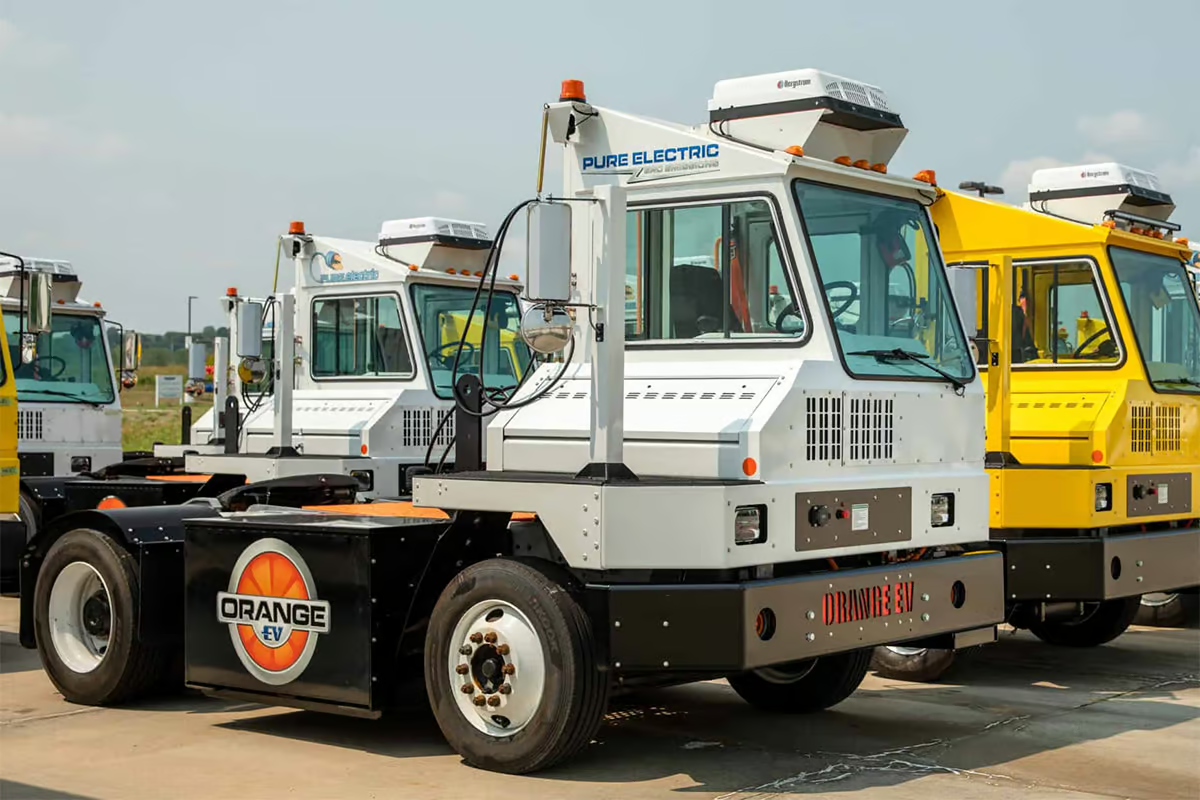
- Shift to medium- and heavy-duty charging (MHD) and charging upgrades: The new guidance allows states to include funding for MHD commercial vehicle charging and upgrades to existing stations to accommodate larger vehicles after charging build-out has been completed. States like Illinois have included MHD funding in its most recent solicitation, and California previously considered MHD charging as part of its NEVI funding. This is beneficial for early adopting states that already built out their light-duty EV charging networks. They can now utilize these funds to build charging stations along major freight corridors that in turn support fleet electrification. These higher-capacity chargers typically require more funding and specialized infrastructure compared to their light-duty counterparts, and having NEVI funding eases the burden on states to support these types of projects.
Going forward, the new guidance and these foreseeable project shifts reduce onerous requirements that could help states effectively deploy remaining NEVI funding. States have more ownership and flexibility to utilize these funds in a manner that meets their needs while still filling the gap in available EV charging infrastructure. More immediately, as eligible entities apply for available funds, they could see shorter and more streamlined application processes, faster selection, and more high-powered chargers built quicker.
TRC maintains partnerships with state agencies and policy makers to map out and estimate the timing and availability of these programs. These insights allow TRC to help eligible entities and technology providers to identify and secure the most advantageous funding opportunities. Contact us if your organization could use support with monitoring state updates and anticipated solicitation openings, as well as support with NEVI grant applications, site selection and feasibility studies, regulatory compliance, cost-benefit analyses, and more. TRC stands at the ready to assist with your EV deployment needs.