Autonomous trucking developers are making progress on several fronts as they prepare for broader commercial deployment, with recent developments addressing technology costs, freight operations, and federal safety requirements.
Bot Auto has selected a new production computing platform intended to lower the cost of its autonomous driving systems, while Kodiak AI has expanded its commercial freight operations through a partnership with Charger USA. Meanwhile, the FMCSA has approved a five-year exemption allowing qualifying Level 4 autonomous trucks to use cab-mounted warning beacons instead of traditional roadside warning devices.
Houston-based Bot Auto recently selected Lenovo’s AD1 autonomous driving domain controller, built on NVIDIA Hyperion, as the production computing platform for its Class 8 driverless trucks. Initial integration is scheduled for the first quarter of 2027, with broader deployment planned as the company expands autonomous freight operations across Texas and the Southwest.
The hardware decision is part of Bot Auto’s efforts to improve the economics of autonomous trucking. The company expects the total hardware cost for its autonomous driving system, including computing equipment and sensors, to reach approximately $50,000 per truck.
Bot Auto estimates that figure is three to eight times lower than other autonomous driving systems. The projected cost covers autonomous system hardware rather than the complete truck.
The company currently moves around 350 freight loads per month across Texas and increased revenue 270% between May and August 2026. Bot Auto is targeting 1 billion autonomous miles by 2031.
While Bot Auto focuses on the costs associated with equipping autonomous trucks, Kodiak AI is expanding the number of commercial freight corridors where its technology operates.
Kodiak and Charger USA are collaborating to transport refrigerated and dry freight between Dallas and Laredo, Texas. The 435-mile route connects Charger terminals and serves customers in the consumer packaged goods, and food and beverage industries.
The companies completed their first delivery in September using a truck equipped with the Kodiak Driver autonomous driving system.
The trucks currently operate with a safety driver behind the wheel. Kodiak and Charger intend to transition the route to driverless operations once Kodiak completes the safety case necessary to demonstrate that its technology can operate safely within the defined operating environment.
Charger operates as an asset-based carrier across North America, with temperature-controlled transportation among its core services. The companies expect to expand the partnership to additional freight lanes as Charger integrates the Kodiak Driver into its fleet.
The collaboration also supports Kodiak’s Driver-as-a-Service business model, under which the company provides autonomous driving technology for trucks owned and operated by its customers.
Alongside these commercial developments, federal regulators have approved an alternative approach to a longstanding roadside safety requirement.
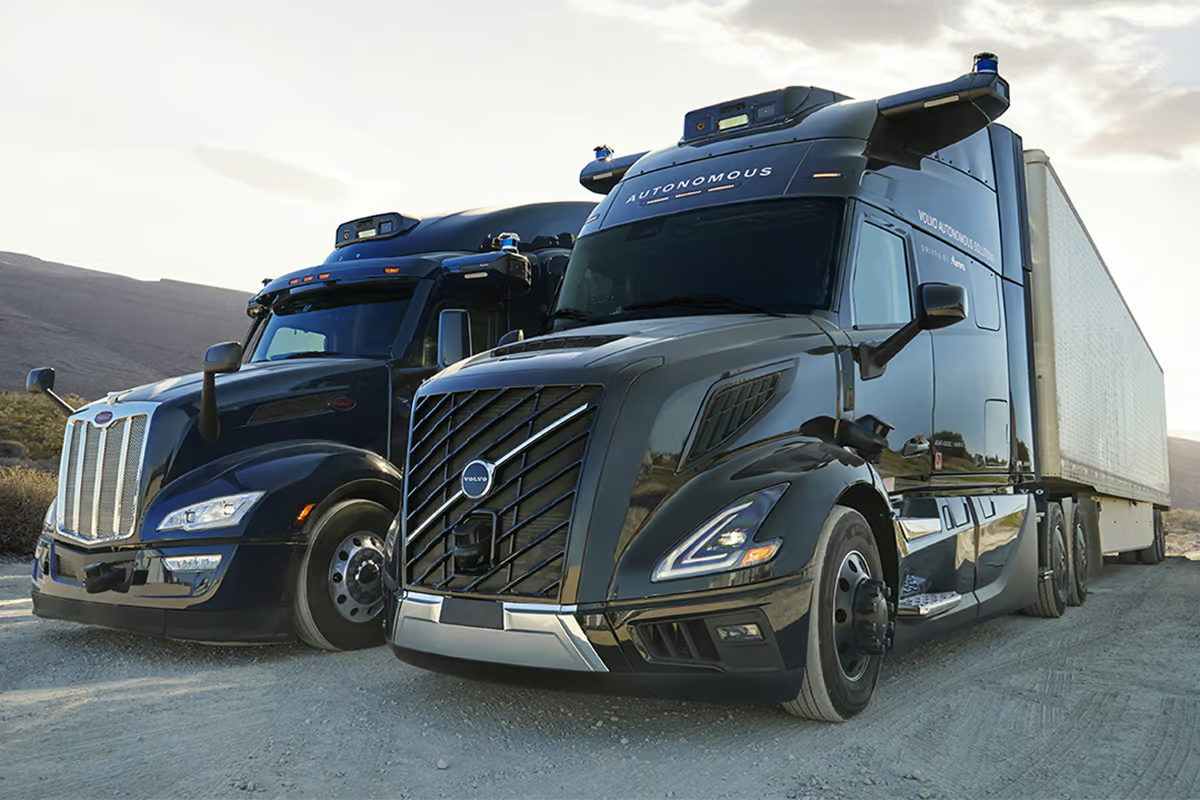
In a recently published notice, FMCSA granted Aurora Operations and other qualifying Level 4 autonomous commercial vehicle operators a five-year exemption from certain warning device requirements.
The exemption allows qualifying autonomous trucks to use cab-mounted flashing warning beacons instead of placing reflective warning triangles around vehicles stopped on the roadway or shoulder.
Federal regulations generally require drivers to deploy warning devices around stopped commercial vehicles under specified circumstances. That requirement presents a practical challenge for autonomous trucks operating without a driver available to exit the vehicle.
FMCSA determined that properly installed and operated warning beacons would likely provide a level of safety equivalent to or greater than the existing requirements.
The exemption includes equipment specifications, operating limitations, and reporting obligations. Participating carriers must use approved warning beacons with redundant power systems and meet requirements governing their activation, visibility, and performance.
Operators other than Aurora must provide prior written notification to FMCSA before using the exemption. Its provisions remain effective through October 7, 2031.
The decision follows Aurora’s previous testing of the technology under a temporary federal waiver. According to the FMCSA notice, Aurora operated 34 trucks equipped with cab-mounted warning beacons for more than 500,000 miles between October 2025 and January 2026. The agency determined that the available operating data did not indicate a reduction in safety during the waiver period.