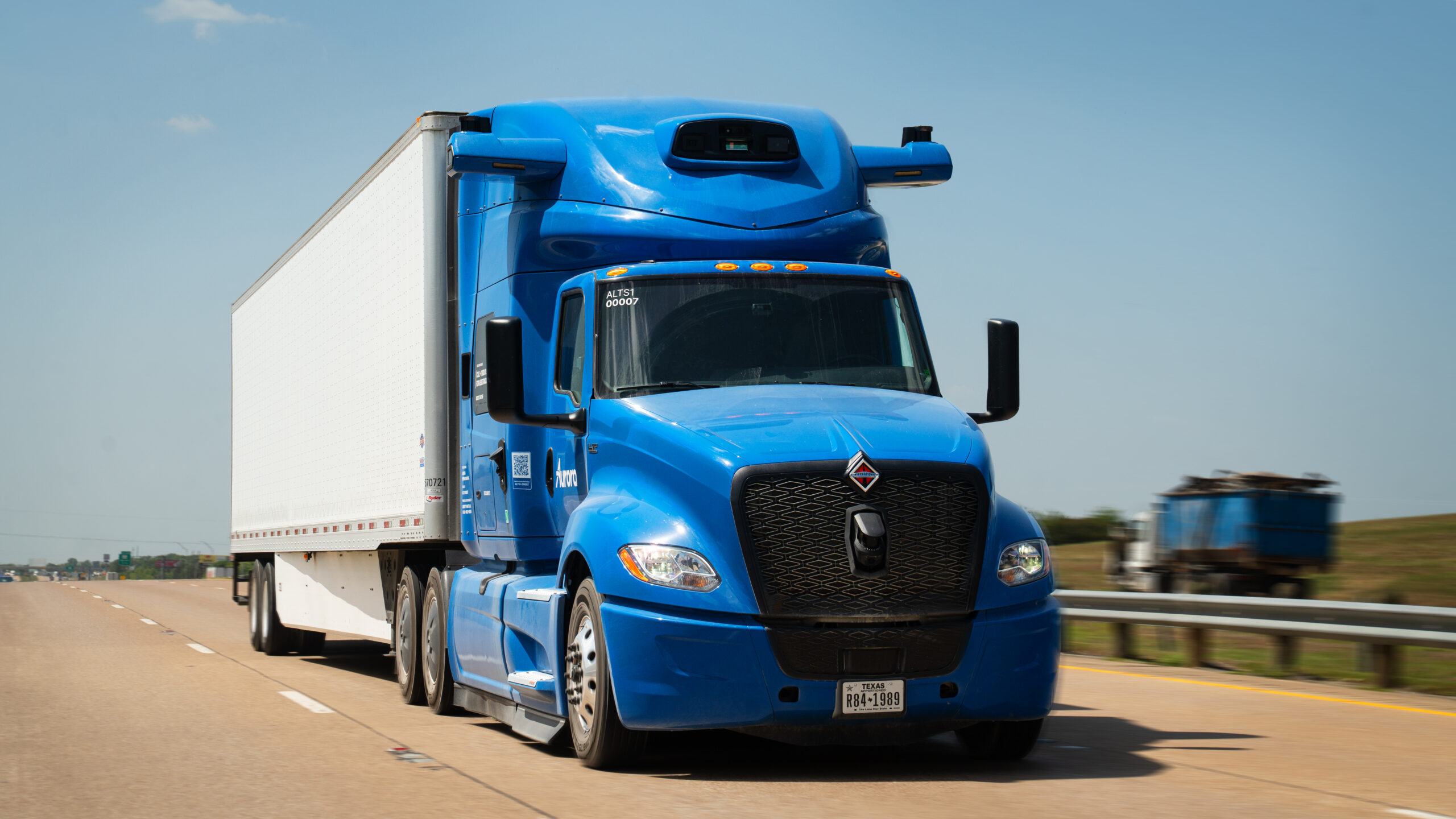
Aurora Innovation expects to have more than 30,000 driverless trucks in operation and more than $5 billion in annual revenue by 2030. The company will exit this year with 200 trucks, which makes the target a roughly 150-fold increase in four years.
Aurora laid out the steps in between. It expects more than 1,000 driverless trucks and roughly $200 million in revenue by the end of 2027, with gross margin breakeven on a run-rate basis in the first half of that year at about 500 trucks. It projects positive free cash flow on a run-rate basis in 2028, which would come with roughly 7,500 trucks on the road.
For 2030, the company is targeting gross margin of about 60%. Chief Financial Officer David Maday told the audience there is “no reason we can’t deliver outstanding gross margins and reach 70%,” and said the company’s current momentum “puts us firmly on the path to profitability.”
The 200 trucks Aurora expects to have allocated by the end of 2026 carry an $80 million annualized revenue run rate. Reaching 30,000 means adding close to 29,800 trucks over four years, an average of about 7,450 a year. The step from roughly 1,000 trucks at the end of 2027 to roughly 7,500 in 2028 works out to about 125 trucks a week.
But the commercial model changes as the fleet grows. Aurora currently operates as Transport as a Service, where it carries the asset and charges roughly $2 per mile including fuel surcharge, and it said it will cap that fleet at 500 trucks. Everything above that is Driver as a Service, where the carrier owns and operates the truck and Aurora’s revenue is 85 cents or more per mile. The two rates explain most of the revenue curve: $80 million across 200 trucks is about $400,000 per truck per year, while $5 billion across 30,000 trucks is about $167,000 per truck per year. At 85 cents a mile and the 225,000 annualized miles Aurora reports today, a single Driver as a Service truck would generate roughly $191,000 a year, which leaves the 2030 average below the rate the company quoted and room in the target for ramp timing and trucks not in service a full year.
Hirschbach Motor Lines is the first named commitment on that side. The carrier intends to own and operate 500 Aurora Driver-equipped trucks under a Driver as a Service agreement, with deliveries beginning in 2027, under a nonbinding memorandum of understanding signed in April 2026. McLane and Werner Enterprises are running Aurora freight today. Aurora said it nearly doubled its driverless customer count during 2026 and has logged more than 500,000 driverless miles since commercial launch, with trucks averaging an annualized 225,000 miles, more than double a typical truck.
Carriers in the room were more measured on cost. Daragh Mahon, executive vice president and chief information officer at Werner Enterprises, said the economics are not settled. “I will be quite honest that we have a gap. We’ve got to figure this out,” he said. “I think the economics become viable at scale, I mean, really viable at scale where nobody is eating some of the cost.” He added that he expects to reach a view within the next few months on whether the numbers work. On insurance, Chris Moore of the Lloyd’s of London syndicate Apollo said autonomous trucks currently price slightly above human-driven equipment, and that he expects rates to fall 15% to 25% a year.
Kodiak AI spent the same stretch moving on a different schedule. In late September, the company completed its first autonomous freight deliveries under a California heavy-duty testing permit, running time-sensitive perishable freight between Fresno and Los Angeles with DTL Transport, a carrier that specializes in cross-country team runs hauling produce for several of the largest US grocers. The route covers about 225 miles on State Route 99 and Interstate 5, the pilot began September 22, and the trucks operate with a safety driver behind the wheel. California’s DMV approved heavy-duty autonomous vehicle testing regulations on April 28 and issued Kodiak its permit on August 13. DTL Transport runs more than 100 trucks.
Kodiak also named Interstate 45 between the Dallas-Fort Worth area and Houston as its driverless launch lane, a 219-mile route it has run daily from its Lancaster, Texas, hub since August with a safety observer aboard who never touched the wheel, including on surface streets. Kodiak said its Autonomy Readiness Measure for long-haul operations, which it defines as the percentage of claims and evidence in its driverless safety case that are materially complete, reached 93% at the end of August, and that it is targeting 100% before launching driverless highway service by the end of this year. The company has hauled freight on the lane with safety drivers since 2019 and reports more than 3.5 million autonomous miles. The Kodiak Driver was also integrated into 35 driverless trucks owned and operated by Atlas Energy Solutions in the Permian Basin, with more than 40,000 cumulative hours of paid driverless operations on that date.
IKEA was named as a driverless launch shipper partner, which would make the retailer the first customer to receive long-haul highway freight with no safety observer in the cab. The 219-mile driver-out leg sits inside a 292-mile route from IKEA’s Baytown distribution center to its Frisco store. Kodiak said the two companies have run that lane for four years with an observer aboard, covering more than 1,300 loads and more than 750,000 autonomous miles.