Volvo Autonomous Solutions is framing autonomous trucking as a fundamental shift in how freight moves, how fleets grow, and how transportation capacity is created.
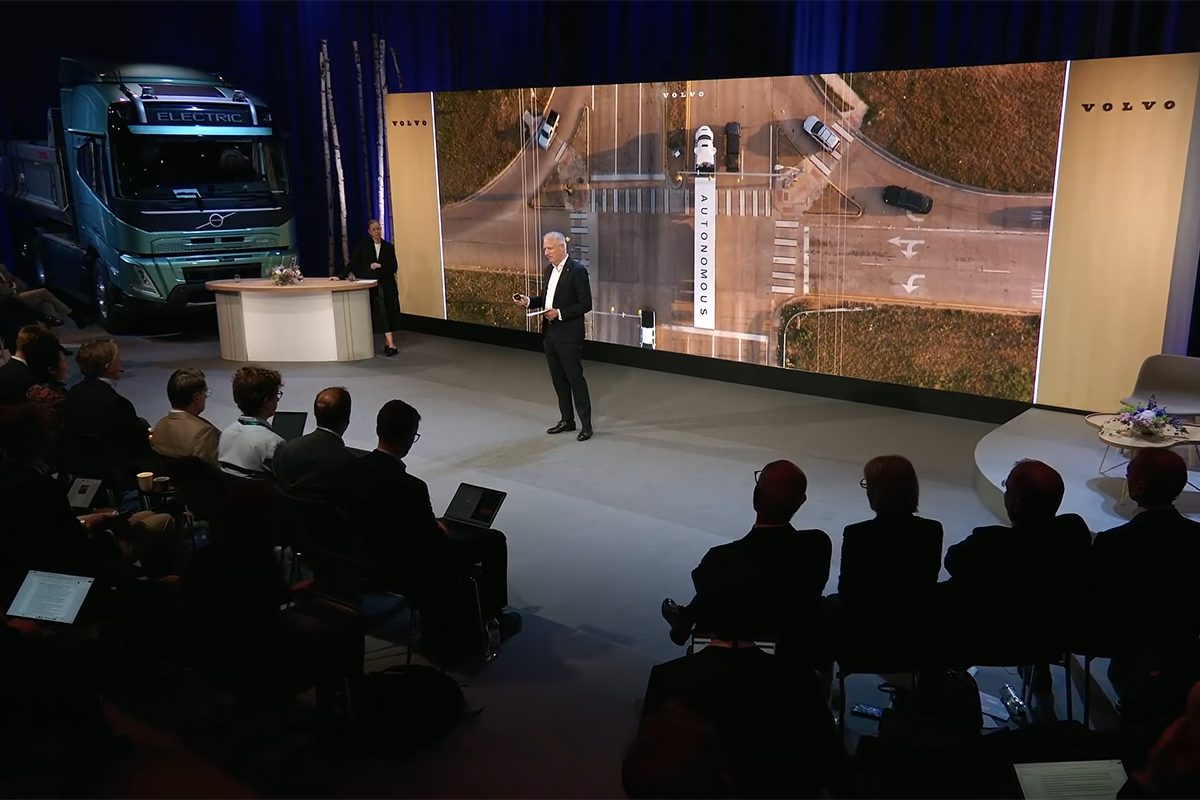
Speaking during Volvo Group Capital Markets Day 2026, Nils Jaeger, president of Volvo Autonomous Solutions, said autonomous trucking is being enabled by the broader public and commercial acceptance of autonomous vehicles, including robotaxis, but he argued that trucking could move faster once deployment begins.
“I think the robotaxis are actually paving the way,” Jaeger said. “They’re paving the way for autonomous trucking. But I believe actually that the deployment curve for autonomous trucking will be steeper, and it will go faster.”
For Volvo, the opportunity is tied directly to the central role trucking plays in the economy. Jaeger described transportation as “the backbone of our economy” and “the backbone of our modern society,” while positioning autonomous transport as the place where artificial intelligence moves from the digital world into physical freight operations.
“By that physical AI, it turns into an AI which has a pulse and a purpose,” Jaeger said. “It is the bridge between digital innovation and the physical movement of goods in our society.”
That framing matters because Volvo is not presenting autonomous trucking only as a safety technology or a response to driver shortages. Jaeger described it as a new operating model that could address several long-standing freight challenges at once, including capacity constraints, delivery reliability, driver availability, safety, utilization, and cost.
He pointed to the size of the U.S. trucking market as the foundation for the opportunity. According to Jaeger, 70% of goods are transported by truck in the U.S., and the market accounted for $900 billion in revenue last year. At the same time, he said the market is facing legacy bottlenecks, including a driver shortage of 80,000 unfilled positions that is forecast to double by the end of the decade.
For fleets, one of the central economic arguments is utilization. Jaeger said a human truck driver can operate 10 to 11 hours per day, while an autonomous truck is not limited by the same legal driving-hour restrictions.
“Our autonomous truck is always available,” Jaeger said. “We will add significant transport capacity.”
Jaeger said that availability could change the economics of trucking by allowing trucks to operate longer, move freight faster, and improve delivery predictability. He described the result as a “scalable, capital-efficient, higher margin transport model” with demand from shippers, carriers, third-party logistics providers, and transport platforms.
“With our autonomous trucks, we will double the asset utilization,” Jaeger said. “We can double that with our autonomous truck, 100% more productive.”
The company is also connecting autonomy to safety and operational consistency. Jaeger said road safety is affected today by driver fatigue, reaction time, and human error. By contrast, he said Volvo’s autonomous truck is “never tired” and has “constant 360-degree awareness of its environment.”
“It sees with modern sensors much further than the human eye can see,” Jaeger said.
While much of the freight industry discussion around autonomous trucks focuses on replacing a human driver with a virtual driver, Jaeger said Volvo views the shift more broadly.
“Autonomous trucking is more than just replacing the human driver with a virtual driver,” Jaeger said. “Autonomous trucking is a new transport system, and each transport system has its own ecosystem.”
That ecosystem is what Volvo calls Autona / freight. Jaeger described the model as Volvo’s transport-as-a-service approach to autonomous trucking, designed to remove barriers that could slow large-scale adoption.
Under that approach, Volvo would offer autonomy as a fully managed service, lowering upfront capital requirements and shifting operational, safety, and regulatory responsibilities away from the customer. Jaeger said the model simplifies adoption by creating a single-partner structure rather than requiring customers to manage separate relationships with an OEM, virtual driver company, dealer, terminal operator, operators, and insurers.
“You have one solution,” Jaeger said. “This will drive adoption.”
Volvo’s timeline is also becoming more concrete. Jaeger said Volvo Autonomous Solutions will begin operating in Q1 2027, describing it as the company’s driverless launch.
“In Q1 next year, we will have trucks on open roads without a human in the cab,” Jaeger said.
He added that Volvo plans to introduce autonomous trucking to more customers throughout the year and expects to have more than 300 trucks operating autonomously on U.S. highways by the end of Q4 2027. From 2028 onward, Jaeger said Volvo intends to scale “at industrial level.”
The company’s broader ambition is also significant. Jaeger said Volvo is approaching its goal of generating $3 billion in U.S. dollar revenue within five years, with margins that are accretive to the group.
That ambition rests on Volvo’s belief that autonomous trucking will not only improve fleet operations, but also change the experience of freight-dependent supply chains. Jaeger illustrated that point with a simple consumer example: strawberries transported from California to New York. He said that move takes four days by truck today, while an autonomous truck could do it in two days.
The point was not just speed. It was what faster, more predictable freight could mean for the quality, freshness, and reliability of goods that consumers ultimately receive.
Jaeger closed by emphasizing Volvo’s position as both an autonomous solutions provider and an OEM with nearly a century of experience in manufacturing and industrialization.
“As an OEM, we know how to industrialize,” Jaeger said. “We know how to scale. Volvo, we are a first mover, and we are here to scale this business.”