
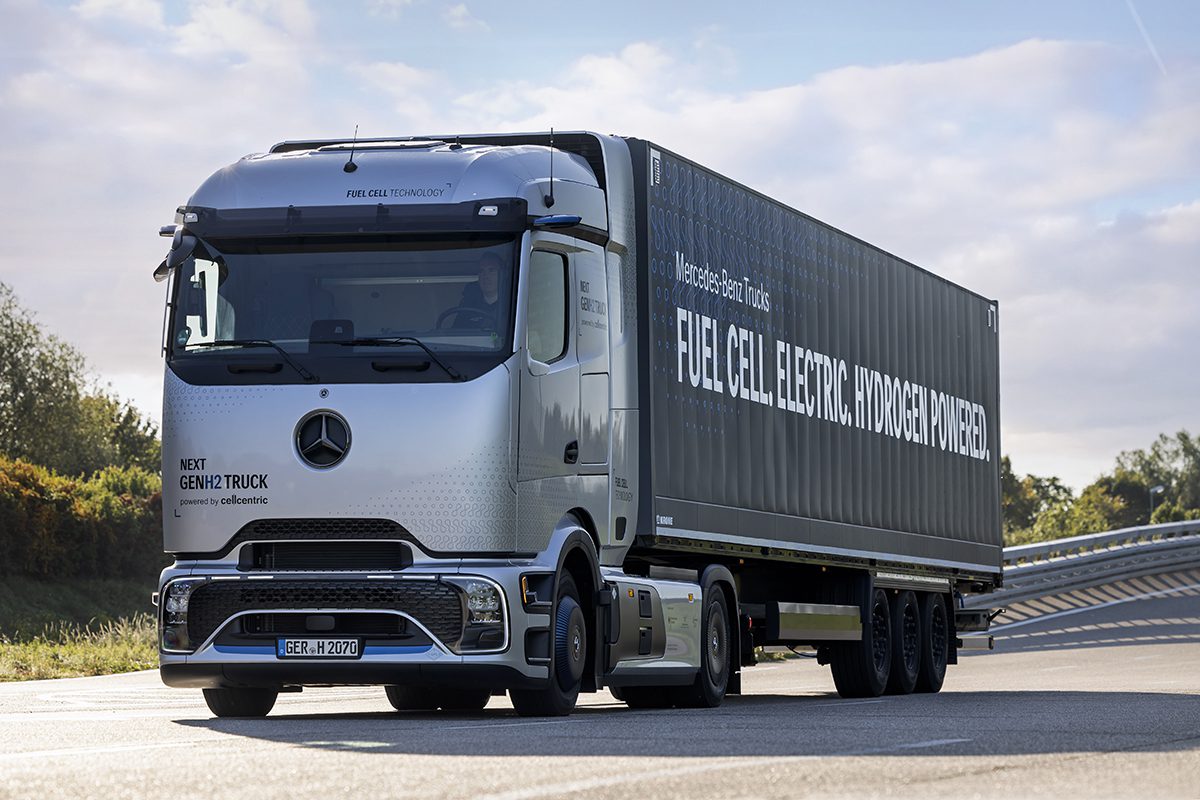
Daimler Truck AG recently unveiled the Mercedes-Benz NextGenH2 Truck, advancing its hydrogen fuel-cell development strategy. The company plans to produce a small series of 100 trucks at its Mercedes-Benz Trucks plant in Wörth, Germany, with the vehicles entering customer operations following completion of production.
The NextGenH2 Truck builds on Daimler Truck’s earlier GenH2 fuel-cell prototypes and continues to rely on liquid hydrogen technology. According to the company, the vehicle is designed for long-haul applications and is expected to achieve ranges of more than 1,000 kilometers (approximately 620 miles) on a single tank fill, with refueling times of around 10 to 15 minutes using Daimler Truck’s liquid hydrogen refueling standard. The truck is powered by the cellcentric BZA150 fuel cell system, which generates electricity onboard, supported by a 101 kWh lithium-iron-phosphate buffer battery that enables energy recuperation and assists the fuel cell during operation.
Daimler Truck said the NextGenH2 Truck incorporates several components already used in series production vehicles, including an integrated electric axle, the aerodynamically optimized ProCabin, the Multimedia Cockpit Interactive 2, and a suite of safety and assistance systems carried over from the battery-electric Mercedes-Benz eActros 600. Packaging changes behind the cab have shortened the wheelbase compared with earlier prototypes, improving compatibility with standard trailers. The vehicle also features an updated boil-off management system and hydrogen leakage detection sensors, which the company said allow overnight stays in the cab.
Achim Puchert, CEO of Mercedes-Benz Trucks, said hydrogen-based powertrains remain a key complementary technology alongside battery-electric vehicles in the transition to zero-emission transport. He described the NextGenH2 Truck as a step toward introducing near-production hydrogen fuel-cell technology into real-world freight operations through customer partnerships starting in late 2026.
The small-series production program is intended to validate the technology under everyday operating conditions and support Daimler Truck’s broader fuel-cell roadmap. Development, production, and deployment of the trucks are being supported by approximately $245 million in funding from the German Federal Ministry of Transport and the federal states of Rhineland-Palatinate and Baden-Württemberg. Daimler Truck continues to target regular series production of hydrogen fuel-cell trucks in the early 2030s.