
Diesel exhaust pollution from the tailpipes of diesel-burning school buses is a threat to students, parents, drivers and community members alike, causing or worsening asthma and respiratory issues and negatively impacting academic performance, among other concerns. And these dangers are not always felt equally.
Students with disabilities rely on school transportation more than their peers without disabilities, leaving them disproportionately exposed to exhaust pollution from diesel-burning buses. Disabled students are also more likely to have longer drives. According to a 2025 survey, approximately one in five students who uses school transportation has a disability.
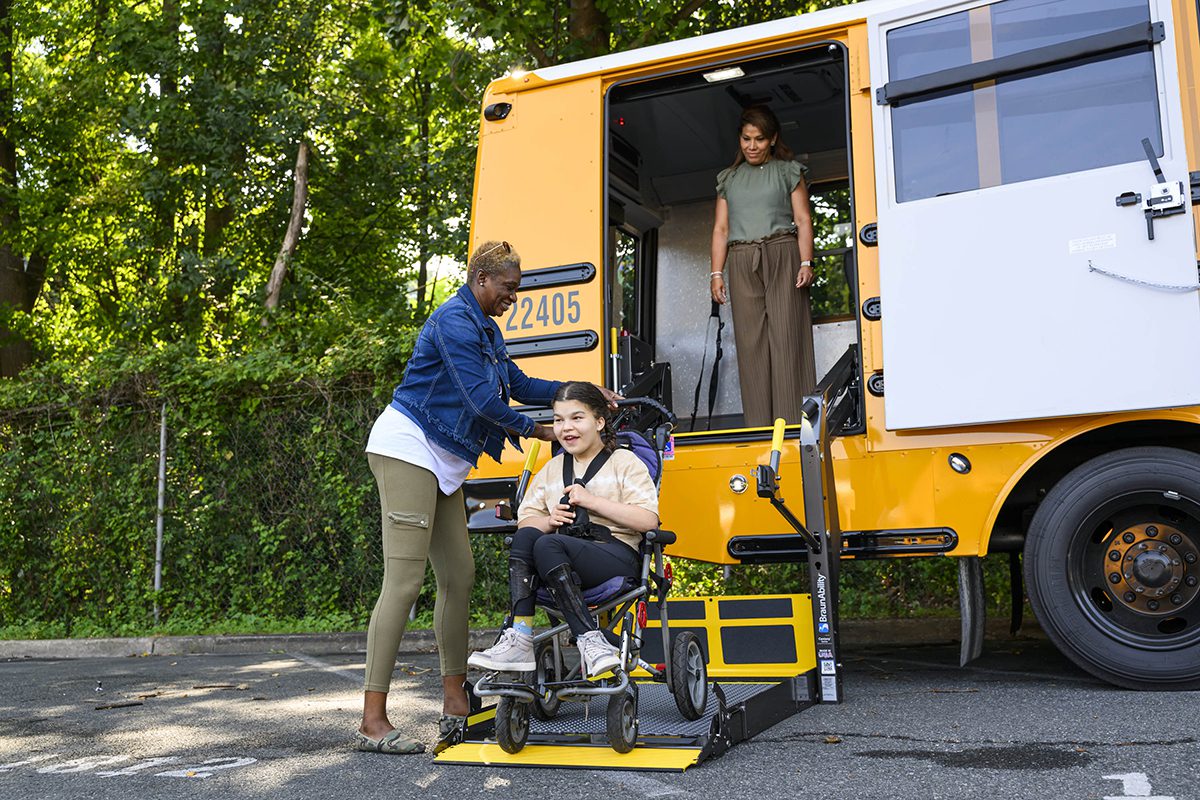
Students who use wheelchair lifts are also overexposed to diesel exhaust pollution because the lifts are often located in the back of the vehicle, near the tailpipe, and the bus idles while the lift is in operation.
Thankfully, there’s an answer. A transition to electric school buses can help alleviate some of these concerns for students with disabilities by greatly reducing their exposure to air pollution, thereby addressing some of the structural inequities in the school transportation system. For instance, students who use wheelchairs would no longer wait amid dangerous diesel exhaust and instead board a vehicle that isn’t emitting air pollution from a nearby tailpipe.
School districts that have made the switch to electric have reported benefits beyond air quality for disabled students in aspects ranging from physical impacts from the smoother ride to sensory processing. Drivers for Shawnee Public Schools in Shawnee, Oklahoma, observed that the quieter ride from the electric school buses was helpful to student with sensory sensitivities, even allowing some students who had opted out of school transportation to return to taking the bus.
One district in West Virginia found that deployment of an electric school bus on its “most diverse special needs route” was a success, leading to reduced disruptions, a calmer environment for students and riders, and better behavior.
However, for the electrification of school bus fleets to truly deliver on health and social benefits promises for students with disabilities, the transition must be conducted with care and intention, and it must center students with disabilities and their families throughout the process.
This might include prioritizing school buses designed to transport students with disabilities in fleet procurement, as St. Louis Public School did prior to the 2025-26 school year. Ensuring that every electric school bus in a fleet includes accessibility features, like wheelchair ramps or lifts or handrails, can also help to work toward universal transportation access for all students.
Students are not the only ones impacted by their rides to school; drivers, paraprofessionals and adults with disabilities or accessibility concerns should also be considered in the transition.
Research, including “Next Stop, Access! An Exploratory Paper on Disability Rights and Justice Throughout the Transition to Electric School Buses,” explored more about student, youth, parent, professional and advocate insight on the state of access for students with disabilities throughout the electrification process.
The findings highlighted issues such as malfunctioning or unreliable wheelchair lifts, overstimulation from the noise, vibration and exhaust pollution of diesel-burning buses, adoption of universal design principles for accessible buses, accessibility in language surrounding the electrification process, among others.
The paper also established recommendations for ensuring that students with disabilities are prioritized in the electric transition, highlighting three major areas of concern:
- Including youth with disabilities during each step of transition efforts.
- Avoiding replication of existing accessibility issues.
- Expanding the accessibility of school buses in the transition.
In districts where electric school buses are on the road, students, drivers and parents are already seeing the benefits of zero-tailpipe-emission rides to school. And students with disabilities shouldn’t be left out of that positive movement just because their buses may require different equipment or management. A successful transition to electric school buses means meeting all riders where they are and centering equity – bringing clean, healthy rides to students with disabilities.